Running an AI assistant entirely on your own machine, with nothing sent to a server, is no longer a niche experiment. A local AI setup built around a privacy-first app and a modest GPU lets you chat with a capable language model where every prompt and response stays on your hard drive. The two decisions that make or break it are the software you choose and how much VRAM your GPU carries, and neither has to cost a fortune.
Quick Answer
A privacy-conscious home local AI setup pairs the Jan app, which ships with zero telemetry, with a GPU carrying 8GB to 12GB of VRAM. That combination runs 7B to 8B parameter chat models smoothly and entirely on-device, so no prompt or conversation ever leaves your machine.
Why Run AI Locally at All
Cloud AI services send everything you type to someone else's servers. For casual queries that may be fine, but for anything sensitive, personal notes, work documents, business ideas, health questions, that data has left your control. A local model answers the same questions without a single byte going to the internet. It also keeps working when your connection drops, costs nothing per query once set up, and lets you use models without account sign-ups or usage limits.
The trade-off is that a home GPU will not match the very largest cloud models. But for everyday assistance, drafting, summarising, coding help and general questions, a well-chosen local model is genuinely useful.
The Software: Why Jan
The app you run matters as much as the hardware, because some local-AI front-ends still phone home with usage data. Jan is built around privacy: it ships with zero telemetry, stores conversations locally, and runs open models on your own hardware. It gives you a clean chat interface, handles model downloads, and keeps everything offline by default.
There are other capable local runtimes, but for a privacy-conscious home user who wants something that works without configuration and does not report back, Jan is the straightforward pick. Install it, download a model, and you have a private assistant running in minutes.
Choosing a Model Size
Local models come in sizes measured in billions of parameters. For home hardware:
- 7B to 8B models: the sweet spot for a home GPU. They run smoothly on 8GB to 12GB of VRAM, respond quickly, and handle general chat, writing help and light coding well.
- 13B and up: noticeably more capable but heavier, needing more VRAM and running slower on mid-range cards.
Most home users are best served starting with a quantised 7B or 8B model, which compresses the model to fit comfortably in VRAM with minimal quality loss.
What the model actually sees
When you type a prompt in Jan, it never leaves your machine. The app passes your text directly to the local model process running on your own GPU, which generates a response and returns it to the chat window. No internet request is made during inference. This is fundamentally different from apps that send your input to a cloud API, even if those apps present a similar interface.
The Hardware: VRAM Is the Gatekeeper
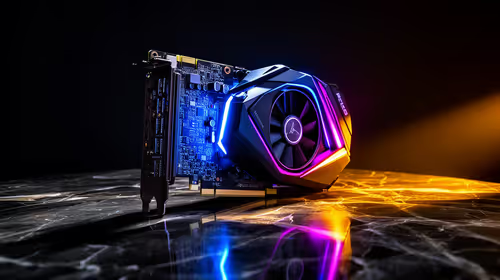
Just as with rendering, VRAM decides what you can run. A language model has to load its weights into the GPU's memory to run quickly. A quantised 7B to 8B model fits comfortably in 8GB to 12GB of VRAM, which is why a mid-range GPU is the recommended floor for a smooth local-AI experience.
Why Not Just the CPU?
You can run small models on a CPU alone, but responses come slowly, often a word at a time at a frustrating pace. A GPU with enough VRAM transforms the experience from a novelty into something you actually use daily. If you are building or buying a machine specifically for this, the AI-ready PC range groups systems suited to on-device model work.
Picking the Rest of the Machine
Around the GPU, aim for at least 16GB of system RAM, with 32GB giving more comfortable headroom for larger models and multitasking. A fast NVMe SSD speeds up loading models, which can be several gigabytes each. The CPU is the least critical part for inference, so do not overspend there at the expense of VRAM. For a balanced pre-built option rather than a parts list, the PC best sellers show configurations that pair a capable GPU with sensible memory.
Putting It Together
The full recipe is short: a GPU with 8GB to 12GB of VRAM, 16GB to 32GB of system RAM, an NVMe SSD, and the Jan app running a quantised 7B or 8B model. That gives a home user a private, capable assistant with zero data sharing, no subscription, and full offline operation. Start with a smaller model to confirm everything runs, then experiment with larger ones if your VRAM allows.
Frequently Asked Questions
Why use Jan instead of a cloud AI service?
Jan runs models entirely on your own machine with zero telemetry, so prompts and conversations never leave your device. Cloud services send everything you type to their servers, which is the privacy concern a local setup removes.
How much VRAM do I need for local AI?
8GB to 12GB of VRAM comfortably runs quantised 7B to 8B parameter models, which is the recommended floor for smooth, responsive local chat. More VRAM lets you run larger, more capable models.
Can I run a local model on just a CPU?
Yes, but responses are slow, often arriving a word at a time. A GPU with enough VRAM makes the experience fast enough for daily use, which is why it is the recommended approach.
What model size should a home user start with?
A quantised 7B or 8B model. These fit comfortably in mid-range VRAM, respond quickly, and handle general chat, writing and light coding well. Larger models are more capable but need more VRAM and run slower.
Does a local AI setup work offline?
Yes. Once the app and model are installed, everything runs on your machine with no internet connection required, so it keeps working even when your connection drops.
Is Jan the only privacy-first option?
Jan is one of the strongest choices for a non-technical home user because it installs simply and has no telemetry by default. Ollama is another respected runtime that runs models locally, though it is more terminal-oriented. For a fully graphical, privacy-first setup with no command-line steps, Jan remains the most practical starting point.
Want a private AI assistant that keeps your data on your own machine? Explore AI-ready PCs and GPUs with the VRAM to run local models at Evetech (https://www.evetech.co.za/components/ai-pcs-443) and set up something that answers only to you.