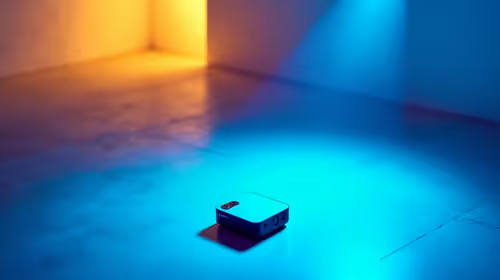
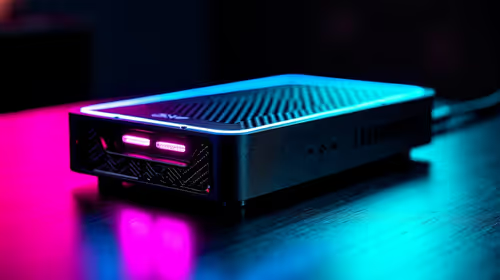
Slipping a full desktop into a backpack sounds like a contradiction, until you hold a mini PC that fits in your palm. Pair one with a single compact power brick and a hotel TV or a borrowed monitor becomes your complete Windows desktop within minutes of unpacking. For frequent travellers, consultants living out of suitcases, and anyone who wants their real working environment wherever they land, this is the most underrated machine category going.
Quick Answer
The best mini PC for travel is a palm-sized model that runs off one compact power brick and outputs to any TV or monitor over HDMI. It gives you a full Windows desktop, your own apps, files, and settings, that fits in a backpack pocket and sets up on a hotel TV in minutes. Look for one with built-in Wi-Fi, enough ports, and a power supply small enough to carry.
Why a mini PC beats a laptop for some travellers
A laptop is the default travel computer, so why reach for a mini PC instead? It comes down to what you actually want at your destination.
A laptop ties you to a cramped keyboard and a small screen. A mini PC lets you walk into a hotel room, plug into the large TV already on the wall, and pair a compact keyboard and mouse for a desktop-class workspace. For longer stays, that ergonomic difference is real.
There is a cost angle too. A mini PC with strong specs often costs less than a laptop of equal power, because you are not paying for the screen, battery, and chassis. If you already own a travel keyboard and can rely on a screen at the other end, you carry less and pay less for more performance.
The trade-off is honest: a mini PC needs an external screen, a keyboard, and mains power. It is not a device you use on a plane. It is a device that turns any room into your office.
What to look for in a travel mini PC
Not every small desktop travels well. These are the specs that matter on the road.
Size and the power brick
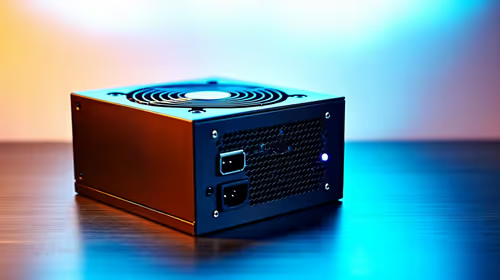
The PC itself is rarely the problem, the power supply is. Some mini PCs use an internal supply or a small external brick, others ship with a chunky block that defeats the point. Check the total carry size, PC plus brick plus cables, not just the headline dimensions.
Ports that match real rooms
You want at least one HDMI for the TV, several USB ports for a keyboard, mouse, and storage, and ideally USB-C. A model that can drive a display over USB-C gives you a useful backup if an HDMI port is awkward to reach behind a wall-mounted TV.
Wireless and connectivity
Built-in Wi-Fi and Bluetooth are essential, since you will lean on hotel Wi-Fi and wireless peripherals. Bluetooth lets you pair a compact keyboard and mouse without carrying dongles.
Enough performance for your work
Match the specs to your tasks. Office work, browsing, and video need far less than editing or development. Do not overbuy, but make sure the storage is large enough for your files since you may be offline often.
Setting up in a hotel room
The appeal is how fast it goes from bag to desktop. The flow is simple:
- Plug the mini PC into the TV or monitor over HDMI.
- Connect power with the compact brick.
- Switch the TV to the right HDMI input.
- Pair or plug in your keyboard and mouse.
- Join the local Wi-Fi and you are working in your own environment.
A few real-world tips. Carry a short HDMI cable in case the TV's ports face the wall. Pack a small multi-plug or travel adapter so one socket runs everything. And keep your files synced to cloud storage so a single bag holds your whole setup. If you want to compare full systems before deciding, the most popular desktop PCs at Evetech put mini models next to larger towers so you can weigh portability against raw power.
Dealing with hotel-room realities
Two recurring snags are worth planning for. First, many hotel TVs lock their HDMI inputs or hide them behind a fixed menu to push their own content. If the input will not switch, a small portable monitor in your bag is a reliable fallback that you fully control. Second, some TVs run at a refresh rate or resolution that feels sluggish for desktop use, so a model that lets you set a sensible output resolution helps. None of these are dealbreakers, but knowing them ahead of time turns a frustrating evening into a five-minute setup.
A travel-friendly accessory worth packing is a compact wireless keyboard and trackpad combo, which removes the need for a flat surface big enough for a separate mouse. Paired over Bluetooth, it keeps your entire kit down to the PC, its brick, one cable, and one small peripheral.
Mini PC versus tablet or phone for travel work
People sometimes ask why not just use a tablet or phone with a keyboard. The honest answer is that a mini PC gives you a real, full desktop operating system with your actual applications, not a mobile approximation of them. If your work depends on desktop software, multiple windows, or tools that simply do not exist on a tablet, a mini PC is in a different league.
The trade is power and bulk. A tablet works on a plane and needs no external screen, while a mini PC needs a display and mains power. For travellers whose work is genuinely desktop-class, the mini PC removes the compromises a tablet forces, and it does so for a fraction of the size of a full tower.
Who it suits and who should skip it
A travel mini PC suits people who reach a destination and stay put for a while: remote workers on long trips, consultants on client sites, students moving between res and home, and anyone who values a proper desktop over a cramped laptop. It is less suited to people who need to work in transit, on planes, trains, or in cars, where a laptop's built-in screen and battery win outright. To see the current spread of compact options, the mini PC range at Evetech covers everything from light office boxes to more capable units.
Frequently Asked Questions
Can a mini PC really replace a laptop for travel?
For travellers who stay somewhere with a screen and mains power, yes. You get a full desktop with your own apps and files, and often more performance for the money. It cannot replace a laptop for working in transit, since it needs an external display and power.
What do I need to carry besides the mini PC?
The power brick, an HDMI cable, and a compact keyboard and mouse, plus a travel plug adapter. Keep the cable handy in case a wall-mounted TV hides its ports.
Will a mini PC run on a hotel TV?
Yes. Most hotel TVs have HDMI inputs, so you plug in, switch to that input, and you have a desktop. Carry a short HDMI cable in case the TV's ports are awkward to reach.
How powerful are mini PCs?
It ranges widely. Entry models handle office work, browsing, and video comfortably, while higher-spec units take on heavier tasks. Match the specs to your work rather than assuming small means slow.
Do mini PCs have Wi-Fi built in?
The travel-friendly ones do, along with Bluetooth for wireless peripherals. Confirm both before buying, since they are what let you work off hotel Wi-Fi with a wireless keyboard and mouse.