Quick Answer
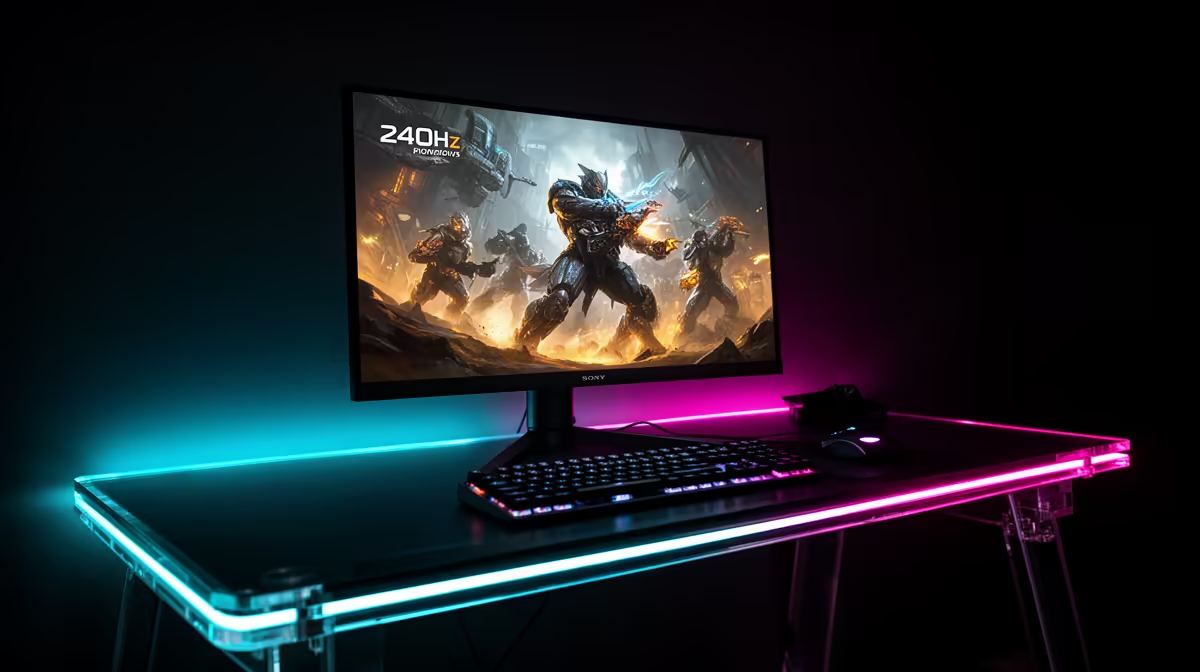
For a rand-conscious 4K 240Hz gaming setup, prioritise these specs in order: OLED panel type (self-emissive, not IPS), DisplayPort 2.1 (for bandwidth headroom), 240Hz native refresh rate, 99% DCI-P3 colour coverage, and G-Sync Compatible plus FreeSync Premium Pro dual certification. Avoid paying premiums for built-in KVM or ultra-slim chassis if those features are not part of your workflow.
Core Panel Specs That Actually Affect Gaming 🎮
For 4K 240Hz on a budget-conscious framework, the panel substrate is the most important specification.
Peak brightness is the most marketed and least practically significant specification for indoor gaming.
Interface and Connectivity Specs Worth Paying For 📡
DisplayPort 2.1 (minimum UHBR10, ideally UHBR20) is worth confirming at any 4K 240Hz price tier. DP 2.1 provides bandwidth headroom for future GPU upgrades without the monitor becoming the interface bottleneck. HDMI 2.1 (48 Gbps) handles 4K at 144Hz uncompressed and 4K at 240Hz with DSC, covering console connectivity and backup GPU connection.
Dual sync certification (G-Sync Compatible and FreeSync Premium Pro) is standard on most OLED gaming monitors and should be confirmed rather than assumed.
Specs That Matter Less Than Marketing Suggests 💡
Built-in speakers on a premium gaming monitor are universally mediocre. Budget for a separate headset or desktop speakers rather than weighting this feature in your purchasing decision. Ultra-slim bezels are aesthetically appealing but have no functional gaming benefit unless you are building a multi-monitor array.
On refresh rate, understand the 360Hz vs 240Hz question clearly. At 4K resolution, 360Hz is currently not achievable on consumer OLED panels. 360Hz OLED is available at 1440p and FHD resolutions. For 4K specifically, 240Hz is the current maximum. At 1440p, the 360Hz tier adds real value for CS2 competitive players who can sustain above 300 fps at 1440p on an RTX 5080, which is achievable.
For SA buyers spending R22,000 to R28,000 on a 4K 240Hz OLED, the sweet spot specs checklist is: 4K OLED panel, 240Hz, DP 2.1, HDMI 2.1, G-Sync Compatible, FreeSync Premium Pro, three-year warranty, and a stand that adjusts for tilt and height. Everything beyond that is preference, not necessity.
Verify the Refresh Rate Is Native, Not Overclocked ⚡
Some 240Hz monitor listings achieve their headline refresh rate through factory overclocking of a panel rated at a lower native rate. Native 240Hz panels are more stable and often carry better warranty support for refresh-related defects. Check the monitor's spec sheet for the native versus maximum refresh rate distinction before purchasing.
FAQ
Is a higher response time spec like 0.1ms better or worse than 0.03ms OLED?
Lower is better. OLED at 0.03ms is faster than 0.1ms IPS panels. Do not be misled by marketing that quotes a 0.1ms GtG figure for an IPS panel tested under ideal conditions with overdrive engaged; the real-world average response of those panels is typically 1ms to 3ms across the full greyscale range.
Does 99% DCI-P3 colour coverage matter for gaming specifically?
For HDR-enabled games on a compatible monitor, yes. For SDR gaming (which is still the majority of online competitive titles), the monitor operates in sRGB mode and 99% DCI-P3 coverage provides no advantage over a well-calibrated sRGB display. The wide gamut benefit is primary for HDR and creative work.
What is the real-world cost per year of a R26,000 4K 240Hz OLED over five years?
R5,200 per year over five years. Compared to replacing a R10,000 IPS monitor every two years (R5,000 per year equivalent), the OLED is essentially cost-equivalent on a per-year basis while delivering substantially superior technology throughout the ownership period.
Building a 4K 240Hz setup and want the best specs per rand?
Evetech's monitor range includes the top QD-OLED and WOLED options at 4K 240Hz with full local warranty. Get the right specs without the spec-sheet noise.