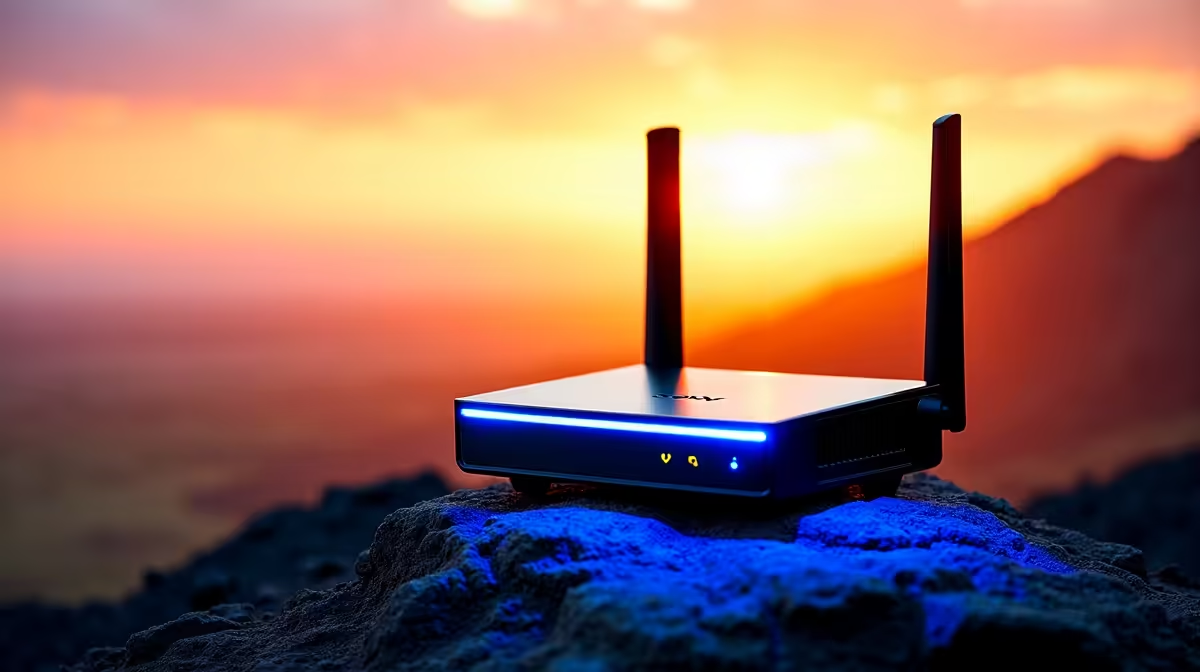
If your home sits at the ragged edge of a 5G cell, an indoor router is fighting a losing battle. The signal has to punch through a wall before it even reaches the device, and on the fringe there is nothing left to punch with. An outdoor 5G CPE flips the problem. You mount it on the wall or roof, point it at the tower, and it grabs the strongest signal available before any wall gets in the way. For weak-coverage homes in South Africa, that placement is often the whole difference between a usable connection and a dead one.
Quick Answer
An outdoor 5G CPE is a weatherproof unit that mounts on your wall or roof and aims directly at the nearest tower to lock onto the best available 5G signal. By sitting outside and high up, it captures signal an indoor router never sees, then feeds it into your home over an Ethernet cable. For fringe-coverage areas where an indoor unit cannot hold a stable connection, an outdoor CPE is the right tool, not an indoor router pushed to its limit.
Why outdoor placement beats an indoor router on the fringe
Cellular signal weakens with distance and with every obstacle in its path. Inside a house, walls, roofing, and even the building's own structure all attenuate it. If you already have plenty of signal, that loss does not matter. On the fringe, where every decibel counts, those same walls are the difference between connecting and dropping.
An outdoor CPE removes the building from the equation. Mounted high on a wall or on the roof, it has a cleaner line toward the tower, and crucially it uses directional antennas. Indoor routers tend to receive from all directions equally, which is fine when signal is strong but wasteful when it is scarce. A directional outdoor unit concentrates its sensitivity toward the tower, capturing 4G and 5G signal in challenging locations where an omnidirectional indoor device simply cannot.
What actually matters when choosing one
The specs that count for an outdoor CPE are not the same as for an indoor router. Three things deserve your attention before anything else.
Weatherproofing rating
This unit lives outside through summer heat and winter rain, so its ingress-protection rating is not a footnote. Look for at least an IP65 rating, and prefer IP67 in harsher coastal or high-rainfall areas. A unit that is not properly sealed will not survive its first wet season on a Cape Town wall, so this is the spec you do not compromise on.
Power and cabling
Most quality outdoor CPEs are powered over the same Ethernet cable that carries their data, using PoE, which means a single run from inside the house to the unit handles both. Keep that cable run reasonable, ideally under about 60 metres of CAT6, because longer runs degrade the power delivery and the connection with it. A clean, short cable path from your indoor switch to the mounting point makes installation far simpler.
Signal targets to aim for
Once mounted, you tune position by signal readings, not guesswork. As a rough target, you want a stronger-than-minimum signal level and a healthy signal-to-noise figure; a noisy connection with a strong raw signal can still perform worse than a cleaner, slightly weaker one. The point of an outdoor mount is that you can physically aim the unit, so spend the time to find the angle that gives the best combined reading rather than the first position that connects.
Mounting and aiming for the best lock
Position is everything with these units. Start as high as practical, since height clears local obstructions and usually improves line toward the tower. If you know roughly where your nearest tower sits, aim the unit's directional antennas in that direction and then make small adjustments while watching the signal readout. A few degrees of rotation can move you from a marginal connection to a solid one.
Be patient here. The temptation is to bolt the unit up at the first spot that gets bars and move on, but the gains from careful aiming on the fringe are large. Twenty minutes of fine-tuning during installation pays off every day afterward in a connection that holds rather than one that drops whenever conditions shift. You can browse the units suited to this kind of fixed-wireless setup in the networking range at Evetech, and it is worth checking the best-selling accessories list for the mounting hardware and outdoor-rated cabling the job needs.
Who this is and is not for
An outdoor CPE earns its place specifically where coverage is marginal. If you live in a well-served suburb with strong indoor 5G, you do not need one; an indoor router will be simpler, cheaper, and just as fast. The outdoor route is for homes on the edge of coverage, in valleys, behind hills, or far enough from the tower that indoor signal is unreliable.
It also assumes you can mount and cable a unit outdoors, which most homes can but some rentals cannot. If you own the property or have permission to fix a unit to the wall and run a cable inside, an outdoor CPE is the most effective fixed-wireless fix for weak signal short of moving closer to a tower.
Frequently Asked Questions
What does IP65 or IP67 mean for an outdoor CPE?
These are ingress-protection ratings describing how well the unit resists dust and water. IP65 is the practical minimum for outdoor mounting, and IP67 offers stronger protection for coastal or high-rainfall areas. A unit without adequate sealing will not survive prolonged outdoor exposure.
How is an outdoor 5G CPE powered?
Most are powered over Ethernet, so a single cable from inside the house carries both data and power to the unit. Keep the CAT6 run reasonably short, ideally under about 60 metres, because longer runs degrade both the power delivery and the connection.
Will an outdoor CPE fix coverage anywhere?
It dramatically improves marginal coverage by mounting high and aiming directional antennas at the tower, but it cannot create signal where there is none. If there is at least a weak 5G signal reaching your roof, an outdoor CPE can usually turn it into a usable connection.
Do I need to know where my nearest tower is?
It helps a lot. Knowing the rough direction of the tower lets you aim the directional antennas correctly from the start, then fine-tune by watching the signal readout. Even without that knowledge you can find the best angle by trial, but it takes longer.
Is an outdoor CPE worth it over an indoor router?
In strong-coverage areas, no; an indoor router is simpler and cheaper. On the fringe, an outdoor CPE is well worth it, because its placement and directional antennas capture signal an indoor unit cannot, turning an unreliable connection into a stable one.
Living on the edge of 5G coverage and tired of an indoor router that keeps dropping? Explore outdoor-ready options in the networking range at Evetech and get a connection that locks onto the tower instead of fighting your walls.