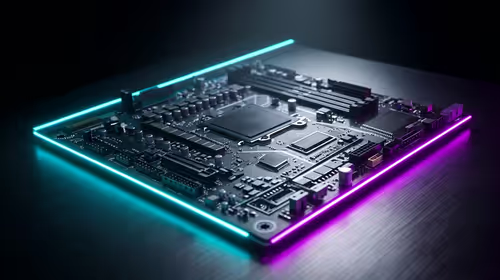
Most people building a PC for a music producer reach for a big graphics card first, and that is the wrong instinct. A digital audio workstation does not lean on the GPU. It leans on raw single-core clock speed, low-latency RAM and a quiet case, because a fast CPU frequency clears plugins in time for the next audio buffer, and a noisy fan ends up baked into your recordings. Build around those three and Logic, Ableton or FL Studio stay responsive even with a dense session loaded.
Quick Answer
For a DAW workstation, prioritise a high single-core-clock CPU, plenty of fast low-latency RAM (32 GB is the comfortable baseline), a quick NVMe SSD for sample streaming, and quiet cooling. The graphics card barely matters for audio, so the budget you would have spent on a GPU is better aimed at CPU clock speed, memory and silence. A capable build sits in the mid-tens-of-thousands of rands depending on core count and storage.
Why clock speed beats core count for audio
Real-time audio is unforgiving. Every audio buffer has a hard deadline, and many plugins, especially synths and effects on the channel you are recording or monitoring, run on a single thread. That means the speed at which one core finishes its work decides whether you get clean audio or a dropout.
A high single-core clock clears those serial tasks faster, which lets you run a smaller buffer size and therefore lower latency while playing software instruments. More cores help with very large mixing sessions, where the project spreads many tracks across threads, but they do nothing for the latency you feel while performing. The right balance for most producers is a strong-clock CPU with a sensible core count, not the highest-core-count chip you can find.
RAM: capacity and latency both count
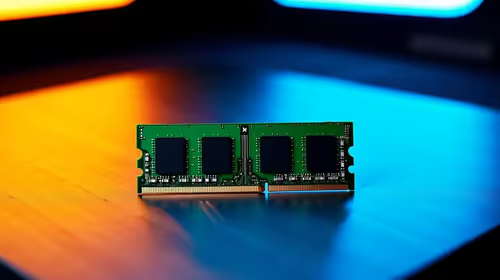
Sample libraries are the memory hogs of music production. Orchestral and acoustic instrument libraries stream hundreds of samples, and a big chunk of that loads straight into RAM.
How much you need
For producing with software instruments, 32 GB is the comfortable working baseline. It holds a healthy session with multiple instrument tracks and effects without forcing the system to lean on disk. If you work with large sampled orchestras or many simultaneous instances, 64 GB removes the ceiling entirely.
Why low latency matters
Memory latency, how quickly the CPU can fetch data from RAM, feeds directly into how smoothly plugin processing keeps up. Faster, lower-latency memory shaves small delays off every buffer the CPU works through, which adds headroom in dense sessions. It is a quieter spec than raw capacity, but for a responsive DAW it earns its place.
Storage that streams samples without stutter
Sample streaming pulls audio off the drive in real time as you play, and a slow disk shows up as crackles or missed notes. An NVMe SSD is the right answer, and the layout that works best is two drives:
- A fast NVMe boot drive for the operating system and your DAW.
- A second large NVMe or SSD purely for sample libraries and project files.
Splitting the OS and the libraries means sample streaming never competes with system tasks for the same drive. A spinning hard drive can serve as cold archive storage, but it has no place in the live sample path.
Quiet cooling is a recording requirement
In a home or project studio the PC often sits in the same room as the microphone. Fan noise from that machine bleeds straight into vocal takes and quiet acoustic recordings, and no plugin fully removes it afterwards.
Quiet cooling is therefore part of the spec, not a luxury. A large low-RPM air cooler or a well-tuned liquid cooler keeps temperatures down while spinning slowly, low-noise case fans move air without whine, and a case with sound-dampening panels lowers the noise floor further. Build for silence and the room stays clean enough to record in.
The audio interface and driver stack
The PC hardware is only half the equation. A quality audio interface and the right driver model complete the low-latency picture.
ASIO drivers on Windows
Windows' built-in audio stack adds latency because it buffers signals through the operating system mixer. ASIO (Audio Stream Input/Output) bypasses that entirely, giving the DAW direct, low-overhead access to the interface hardware. Every serious Windows DAW setup should run ASIO. Most professional interfaces ship with their own ASIO drivers; ASIO4ALL can bridge interfaces that do not have native ASIO support, though a proper interface is the cleaner solution.
Buffer size and roundtrip latency
Buffer size sets the trade-off between latency and CPU headroom. At 44.1 kHz, a 128-sample buffer produces a roundtrip latency below 10 milliseconds, which is the threshold where most musicians stop feeling a performance delay in software instruments. A 64-sample buffer tightens that further but demands more from the CPU. The faster your single-core clock, the smaller a buffer you can run cleanly without dropouts.
Interface connectivity
USB interfaces cover most home and project studio needs. For higher track counts and the absolute lowest roundtrip figures, a Thunderbolt-connected interface is worth considering. Thunderbolt 4 provides the sustained, low-overhead bandwidth that handles many simultaneous channels without the small timing irregularities that can appear on USB under heavy system load.
Where the GPU fits, and where it does not
You still need a graphics output, but a modest integrated GPU or a basic discrete card is plenty for a pure audio workstation, since the DAW puts almost no load on it. The exception is if you also score video or run heavy visual work, in which case a stronger card earns its keep, and the workstation graphics range at Evetech covers the cards suited to that crossover work. For an audio-only build, redirect that money to CPU clock, RAM and quiet cooling instead. If you would rather start from a complete machine and tune from there, the best-selling desktop PCs at Evetech are a sensible base to build a low-latency studio rig around.
Frequently Asked Questions
Do I need a powerful graphics card for music production?
No. A DAW puts almost no load on the GPU, so integrated graphics or a basic card is enough. Spend the saved budget on a faster CPU, more low-latency RAM and quieter cooling instead.
How much RAM does a music production PC need?
32 GB is the comfortable baseline for sessions with software instruments and effects. Move to 64 GB if you stream large sampled orchestras or run many instrument instances at once.
Why does CPU clock speed matter more than core count?
Real-time audio plugins on the channel you are monitoring often run on a single thread, so a higher single-core clock clears them faster and lets you run lower latency. Extra cores only help with very large mixing sessions.
Will a noisy PC really affect my recordings?
Yes, if it shares a room with your microphone. Fan noise bleeds into vocal and acoustic takes and is hard to remove cleanly afterwards, which is why quiet cooling belongs in the build spec.
What storage setup works best for sample libraries?
Use a fast NVMe SSD for the OS and DAW, and a second large NVMe or SSD dedicated to sample libraries and projects. Keeping them separate stops sample streaming from competing with system tasks.
Building a quiet, low-latency DAW workstation? Browse Evetech's workstation components and desktop range, prioritise CPU clock, fast RAM and silent cooling, and skip the oversized graphics card your music does not need.