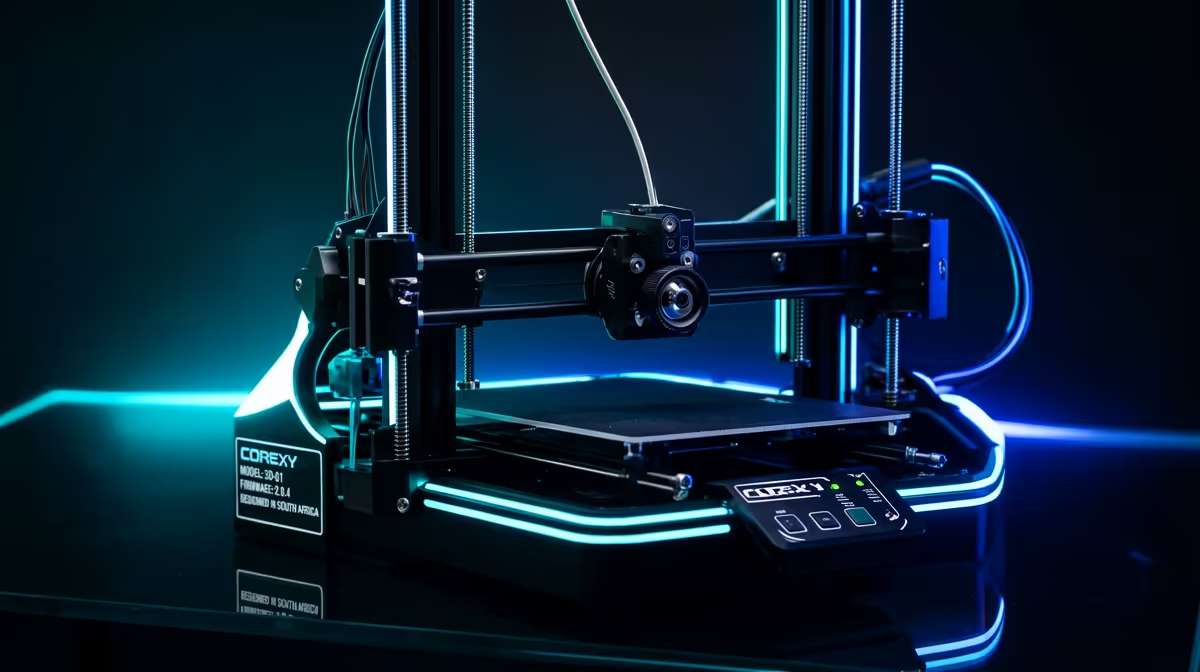
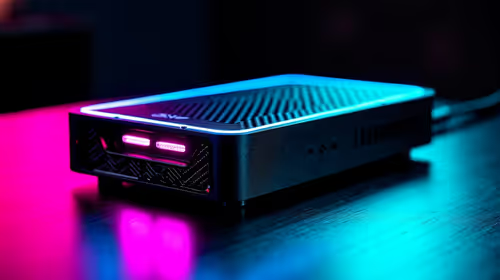
A printer that holds tight tolerances at 500 mm/s while sealing fumes inside a filtered chamber is what separates a serious workshop from a hobby bench, and the prosumer CoreXY 3D printer worth buying in South Africa today is the Bambu Lab P2S, which lands near the R14,999 mark. CoreXY geometry keeps the heavy gantry stationary and moves only the lightweight toolhead, so the machine can chase high acceleration without ringing artefacts showing up on flat walls.
Quick Answer
Priced around R14,999, the Bambu Lab P2S leads the prosumer CoreXY field in SA: a fully enclosed, filtered chamber, speeds up to 500 mm/s, a 0.6 mm hardened nozzle and dual auto-calibration as standard. It is a clear tier above entry bed-slingers for anyone printing functional parts daily.
Why CoreXY Beats a Bed-Slinger at This Price
Entry kits move the whole print bed forward and back on the Y axis. The faster you push that bed, the more the tall part on top of it wobbles, which limits real-world speed long before the marketing numbers suggest. CoreXY locks the bed to vertical Z motion only and drives the toolhead through two crossed belts in the X-Y plane. The result is lower moving mass, less inertia at direction changes and cleaner corners at speed.
That difference is the whole reason to step up. A bed-slinger advertised at 250 mm/s often prints accurately at half that on a tall model. A well-tuned CoreXY holds its quality much closer to its rated figure, which is what you are paying the premium for. Browsing the current 3D printer range stocked at Evetech makes the split obvious: the prosumer tier is almost entirely CoreXY and enclosed, while the budget shelf is open-frame.
The Enclosed, Filtered Chamber Earns Its Keep
An open printer is fine for PLA decorations. The moment you move to ABS, ASA or nylon for parts that live in a hot car or take mechanical stress, you need a sealed chamber. Warping comes from uneven cooling, and an enclosure holds ambient heat around the part so layers bond evenly instead of curling off the bed.
The filtration matters just as much in a South African home or small office. ABS and resin-adjacent materials release fine particles and styrene during printing. The P2S routes chamber air through an activated-carbon and particulate filter before it vents, which keeps a printer sensibly placed in a study or workshop rather than banished to a garage.
Materials This Unlocks
With a hardened 0.6 mm nozzle and a heated, enclosed build volume, the P2S handles abrasive and engineering filaments that destroy soft brass nozzles on cheaper machines. Carbon-fibre-filled PETG, PA-CF nylon and polycarbonate blends all become realistic. The wider 0.6 mm orifice also lays down material faster, trading a little fine detail for a meaningful drop in print time on larger functional parts.
Speed You Can Actually Use
The headline 500 mm/s is a ceiling, not a default, and that is the honest way to read it. What the high acceleration buys you in practice is everyday prints finishing in a fraction of the time a slower machine needs, with input shaping cancelling the vibration that would otherwise leave ghosting on the surface. For a freelancer iterating on a bracket design, cutting a four-hour print to ninety minutes changes how many revisions you fit into a day.
Auto-Calibration Removes the Tedium
Dual auto-calibration handles bed levelling and flow or resonance tuning at the start of a job. The reason this matters for a prosumer is consistency: you are not re-levelling by hand or babysitting a first layer before every print. You send the file and walk away, which is the difference between a tool and a project.
How It Stacks Up Against Entry Kits
The honest comparison is not about top speed on a spec sheet, it is about consistency and capability over hundreds of prints. A R3,000 to R5,000 open-frame kit will make good PLA models once you tune it, but it asks for manual levelling, struggles with engineering materials, and slows dramatically on tall parts to avoid wobble. You spend time being its operator rather than its user.
The P2S closes that gap on every front: the sealed chamber unlocks ABS and nylon, the hardened nozzle survives abrasive filament, auto-calibration removes the setup ritual, and the CoreXY motion holds quality at speed. The premium over an entry kit buys reliability and material range, which is exactly what a working maker is paying for. Against other prosumer machines, its filtration and the fully enclosed design are what keep it sensible to run indoors.
Running Costs to Budget For
The printer price is the start, not the finish. Plan for spare hardened nozzles, since abrasive filaments wear even hardened steel over time, a stock of engineering filament at a higher cost per kilogram than basic PLA, and replacement build plates. None of this is dramatic, but pricing it up front means the machine pays for itself in completed parts rather than surprising you later.
Who Should Buy It, and Who Should Not
This printer suits a product designer, a small-batch maker, an engineer prototyping enclosures, or a hobbyist who has outgrown a starter machine and is tired of fighting it. If you only ever print the occasional PLA model for fun, the prosumer premium is money you do not need to spend, and an open-frame starter will serve you well.
If you do print functional parts in tougher materials, the maths favours the step up. Factor in the consumables too: spare hardened nozzles, build plates and filament. The 3D printing accessories and best-selling add-ons are worth pricing alongside the printer so the running cost is clear before you commit.
Frequently Asked Questions
Is the Bambu Lab P2S good for ABS and nylon?
Yes. The enclosed, heated chamber holds warm air around the part to stop warping, and the hardened 0.6 mm nozzle resists wear from abrasive filaments. That combination makes ABS, ASA and carbon-filled nylon practical rather than a fight.
Does CoreXY really print faster than a normal printer?
At the same quality level, yes. CoreXY moves only the light toolhead instead of the whole bed, so it tolerates higher acceleration without surface artefacts. You get speed closer to the rated figure on tall parts where a bed-slinger would have to slow down.
What does the chamber filter actually do?
It passes printing exhaust through carbon and particulate media to capture fine particles and fumes from materials like ABS before the air vents. That makes the printer reasonable to run in a study or office rather than only in a garage.
Do I need to level the bed before every print?
No. Dual auto-calibration handles bed levelling and flow tuning automatically at the start of a job, so your first layer is consistent without manual fiddling.
Is R14,999 worth it over a cheaper starter printer?
If you print functional parts in engineering materials regularly, yes, because the speed, reliability and material range save real time. If you only print occasional PLA models, a budget open-frame machine is the smarter spend.
Ready to move up to a sealed, fast, prosumer machine? Compare the enclosed CoreXY printers and stock-on-hand pricing in the Evetech 3D printer range, then add the nozzles and plates you will need from the best-selling accessories to be print-ready on day one.