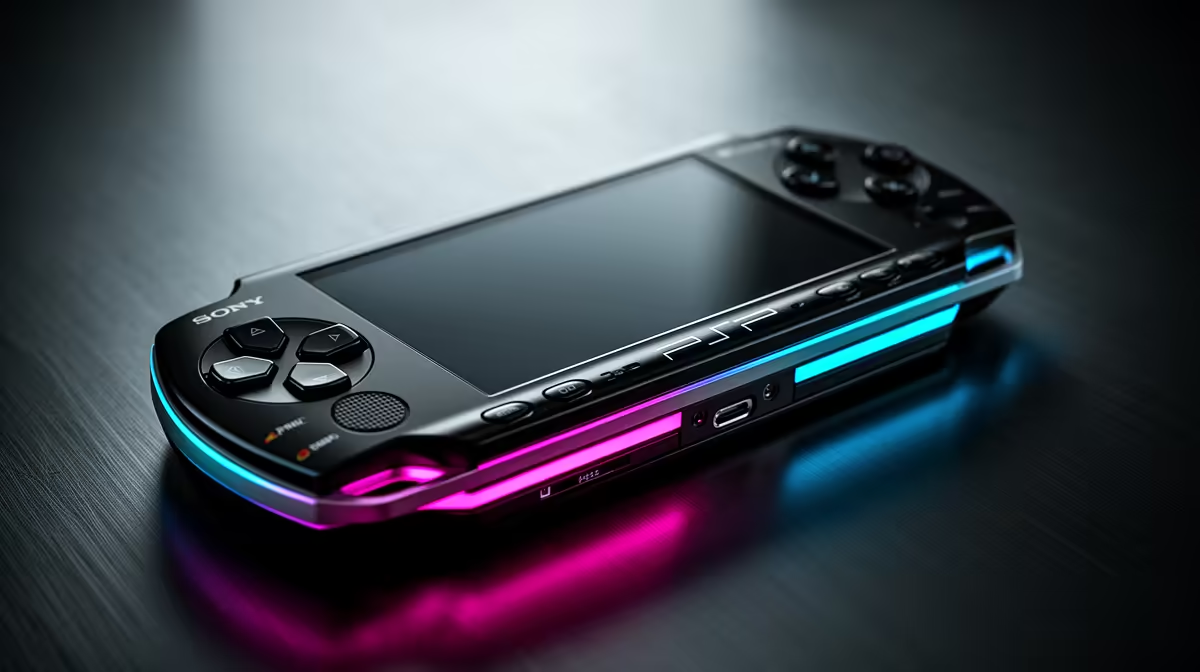
PSP and Dreamcast are the wall that cheap retro handhelds hit. The little Allwinner H700 units that breeze through SNES and Game Boy Advance simply do not have the horsepower for sixth-generation hardware. To run both libraries at full speed you want an Android handheld on a proper Snapdragon chip, and the Retroid Pocket 5 has become the reference pick for exactly that job. It clears PSP and Dreamcast comfortably, with headroom to spare.
Quick Answer
The Retroid Pocket 5 is the device to beat for PSP and Dreamcast emulation. Its Snapdragon 865, 8GB of RAM, and 5.5-inch AMOLED run PPSSPP at full speed with resolution upscaling to 1080p or beyond, and Redream at smooth 1080p upscaling across the Dreamcast catalogue. Budget Allwinner-class handhelds cannot, which is why the jump to Snapdragon is the real dividing line.
Why Cheap Handhelds Choke on These Two Systems
PSP and Dreamcast are far heavier to emulate than 16-bit and handheld consoles. They have full 3D graphics pipelines, larger memory footprints, and more complex timing. The Allwinner H700 chip in entry-level Linux handhelds was built for retro 2D and early 3D, so it stutters or drops frames the moment you load a demanding PSP 3D title or a busy Dreamcast scene.
The fix is not a setting, it is silicon. A Snapdragon-class Android handheld has the GPU and CPU performance to brute-force both libraries, plus the Android app ecosystem that gives you the best emulators for each system. That is the gap the Retroid Pocket 5 fills.
What the Retroid Pocket 5 Actually Runs
PSP
PSP runs through PPSSPP, and the Pocket 5 handles it at high resolution with room to push further. Demanding titles such as God of War: Chains of Olympus, Crisis Core: Final Fantasy VII, Persona 3 Portable, and Patapon all run at full speed. The Adreno 650 GPU handles PSP workloads with ease, and Retroid's custom Turnip driver support means GPU overclocking is available for the few titles that benefit from extra headroom. In practice, the PSP library is effectively fully playable rather than merely launchable. PPSSPP can be configured to run at native 3x resolution or pushed toward maximum settings at 1080p, and the Pocket 5 does not flinch.
Dreamcast
Dreamcast emulation through Redream runs at 1080p upscaling, and broad testing across the catalogue shows consistently smooth performance. Skies of Arcadia, Crazy Taxi, and Marvel vs Capcom 2 all play cleanly. The Flycast emulator is also available as an alternative and covers the catalogue with similar results. A rough 50-title test by the community showed consistently smooth results across both demanding and lighter games, so you are not chasing a narrow compatibility window. For a console that defined the early 2000s, having the whole library run well in your hands is the headline reason to buy.
Everything below
Because it clears the two hardest sixth-gen systems, everything lighter, PS1, N64, SNES, GBA, Mega Drive, runs without breaking a sweat. Buy for PSP and Dreamcast and you get the entire back catalogue beneath them for free.
Specs That Matter
The Snapdragon 865 does the heavy lifting, paired with 8GB of LPDDR4x RAM and a 5.5-inch AMOLED panel at 1080p resolution. The panel delivers deep blacks and punchy colour that suit old games well, and the 1080p resolution means upscaled output looks sharper than on cheaper 480p LCD screens. Storage is 128GB UFS 3.1, which is fast enough that load times rarely feel like a constraint. The active cooling fan is an important practical detail: without it, sustained PSP and Dreamcast emulation causes thermal throttling in passively cooled handhelds. The Pocket 5's fan keeps the chip at a consistent clock through long sessions so performance does not gradually degrade. To see where handhelds sit in the wider gaming lineup, the handheld gaming console range is a good overview of the category.
Emulator Setup for Best Results
Getting the most from PSP and Dreamcast on the Pocket 5 takes about fifteen minutes of one-off configuration. For PPSSPP, the recommended approach is to use Vulkan as the graphics backend and set the internal resolution to 3x or higher, enabling texture scaling if you want to push the image quality further. For Dreamcast, Redream is the simpler option and runs well at 1080p out of the box, while Flycast through RetroArch gives more per-game configuration options for the small number of titles that need tweaking. Both are available from the Play Store or as direct downloads, and the Pocket 5 community has documented per-game settings for the most popular titles in each library.
Value and the SA Picture
The Pocket 5 sits in the premium-but-sensible bracket rather than the bleeding edge. Its price has settled around 219 to 249 US dollars, and against newer flagship handhelds it is no longer the cheapest Snapdragon option. The Retroid Pocket 6 has since launched with a Snapdragon 8 Gen 2, which extends the performance ceiling further. For South African buyers weighing value per Rand, the Pocket 5 remains the most proven pick for the PSP and Dreamcast brief without paying flagship money. Weigh local availability and current import pricing before committing. The best-selling gaming devices are a quick gauge of what local buyers are actually choosing right now.
Who Should Buy It
Anyone whose retro wishlist centres on PSP and Dreamcast. If your collection stops at 16-bit and GBA, a cheaper handheld will do and you can save the money. But the moment sixth-generation 3D matters to you, the Snapdragon jump is non-negotiable, and the Pocket 5 is the most proven way to make it.
The practical note for SA buyers is that this device lands as an import. Factor in the rand-to-dollar conversion on the day, the shipping tier you choose, and any duties, and the all-in cost is higher than the advertised dollar price. For most people that overhead is worth paying once rather than twice by starting with an underpowered device and upgrading later. The Pocket 5 also benefits from a large, active Android emulation community, which means emulator updates, per-game settings guides, and firmware improvements are consistently available rather than relying on a manufacturer to push fixes.
Frequently Asked Questions
Can the Retroid Pocket 5 run PSP at full speed?
Yes. Through PPSSPP it runs PSP at high resolution with demanding 3D titles playing smoothly, so the library is effectively fully playable rather than just launching. Retroid's custom GPU driver support adds further headroom for the most demanding games.
Does it handle Dreamcast well?
Very well. Redream upscales Dreamcast to 1080p and broad testing shows consistently smooth performance across the catalogue, including heavier titles like Marvel vs Capcom 2. Flycast is available as a second emulator option with similar coverage.
Why can't a cheap H700 handheld do the same?
The Allwinner H700 was designed for retro 2D and light 3D. PSP and Dreamcast need far more GPU and CPU performance, which only a Snapdragon-class chip in an Android handheld delivers.
Will it run consoles older than PSP and Dreamcast?
Easily. Since it clears the two hardest sixth-gen systems, lighter platforms like PS1, N64, SNES, and GBA run without any strain.
Is AMOLED worth it on a handheld?
For retro content, yes. The AMOLED panel gives deeper blacks and richer colour than the budget LCDs on cheaper units, which suits both vivid sprite art and Dreamcast-era 3D.
How long does the Pocket 5 battery last during PSP sessions?
Under active PSP or Dreamcast emulation with the screen at moderate brightness, expect around four to five hours. Lighter 2D systems extend that closer to six hours. USB-C fast charging means a short top-up restores a significant portion of charge quickly.