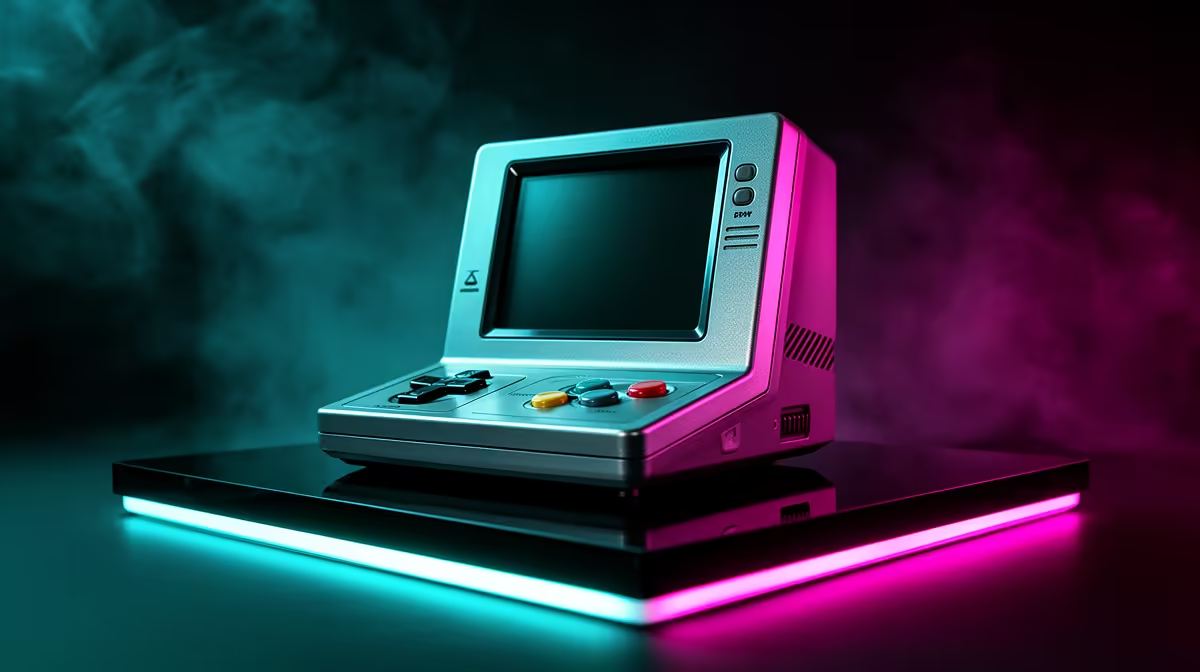
Load up a Game Boy classic on a normal widescreen handheld and the picture sits marooned between two thick black bars, using maybe half the panel. The Powkiddy RGB30 answers that with a 4-inch 720x720 display in a perfect 1:1 shape, and the result is one of those differences you notice the instant the first ROM boots: the game finally fills the screen.
Quick Answer
The Powkiddy RGB30 is the square-screen pick for 1:1 and 4:3 classics. Its 4-inch 720x720 IPS panel shows Game Boy, NES and pocket-era games without the letterboxing or pillarboxing that widescreen handhelds force on them. A Rockchip RK3566 chip clears 8-bit and 16-bit eras with ease, handles PS1, and the square shape is the whole point: it matches how those old games were drawn.
What a Square Screen Actually Changes
Most retro games of the Game Boy, NES and arcade era were not widescreen. They were close to square or 4:3, so on a 16:9 handheld they either stretch and distort or sit small inside black borders. The RGB30's 1:1 panel sidesteps that entirely. A 720x720 image gives a 4:3 game far more usable pixels than the same game squeezed into a widescreen frame, so it looks larger and sharper without any stretching.
The panel reaches around 400 nits, bright enough to stay readable outdoors on an overcast Cape Town afternoon, and the whole unit weighs around 207 grams with a generous 4,100mAh battery. If you are scoping out handheld emulation hardware in general, you can browse square-screen and widescreen designs side by side in Evetech's handheld gaming consoles range to see what is locally available.
How It Performs Across the Eras
The RK3566 is a sensible budget chip rather than a powerhouse, and the RGB30 plays to that honestly. It clears the entire 8-bit and 16-bit catalogue without breaking a sweat, and PS1 runs cleanly. Arcade boards are where the square panel really sings: vertical shooters, Street Fighter II, Metal Slug and King of Fighters all fit the 1:1 screen far better than they would on a widescreen device.
The chip in more detail
Rockchip's RK3566 packs four Cortex-A55 cores clocked up to 1.8GHz alongside a Mali-G52 GPU, backed by 1 GB of LPDDR4 RAM. That combination is well-matched to the systems the RGB30 targets. Retro emulator cores for NES, SNES, Game Boy Advance and PS1 are not demanding, so the chip runs them at full speed with no frame-skip needed. Push toward N64 or PSP and you will notice the ceiling, which is the honest limit of this class of hardware.
Battery and handling
The 4,100mAh cell is generous for the size, giving roughly eight hours on lighter systems, with less when you push it toward N64 or PSP. The device measures 145 mm wide by 86.5 mm tall and 18 mm thick -- compact enough for a bag pocket. The body fits naturally in the hand and the weight is light enough that long sessions do not fatigue your wrists.
Connectivity worth noting
The RGB30 ships with built-in dual-band Wi-Fi and Bluetooth, a USB-C charging port, a USB OTG port and an HDMI output for playing on a TV. For a device at this price point that is a complete connectivity set, covering everything from loading ROMs wirelessly to running a session on a larger screen.
Where the square shape works against you
Honesty matters here. If your library is mostly horizontal console games, the square panel turns the letterboxing problem around: widescreen content now sits inside top-and-bottom bars instead. The RGB30 is purpose-built for handhelds, arcade boards and shooters. For a library dominated by 16:9 titles, a widescreen handheld is the better match.
Arcade and Vertical Shooters: The Sweet Spot
The RGB30's 1:1 screen is not just good for Game Boy games -- it is transformative for vertical arcade shooters. Titles like DoDonPachi, Ikaruga, Strikers 1945 and the Raiden series were originally designed for portrait-oriented CRT cabinets, and a square screen fills more of that vertical space than any widescreen alternative. On a 720x720 panel these games look correct in a way that a 16:9 device cannot replicate. If arcade shoot-em-ups are any part of your library, the RGB30 is the closest you will get to the original presentation in a pocket-sized device.
Neo Geo and CPS1/CPS2 boards are similarly well-served. Street Fighter II, Metal Slug and King of Fighters all output close to 4:3, and on the RGB30 those games fill the screen with crisp, pixel-accurate output that a widescreen device would either pillarbox or stretch. For a library centred on these classics, no other mainstream handheld in this price range matches the RGB30 for display authenticity.
Software and Firmware
The RGB30 ships running a Linux-based retro frontend, and the community has embraced it well. Custom firmware options including ROCKNIX and Batocera are available and actively maintained, which matters for long-term support. The default firmware is functional, but flashing a community build typically unlocks better emulator compatibility and a cleaner interface. Setup is a matter of copying ROMs to a microSD card and adjusting a few emulator settings, which is straightforward even for first-time Linux handheld users.
Who It Suits
Buy the RGB30 if your nostalgia lives in the Game Boy, NES, arcade and pocket-era world and you want those games to fill the screen the way they were meant to. It is a focused device, not an all-rounder, and that focus is exactly why it is so good at the one thing it does. For a broader emulation library, the PC best sellers at Evetech include more general-purpose systems worth weighing up before you commit to a square panel.
Frequently Asked Questions
Why does a 1:1 screen suit retro games?
Many classic games were drawn close to square or 4:3, not widescreen. A 1:1 panel shows them without the black bars or stretching a 16:9 screen forces, so the image fills more of the display and looks larger and cleaner.
What can the RGB30 actually run?
It handles the full 8-bit and 16-bit range comfortably, runs PS1 cleanly, and is excellent for arcade boards and vertical shooters. More demanding systems like N64 and PSP are possible but push the chip and shorten battery life.
How long does the battery last?
The 4,100mAh battery gives roughly eight hours on lighter systems such as Game Boy and 16-bit consoles, dropping as you move to heavier emulation. It is generous for a handheld this size.
Is the square screen ever a drawback?
Yes, for widescreen-heavy libraries. Horizontal console games end up with top-and-bottom bars on a square panel, the mirror image of the letterboxing problem. The RGB30 shines on 1:1 and 4:3 content and is less ideal for 16:9 titles.
Can I play on a TV with the RGB30?
Yes. The RGB30 includes an HDMI output, so you can connect it to a TV for a big-screen session. The 720x720 output scales to fit common screen ratios with black bars on the sides, which suits square-native content well.
Want your retro classics to fill the screen instead of floating in black bars? See the square-screen and widescreen handhelds at Evetech's handheld gaming consoles range and pick the shape that matches your library.