Every PC builder eventually faces the same crossroads: keep squeezing performance from 1080p or step up to a sharper world. For South African builders on the QHD upgrade path, the question is not just whether to move to 1440p but how to do it in a sequence that makes financial sense locally, where component pricing responds to import costs and the rand's movement. Getting the order right means you spend once on the monitor and replace only the GPU as budget allows.
Quick Answer
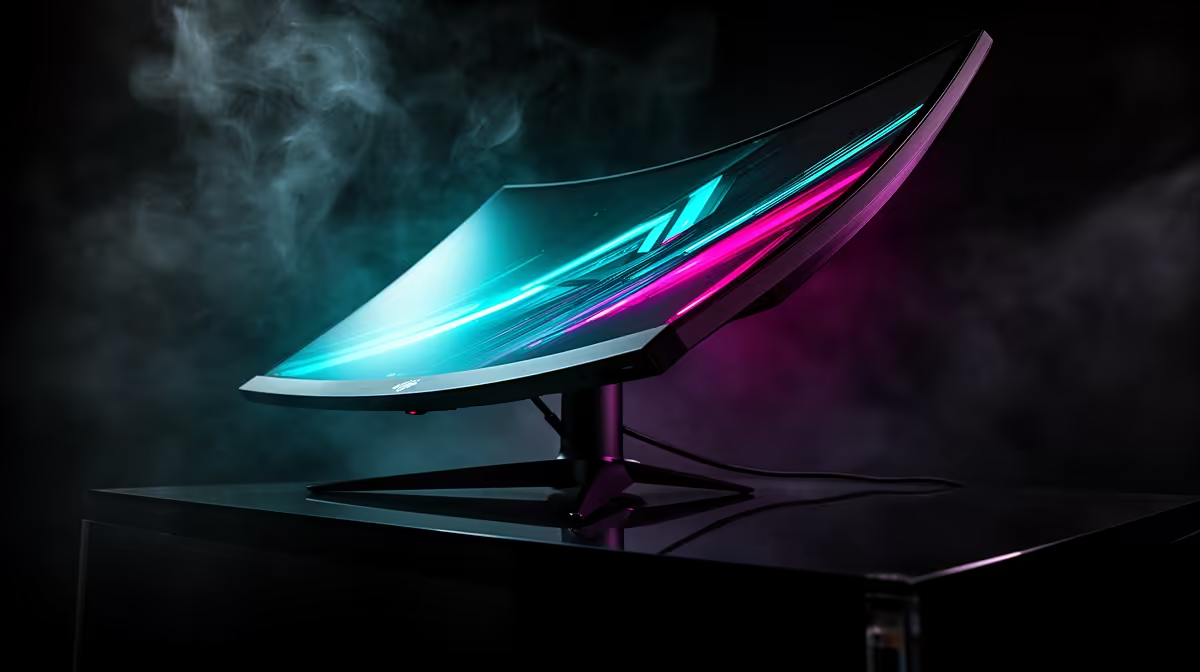
Start with the 27-inch 1440p 144Hz IPS monitor, ideally around R6,000. It outlasts multiple GPU upgrades and future-proofs the build for years. Pair it initially with an RTX 4060 Ti class card for smooth 1440p high settings, then upgrade the GPU further down the line when prices drop.
🖥️ Why the Monitor Should Come First
The logic is counterintuitive until you think through the lifespan difference between display and GPU. A quality 27-inch IPS panel bought today will still be an excellent screen in five years. The GPU you buy alongside it will likely be replaced within two or three. If you buy the GPU first and keep the 1080p screen, you are running expensive hardware through a display that cannot show you what you are paying for.
Buying the monitor first also forces a clarity of purpose. A 1440p panel on your desk is a permanent reminder of what the build is headed toward. You can run it at 1440p immediately with whatever card you have, accepting lower settings or reduced frame rates temporarily, and the experience still beats 1080p in terms of image sharpness. As your GPU budget grows, you feed the display rather than replace it.
In South Africa this sequencing makes particular sense because IPS panel pricing tends to be more stable over time than GPU pricing, which swings with global silicon supply, rand exchange rates, and import cycles. Locking in the display at a favourable price protects that part of the build against the volatility.
Choosing the 27-Inch at 1440p
The 27-inch format at 1440p hits a pixel density of 109 pixels per inch. That is the point where individual pixels disappear at normal viewing distances of 60 to 80cm. Go larger than 27 inches at 1440p and density drops toward 90 PPI, where the image softens noticeably. Go smaller and you are paying QHD pricing for a panel that does not need the resolution to look sharp.
A 144Hz panel is the minimum worth targeting in this upgrade. The refresh rate holds through at least two GPU generations: your current card may manage 80 to 100 FPS at 1440p today, but a future upgrade will push past 120 FPS in the same titles. Buying a 144Hz panel now means you do not need to upgrade the display when the GPU improves.
🔧 Matching the GPU Tier to Your 1440p Panel
Not every card handles 1440p equally, and the choice of GPU should be honest about your specific game library rather than built around theoretical peak performance in demanding benchmarks.
An RTX 4060 Ti is the current value reference for 1440p high settings. In most competitive and mid-weight titles it sustains 90 to 110 FPS at high quality settings, which keeps the frame rate comfortably within a 144Hz panel's range. In heavier open-world or AAA titles it may need some settings dialled back to maintain smooth framing, particularly with ray tracing enabled.
An AMD RX 7700 XT occupies a similar position and performs comparably at 1440p rasterised workloads. The choice between the two often comes down to local pricing at the time of purchase rather than a meaningful performance gap.
Pro Tip ⚡
Enable FreeSync on your QHD panel from the first day you run it. Nearly every value 1440p monitor supports FreeSync over its full refresh range, and the variable sync removes frame tearing entirely at any frame rate above the minimum threshold. It costs nothing and makes a 70 FPS session feel noticeably smoother than a torn 90 FPS one.
💰 Structuring the Upgrade Budget in ZAR
At current SA pricing a 27-inch QHD 144Hz IPS panel sits around R5,500 to R7,000 depending on brand and feature set. An RTX 4060 Ti class card adds approximately R9,000 to R11,000. That puts the combined first-phase upgrade around R15,000 to R18,000, which is meaningful but not unreachable when planned across a few months.
One practical approach is to split the upgrade into two phases separated by three to six months. Phase one is the monitor purchase when panel prices dip, combined with DLSS or FSR enabled on your existing card to extract acceptable 1440p frame rates from hardware that was tuned for 1080p. Phase two is the GPU upgrade once you have saved the additional funds.
DLSS 3 and FSR 3 both offer a frame generation mode that can add meaningful FPS above what the GPU renders natively. On an older card at 1440p, this can bridge the gap between a choppy 45 FPS and a smooth 80 FPS while you wait for the next GPU purchase, making the two-phase approach more liveable than it sounds.
🚀 Planning Beyond the First Upgrade
The QHD platform you build today has room to grow without replacing the foundation. Once you have the 1440p panel and a mid-tier GPU, the next meaningful upgrade options are a higher-tier GPU for more frame rate headroom, or eventually a 165Hz or 240Hz panel if sustained high frame rates become a priority.
The existing 1440p panel makes sense as a second display rather than a discard when that happens. Repurposing it for chat, Discord, or a stream dashboard extends its useful life and saves buying a secondary monitor separately.
A 4K upgrade path exists beyond QHD but requires a significant GPU investment. Cards that can sustain 60 FPS at 4K in heavy titles cost considerably more than 1440p options, and the display hardware is similarly expensive. For most South African builders 1440p is the practical ceiling that delivers the clearest visual improvement per rand over the longest period.
Frequently Asked Questions
Should I upgrade the monitor before the GPU or at the same time?
The monitor first is the cleaner sequence. It outlasts several GPU generations, so buying it first secures the display at current pricing and lets you use it immediately, even at reduced settings or via upscaling. A GPU bought before the monitor might be partially obsolete by the time you eventually upgrade the display.
Which GPU handles 1440p high settings without major compromises?
An RTX 4060 Ti or RX 7700 XT class card holds 1440p high settings above 90 FPS in most current titles without needing drastic quality reductions. In the most demanding open-world games a few settings may need adjusting, but competitive and mid-weight titles run comfortably within the 144Hz range.
Is jumping straight to 4K smarter than stopping at QHD?
Rarely for budget-conscious builders. 4K at high frame rates demands the top tier of current GPU hardware, roughly double the cost of a good 1440p card. The visual step from 1440p to 4K on a 27-inch panel at normal viewing distances is smaller than most benchmarks suggest, while the GPU cost difference is large.
Does DLSS or FSR make a meaningful difference at 1440p?
Yes, particularly on mid-tier cards. Both technologies render at a lower internal resolution and upscale to 1440p, often recovering 30 to 50 percent of lost frame rate with minimal visible quality impact. Frame generation in newer implementations can add further FPS on top of that, making an older card more viable during the gap between display purchase and GPU upgrade.
Can I use my old 1080p monitor as a second screen during the transition?
Yes, and it makes sense to do so. Keeping the old panel for chat, messaging, and secondary apps frees the new QHD display for the game itself and avoids the cost of buying a purpose-made second monitor. Most modern GPUs support two or more displays at different resolutions without any performance impact.
Ready to start your QHD upgrade with the right foundation?
Browse the 27-inch 1440p gaming monitor range and pair it with a GPU that feeds it properly, building the resolution you actually want.