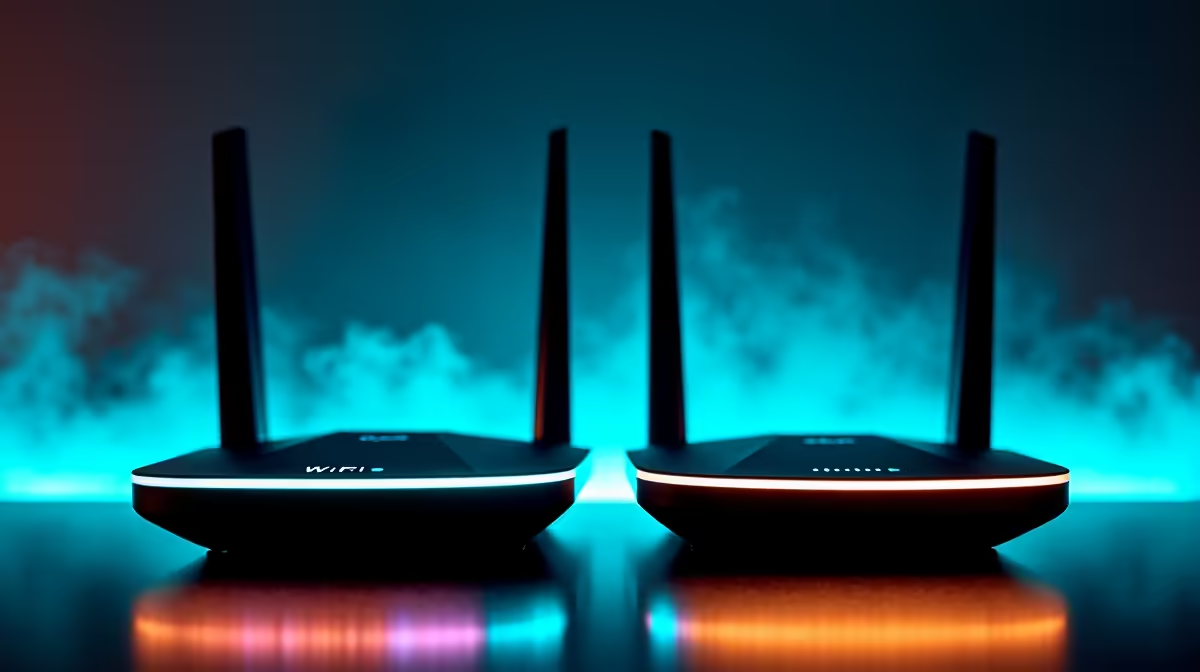
A 5G home connection can be quick on a speed test and still feel sluggish the moment the whole household piles on. The bottleneck is usually not the cellular signal but how the router shares it across many devices at once. A WiFi 6 5G router handles that congestion far better than the older WiFi 5 units that shipped with early fixed-wireless plans, which is exactly what a busy South African home needs from a single shared connection.
Quick Answer
WiFi 6 is the standard that keeps a crowded home network fast, because it serves many devices at once efficiently rather than queueing them one behind another like WiFi 5. For a household streaming, gaming and working over one 5G line, a WiFi 6 5G CPE router is the unit that stops slowdowns when everyone is online.
Why WiFi 6 matters more than peak speed on a busy network
The number people fixate on is top speed, but the metric that decides whether your home feels fast is how the router behaves under load. WiFi 6 introduced techniques that let an access point talk to many devices in the same airtime instead of servicing them sequentially. The practical result is that twenty devices sharing a WiFi 6 router each get a steadier slice than they would on an older WiFi 5 unit, where contention drags everyone down.
That is precisely the situation in a typical SA home: phones, a TV stick, a console, a couple of laptops and a handful of smart devices, all leaning on one 5G connection. The cellular link might be capable, but a weak WiFi stage in front of it throttles the experience. Upgrading the router is often the single biggest improvement you can make without changing your plan.
What to look for in a 5G CPE router for a full house
Three specifications separate a router that copes from one that struggles. The first is the WiFi 6 standard itself, which brings the efficient multi-device handling described above. The second is dual-band operation, so older or distant devices sit on one band while fast, nearby devices use another, keeping them from competing.
The third is a high simultaneous-device ceiling. Strong CPE units advertise support for well over a hundred connected devices and can transmit to many of them at once through multi-user techniques. A router built for crowded offices and large homes, rated to serve a dozen or more devices in the same instant, is the kind of headroom a packed household wants. The current cellular and home-networking gear sits in the networking range, which is where to compare the available CPE units.
Antennas, placement and mesh
A 5G CPE router has to do two jobs: pull in a strong cellular signal and then broadcast it well indoors. Placing the unit near a window facing the nearest tower helps the incoming signal, and some models accept an external antenna to improve it further. For larger or double-storey homes, a router that supports mesh extension lets you add nodes so the WiFi reaches every room rather than fading down the passage. The add-on antennas and mesh nodes that pair with these routers often turn up among the popular accessory picks, worth a look when you plan coverage.
Wired backhaul and the devices that matter most
A detail that transforms a busy home network is using Ethernet for the devices that sit in one place. A smart TV, a desktop, a console or a games PC does not need to compete on Wi-Fi at all if you run a cable to it from the router's LAN port. Every device you move onto a wired connection is one fewer fighting for airtime, which frees up the wireless side for the phones and tablets that genuinely need to roam. A 5G CPE router with several gigabit Ethernet ports earns its keep this way.
The same thinking applies to the heaviest users. If gaming latency or a work-from-home video setup is the priority, wiring that machine directly gives it a stable, low-latency path while the rest of the house shares the Wi-Fi. It is the cheapest performance upgrade available, because the cable costs little and removes the most demanding traffic from the congested wireless medium entirely.
Band steering and channel sense
Modern dual-band routers can steer devices to the band that suits them, keeping slower or distant devices on one band and fast, nearby ones on another so they do not drag each other down. Leaving this feature on usually gives a smoother result than forcing everything onto a single band. In a flat or townhouse complex where many neighbouring networks crowd the air, a router that chooses a clearer channel automatically also helps, since congestion from other homes is as real a problem as congestion from your own devices. These are settings worth checking in the router's app once it is set up, because they cost nothing and lift performance on a crowded network.
Matching the router to your household size
A flat or small home with a handful of devices is well served by a solid dual-band WiFi 6 CPE unit on its own. The efficient device handling does the heavy lifting and a single well-placed router covers the space.
A family home with many devices spread across rooms benefits from a higher-tier CPE router with strong multi-device support, and likely a mesh node or two for the far corners. The goal is to remove the WiFi stage as the bottleneck so the 5G connection is the only thing setting your speed. Budget for the router based on how many devices realistically run at once and how much area you need to cover, rather than chasing the highest headline speed.
Frequently Asked Questions
Will a WiFi 6 router speed up my 5G connection?
It will not increase the cellular speed, but it shares that speed far better across many devices. On a crowded home network, a WiFi 6 router removes the WiFi bottleneck so your devices actually get the 5G performance the plan offers.
How many devices can a good 5G CPE router handle?
Strong units advertise support for well over a hundred connected devices and can serve many simultaneously through multi-user techniques. For a busy household, look for that high simultaneous-device ceiling rather than just a fast peak speed.
Do I need an external antenna for a 5G router?
Not always. Placing the router near a window facing the nearest tower often gives a good signal. If reception is weak, a model that accepts an external antenna can meaningfully improve the incoming cellular link.
Is mesh worth adding to a 5G router setup?
For larger or multi-storey homes, yes. A mesh node extends coverage so the WiFi reaches rooms a single router cannot, which matters once the cellular signal is strong but the indoor coverage falls short.
What is the difference between WiFi 6 and WiFi 5 for this?
WiFi 6 serves many devices efficiently in the same airtime, while WiFi 5 tends to handle them more sequentially, so it bogs down under load. On a network with many simultaneous devices, WiFi 6 is the meaningful upgrade.
If your 5G line is fast on paper but slow when the house is full, the router is usually the fix. Compare the current WiFi 6 CPE options in the Evetech networking range and match one to your household's device load.