Quick Answer
For standard monitor connections, bi-directional DisplayPort cables work in both orientations since modern DP spec negotiates roles automatically, while uni-directional cables have fixed source and display ends. For most gamers and home office users, a DP 1.4 cable is inherently bi-directional and the right choice. Uni-directional active optical cables are the exception, used only for very long runs.
The Practical Difference Between Cable Types 🖥️
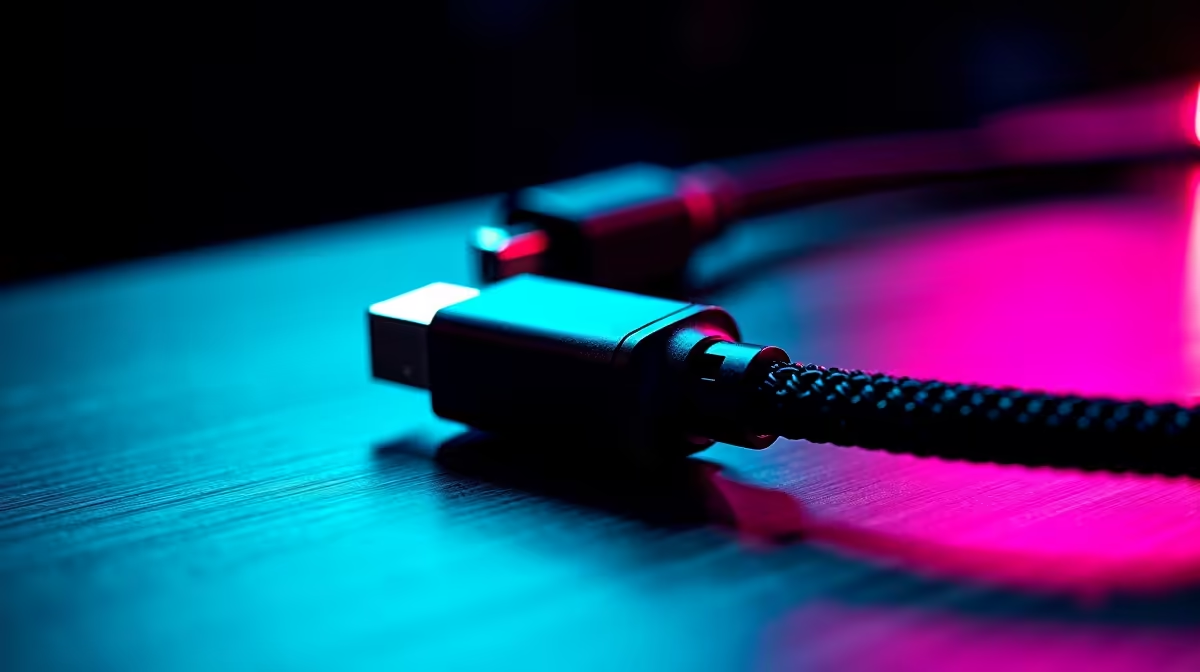
A passive copper DisplayPort cable is bi-directional by default: the electronics on each end negotiate which is the source and which is the sink during link training at connection. You can insert either end into either device. Active optical DisplayPort cables designed for runs of 5m to 30m are uni-directional because the optical transceiver at one end converts electrical to optical signal and the other end does the reverse; swapping them shorts the conversion chain. These long-run active cables are clearly labelled with source and display arrows. For the typical gaming or productivity monitor setup with a 1m to 2m copper cable, this distinction is irrelevant since all such cables are bi-directional.
When Directionality Becomes a Real Concern 🔧
Professional AV installations and multi-monitor display wall setups in South African broadcast studios or conference rooms use active optical cables where directionality matters. In these cases, incorrect orientation results in no signal, and the fix is simply reversing the cable. For home or office single-monitor setups, the only scenario where directionality causes confusion is when an HDMI 2.1 48 Gbps ultra-high-speed cable is used; some budget implementations with directional signal boosters inside are sensitive to orientation. The solution is to follow the directional arrows printed on the cable jacket. Quality HDMI 2.1 cables from reputable brands (available at Evetech from R180 to R450 for 2m) do not have this limitation.
Matching Cable Choice to Your Monitor and GPU 🎮
For a 1440p 144Hz gaming monitor connected to an RTX 4070 or RX 7900 GRE, a standard bi-directional DisplayPort 1.4 cable at 1m or 1.5m is the optimum choice. DP 1.4 supports 1440p at 144Hz with Display Stream Compression (DSC) and handles 4K 120Hz. For 4K 144Hz on an RTX 4080 or RX 7900 XT setup, use a DP 2.1 cable or HDMI 2.1 cable, both inherently bi-directional at copper lengths under 2m. If your monitor is more than 3m from the PC, consider an active DisplayPort extender rather than a passive long cable, which risks signal loss at high bandwidth. Budget for quality copper cables: R120 to R280 for DP 1.4 and R180 to R450 for HDMI 2.1 at Evetech.
Check for Directional Arrows on Long Cables ⚡
Active optical and long-run active copper cables print small source and display arrow icons near each connector. If you see no such markings, the cable is passive and bi-directional. Always check before assuming a connection failure is a hardware fault.
FAQ
Can I damage a uni-directional cable by connecting it backwards?
Not typically. Incorrectly oriented uni-directional active cables simply produce no signal; they do not damage connected hardware. The fix is reversing the cable.
Do I need a bi-directional cable for a USB-C to DisplayPort connection?
USB-C to DisplayPort cables using DisplayPort Alt Mode are inherently directional: the USB-C end connects to the source device (PC or laptop) and the DP end to the monitor. These cannot be reversed because USB-C carries multiple protocols and the Alt Mode negotiation is not symmetric.
Does cable directionality affect gaming performance or latency?
No. Whether a cable is bi-directional or uni-directional has no effect on signal latency, refresh rate, or frame time. Performance is determined by the bandwidth standard (DP 1.4, HDMI 2.1) and the cable's signal integrity.
Upgrading your gaming monitor setup?
Evetech stocks DP 1.4 and HDMI 2.1 cables for high-refresh-rate gaming monitors, plus the monitors themselves. Visit the display category to explore current options.