Quick Answer
BTF (Back-To-Front) motherboard layouts move power connectors and most headers to the rear of the PCB, so all cables exit through the motherboard tray rather than across the front face. Standard ATX layouts have connectors on the front face, requiring cables through grommet holes. BTF dramatically improves cable aesthetics but requires a BTF-compatible case.
What BTF Changes About Your Build 🔧
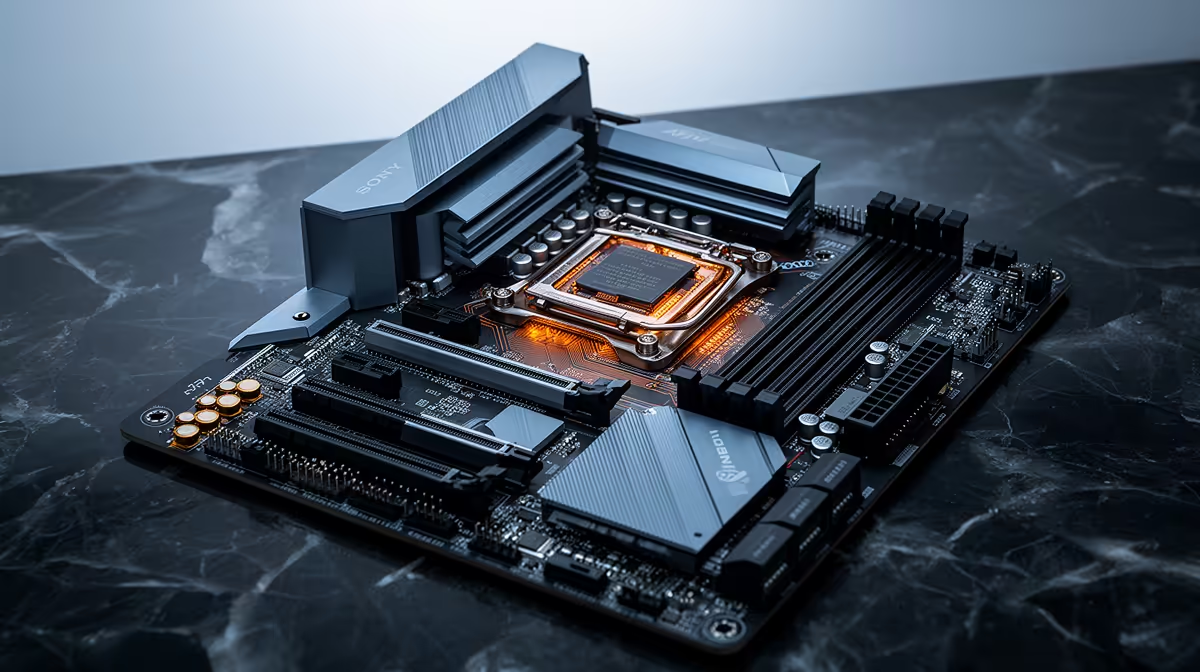
ASUS ROG Maximus BTF and MSI MEG BTF boards relocate the 24-pin ATX power, CPU 8-pin EPS, front-panel headers, and USB internal headers to the back of the PCB. From inside the case you see a near-bare board, the main appeal for glass-panel showcase builds. Standard ATX boards have these connectors on the component-facing side, so the 24-pin cable, CPU power cable, and front USB cable snake across the motherboard area. On a well-managed standard ATX build these cables are tucked through grommets, but some always remain visible. BTF eliminates this entirely. The trade-off is that BTF boards pair only with BTF-compatible cases that have rear cable channels aligned with the relocated connectors. BTF motherboards are stocked at Evetech from around R8,000 to R22,000 for Z890 and X870E platforms.
Standard ATX: The Flexible, Universal Option 🖥️
Standard ATX motherboards work in virtually every ATX, micro-ATX, or E-ATX case ever made, with no compatibility requirements on the case side. Cable management on a standard board in a premium case with good grommet placement looks excellent in glass panels when done carefully. Standard ATX also offers the broadest range from every brand across budget, mid-range, and flagship tiers. For a Ryzen 7 9800X3D on X870E or an Intel LGA1851 build on Z890, the ATX motherboard ecosystem is mature and available from R3,000 to R15,000 at Evetech.
Which Should SA Builders Choose? 🇿🇦
For first-time builders or those prioritising case flexibility, standard ATX is the clear recommendation. The BTF ecosystem is still young: case and board pairings are limited, and component availability in South Africa can lag global launches by four to eight weeks. For experienced builders who prioritise aesthetics and are buying a new system from scratch, BTF delivers a genuinely superior visual result. The BTF premium is typically R2,000 to R5,000 over an equivalent standard board, which is difficult to justify on pure performance grounds since the specs are identical. It is an aesthetics investment.
Confirm Case BTF Compatibility Before Ordering ⚡
The BTF connector position varies between ASUS and MSI implementations, and not every BTF-labelled case supports both brands. Before ordering a BTF motherboard, check that the case manufacturer explicitly lists compatibility with that board brand and socket. Cross-brand BTF fitment issues have been reported where connector cutouts do not align precisely, making the case unusable for that motherboard.
FAQ
Does BTF affect CPU cooling compatibility?
No. The CPU socket, mounting holes for coolers, and VRM heatsink positions are unchanged in BTF designs. Any cooler compatible with AM5, LGA1851, or LGA1700 on a standard board fits the BTF equivalent identically.
Can I use a BTF case with a standard ATX board?
Yes, in most cases. BTF cases still include standard grommet holes and cable routing channels for non-BTF boards. The case simply does not benefit from the BTF design when used with a standard board, but installation works normally.
Is the BTF standard universal across brands?
No. ASUS BTF and MSI BTF implement relocated connectors in different positions on the PCB. A case designed specifically for ASUS BTF may not align correctly with an MSI BTF board. Always verify compatibility at the model level before purchasing.
Considering a BTF build or a traditional ATX build?
Evetech stocks both BTF and standard ATX motherboards across AMD AM5 and Intel LGA1851, alongside BTF-compatible cases for the full showcase build experience.