Quick Answer
Protective PCB coatings guard circuit boards against moisture, dust, and oxidation that accumulate over years of daily use. In South African coastal cities like Cape Town and Durban, high humidity accelerates copper trace corrosion on uncoated boards, and a conformal coating reduces that risk significantly across a five-to-seven-year home office ownership window.
What PCB Coatings Do and Where They Appear 🔧
A conformal coating is a thin polymer layer, typically acrylic or silicone, applied over the solder mask of a PCB. It prevents moisture bridging between adjacent traces, which can cause leakage currents that degrade signal integrity over time. On a motherboard the most vulnerable areas are the VRM section, PCIe slots, and DIMM slots, where trace density is highest and voltage differentials are large enough for minor moisture contamination to cause problems. Coatings also reduce ingress of conductive dust, a real concern in SA homes near unpaved roads or in older suburbs with dusty winters. Premium motherboards with conformal coating typically sit in the R3,500 to R6,000 price range locally and carry this spec alongside other quality markers such as 105-degree capacitors and robust VRM designs.
Home Office Conditions That Accelerate PCB Degradation 🖥️
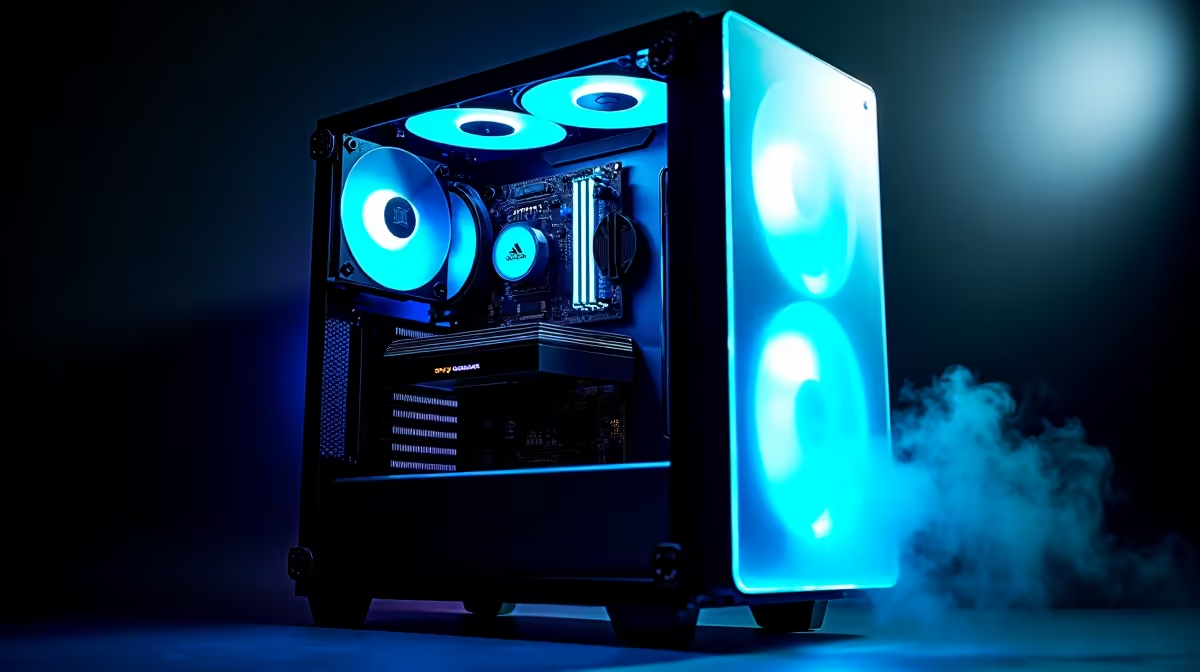
Home office PCs often run eight to ten hours daily for years without meaningful maintenance. Each power cycle thermally expands and contracts solder joints and trace materials. Over thousands of cycles, uncoated boards in humid environments develop micro-cracks at solder joints faster than coated equivalents. In Durban, where relative humidity regularly exceeds 80 percent, this process is noticeably accelerated compared to drier inland cities. Adding a coated motherboard to even a modest R8,000 to R15,000 home office build extends useful service life and reduces the risk of an unexpected failure during a work deadline. For PSUs, look for conformal coat mentions in the spec sheet: units with coated PCBs are better suited to humid environments and are worth the slight premium in coastal South African conditions.
Silica Gel Desiccant Inside Your Case ⚡
Placing two or three fresh silica gel packets near the case floor intake reduces sustained humidity inside the chassis by several percentage points. This is particularly useful in coastal SA homes during summer. Recharge packets every six months in an oven at 120 degrees Celsius for two hours rather than replacing them, which keeps ongoing cost minimal.
FAQ
Can I apply conformal coating to an existing uncoated motherboard?
Yes. DIY conformal coating aerosols are available locally. Mask all sockets, slots, and headers before applying, as cured coating inside a DIMM or PCIe slot prevents future hardware installations. This halts ongoing corrosion but cannot reverse existing damage.
Does PCB coating affect warranty or repairability?
Factory-applied coatings do not affect manufacturer warranty. DIY coating typically voids the warranty as a user modification. For solder rework, coating adds difficulty, so factor this in if you plan to self-repair in future.
Is humidity a bigger long-term threat than heat for PCB reliability?
Both matter, but humidity is more insidious because damage is invisible until failure. Heat produces audible fan noise and visible throttling that prompts action. Moisture corrosion is silent and progressive, making coated boards especially valuable in coastal SA environments.
Building a home office PC that lasts?
Evetech stocks motherboards with protective PCB coatings across Intel and AMD platforms. Browse the motherboard range to find a board matched to your home office CPU and budget.