Quick Answer
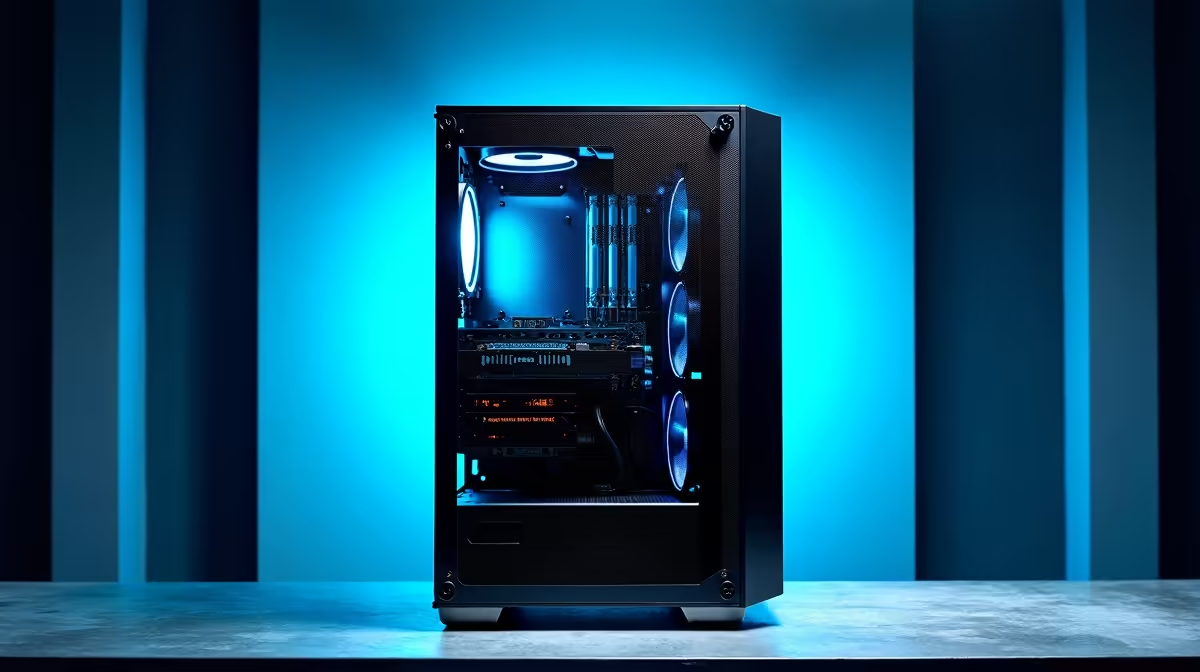
A professional rendering workstation in South Africa typically needs 1,200W to 1,600W from the PSU. A Threadripper Pro 7985WX paired with an RTX 5090 pulls around 575W GPU plus up to 350W CPU at full render load, plus memory, drives, and board overhead, reaching 1,050W to 1,200W sustained. Size your PSU to run at 70% to 80% of that peak, meaning 1,200W to 1,600W rated capacity.
Spec'ing Power for GPU Rendering 🖥️
Octane, Redshift, and Arnold GPU renderers push the RTX 5090 to sustained 95% to 100% GPU utilisation for hours at a time, which is fundamentally different from gaming loads that vary by scene. At full GPU render, an RTX 5090 draws close to its full 575W TDP continuously, not in spikes. Simultaneously, the CPU handles scene data management and denoising, adding 200W to 350W depending on the Threadripper model. A single 4K texture-heavy scene in Blender Cycles on this configuration can sustain 900W to 1,100W system draw for 30 minutes to several hours. This sustained nature is why rendering workstations need PSUs rated for continuous high-load operation, not just peak headroom.
South African Considerations for Professional Builders 💼
Professional-grade Threadripper Pro boards and CPUs carry significant import pricing, often pushing a complete workstation to R120,000 to R180,000. At that investment level, a quality Titanium-rated 1,600W PSU at R7,000 to R9,000 should not be the compromise point. Sustained rendering loads also translate directly to electricity costs: a system drawing 1,100W for 8 hours daily consumes 8.8 kWh per workday. At R4.00 per kWh, that is R35.20 per day or around R8,450 per year. The efficiency difference between Titanium (93%) and Bronze (82%) saves around R1,000 to R1,200 annually on an 8-hour daily render schedule.
Recommended PSU Features for Renderers 🔧
Beyond raw wattage, render workstations need PSUs with low ripple on the 12V rail (under 50mV), tight voltage regulation (plus or minus 0.5%), and Japanese capacitors rated for 105 degrees C. Digital control platforms like those in the ASUS ROG Thor series allow real-time power monitoring via the OLED display, useful for tracking render job electricity consumption. A fully modular design also matters: Threadripper builds often use bespoke cable routing in large EATX cases, and modular cables allow clean builds without cable clutter near the VRM zone.
Account for Electricity in Project Costings ⚡
South African freelance 3D artists should include electricity consumption in project quotes. A R120,000 workstation running 8 hours daily at full GPU render costs around R8,500 per year in electricity at current Eskom rates. Dividing that across billable render hours lets you add a realistic infrastructure cost line to client quotes.
FAQ
Do I need a UPS for a professional rendering workstation in South Africa?
Yes. Even with improved power stability, localised outages and short dips can interrupt multi-hour renders. A UPS rated for 1,500VA or more provides enough runtime to save the render state and shut down cleanly.
Can I use two RTX 5090s in a workstation for faster rendering?
Yes, in applications that support multi-GPU rendering like Redshift and Octane. A dual-5090 workstation needs at least a 1,600W PSU and a Threadripper platform with sufficient PCIe lanes.
What cooling is needed for a sustained-load render workstation?
A 360mm or 420mm AIO or a top-tier air cooler is the minimum for Threadripper Pro CPUs. Sustained 200W to 350W CPU load in a warm South African environment makes adequate cooling non-negotiable.
Speccing a professional render workstation in South Africa?
Evetech stocks high-wattage Titanium PSUs, RTX 50-series GPUs, and professional-grade components suited to heavy GPU rendering workflows. Get the power foundation right from the start.