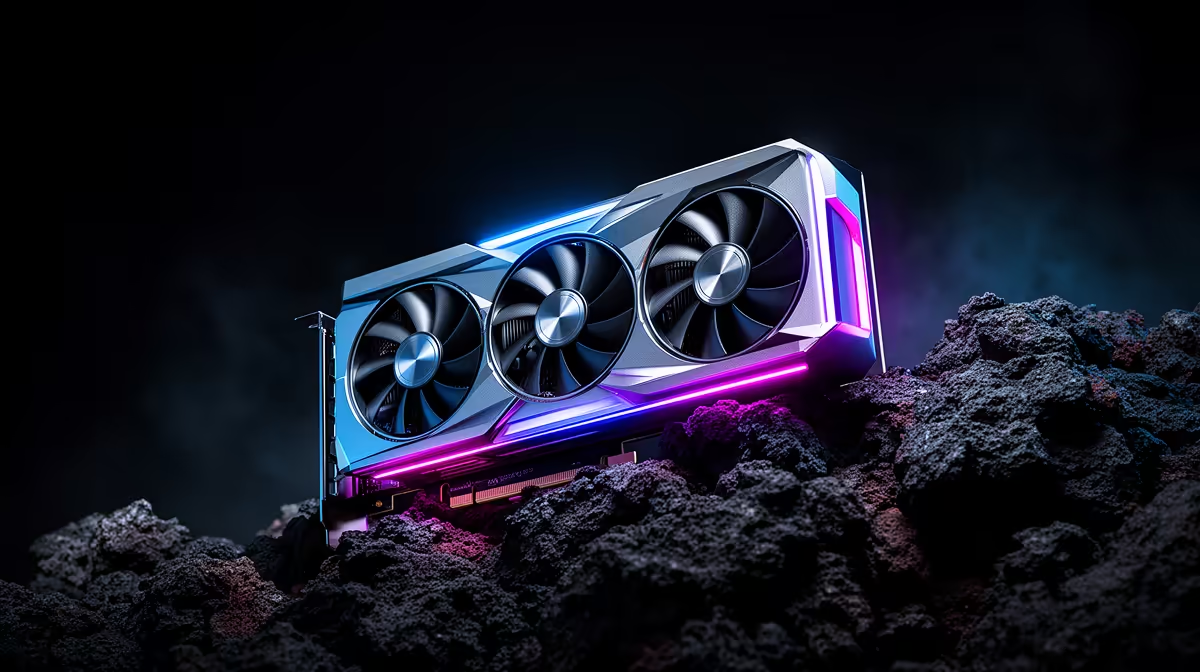
Holding off on a graphics card purchase usually makes sense when a new generation is months away. The trouble in 2026 is that it is not. No flagship generation ships this year, every meaningful next-gen launch sits in 2027 or later, and SA buyers carry an extra weight that overseas guides ignore: Rand depreciation stacked on top of global GPU price rises. The choice to buy a graphics card now or wait for next-gen comes down to whether waiting buys you anything real, and right now it largely does not.
Quick Answer
For SA buyers in 2026, buying current-gen now is the rational call. No new flagship GPU generation launches this year, all next-gen hardware is 2027 or beyond, and waiting means paying later at a likely worse Rand exchange rate while global GPU prices climb. Unless you specifically need a card that does not yet exist, current-gen at today's price is the sound purchase.
The 2026 Release Picture
Waiting only pays off if something better is arriving soon at a sensible price. Neither condition holds this year. The next true flagship generation is positioned for 2027 at the earliest, and history says availability lags any paper launch by months, with the first wave thin and marked up. A card announced in early 2027 may not sit affordably on a local shelf until well into that year.
That reframes the wait. You are not deciding between a card now and a card in three months; you are deciding between a card now and a card in roughly a year and a half, during which your current machine either performs or it does not.
If you are mapping what is actually available today, the current graphics card range is the realistic shortlist rather than anything on a future roadmap.
The Rand Factor Overseas Guides Miss
International buying advice treats GPU prices as fairly stable in their own currency. SA buyers do not have that luxury. A card's local price tracks not just its global cost but the Rand-to-dollar rate on the day it is imported and restocked, and that rate has a long record of weakening over time.
Why Waiting Can Cost You Twice
Delay a purchase by a year and two forces can push the price up together. First, the global trend on new silicon has been upward, with each generation often launching dearer than the last at equivalent tiers. Second, if the Rand softens over that period, the same dollar price converts to more Rand. Wait for next-gen and you risk paying a higher base price at a worse exchange rate, a double increase that can wipe out any performance-per-Rand advantage the new card promised. Buying proven current-gen now fixes the exchange rate and the price together at the moment of purchase.
When Waiting Genuinely Makes Sense
Buying now is not automatic for everyone, and the honest framework has exceptions.
Wait if your current card still comfortably runs everything you play at your resolution and settings. There is no prize for upgrading hardware that is not holding you back, and an unbothered card owes you nothing. Wait, too, if you are chasing a specific capability that only future hardware will deliver and you can comfortably tolerate the gap until 2027 or later. And if you are mid-build with no working GPU at all, a sensible interim card beats sitting idle for over a year waiting on a launch that may slip.
For most buyers, though, none of these apply. If your card is ageing, struggling at your target resolution, or you are building fresh and want to game today, the wait offers no payoff worth the delay.
What the Next-Gen Timeline Actually Looks Like
It helps to put real shape on the wait rather than leaving it as a vague "soon". The successors people are holding out for, the next NVIDIA architecture and AMD's next Radeon generation, are both pencilled in for the second half of 2027 on current leaks, with some chatter pushing them toward late 2027 or early 2028. Nothing is officially confirmed, which is itself a reason for caution: planning a purchase around an unannounced launch date is planning around a moving target.
Even the optimistic reading puts a meaningful upgrade well over a year away from the middle of 2026, and that is before the usual gap between a global paper launch and cards landing on SA shelves at sane prices. The first wave of any new generation is thin, top-heavy on the most expensive models, and marked up while demand outstrips supply. The card most buyers would actually want, a mid-tier next-gen part at a fair Rand price, realistically sits even further out than the headline launch date suggests.
The Memory-Pricing Wildcard
There is one more factor stacked against waiting, and it is easy to miss: memory cost. Graphics cards lean heavily on fast dedicated memory, and the pricing of that memory has been under real pressure, with next-generation GDDR7 supply tight and expensive. If that crunch has not eased by the time new GPUs arrive, it feeds straight into launch pricing, because the memory is a significant slice of a card's bill of materials.
For an SA buyer that is a third upward force layered on top of higher base prices and Rand weakness. A new generation arriving into an expensive-memory market is unlikely to be the bargain the "just wait" instinct imagines. Current-gen stock, by contrast, was built and priced before that pressure peaked, which is part of why it represents sane value right now.
Matching the Card to Your Resolution
The right current-gen card is the one that fits how you actually play, not the most expensive one you can stretch to.
1080p and 1440p Gamers
At 1080p and 1440p, the upper-midrange current-gen tiers deliver strong frame rates across modern titles without paying flagship money. This is where most SA gamers sit, and it is also where performance-per-Rand is healthiest, since you are not funding 4K headroom you will never use.
4K and High-Refresh Players
Targeting 4K or very high refresh rates pushes you toward the top current-gen tiers, where the extra memory and bandwidth earn their keep. Even here, current-gen handles 4K capably today, and there is no 2026 flagship that would reward holding out. Browsing the best-selling GPUs is a quick way to see which tiers SA buyers are actually settling on at each resolution.
Frequently Asked Questions
Is a new flagship GPU launching in 2026?
No. The next true flagship generation is positioned for 2027 at the earliest, and real availability typically trails any announcement by months. There is no 2026 flagship to wait for.
Will GPU prices drop if I wait for next-gen?
For SA buyers that is unlikely. New generations have tended to launch at higher prices, and any Rand weakening over the wait pushes local prices up further, so waiting more often costs more rather than less.
How does the Rand affect what I pay for a GPU?
Local GPU prices track the Rand-to-dollar rate at the time of import and restock. If the Rand weakens while you wait, the same card converts to more Rand, which is why buying at the current rate and price is often the safer move.
Should I ever wait rather than buy now?
Yes, in a few cases: if your current card still runs everything you play well, or if you specifically need a capability only future hardware will offer and can wait until 2027 or later. Outside those, current-gen now is the stronger choice.
What current-gen card should an SA gamer get?
Match it to your resolution. Upper-midrange tiers handle 1080p and 1440p excellently with the best value-per-Rand, while 4K and high-refresh play justifies the top current-gen tiers. There is no benefit to delaying for a 2026 flagship that does not exist.
Done waiting on a roadmap that points to 2027? Compare what is in stock today in our graphics card range and lock in current-gen at today's Rand price.