A podcast recorded in a dim room with a budget webcam looks exactly like what it is. Viewers make that judgment in the first few seconds. The good news is that camera specs for a high-resolution SA podcast setup follow a clear logic: a large sensor, clean output, and reliable subject tracking matter far more than a headline megapixel figure. Understand those three pillars and you can spec a camera that keeps two hosts sharp through a two-hour episode without constant operator intervention.
Quick Answer
For a SA podcast setup, prioritise a camera with clean 4K output, a sensor of 1 inch or larger for good low-light performance, reliable face-tracking autofocus, and a clean HDMI or USB output that feeds your recorder or PC without overlays. Resolution and sensor size outweigh lens speed at this use case.
📺 Resolution and Why 4K Matters Even for 1080p Output
Most podcast platforms and social clips are delivered at 1080p. Shooting in 4K when your final output is 1080p sounds redundant, but the practice delivers two practical advantages that compound each other over a long recording day.
First, the post-production latitude. A 4K original downscaled to 1080p is a 4:1 pixel reduction. Every pixel in the export is drawn from four native pixels averaged together, producing a sharper, cleaner 1080p image than a natively 1080p capture. When either host moves, leans in, or changes position, the extra resolution absorbs the motion with less visible softness.
Second, the reframe flexibility. Shooting wide to capture both hosts at 4K and then cropping to individual 1080p talking-head shots for social clips requires no re-recording. A single wide-angle take at 4K produces both a full two-shot and usable individual crops from the same file. For a small production team in SA putting content across multiple formats, that efficiency is worth building into the camera choice.
Sensor readout matters too. Cameras that crop the sensor to achieve 4K produce a narrower field of view and more low-light noise. Look for full-sensor 4K readout rather than a Super 35 or crop-factor mode.
🧠 Sensor Size and Low-Light Performance
SA podcast studios range from professionally lit studios to converted spare bedrooms with a single window and a ring light. The camera's sensor size determines how well it performs when ambient light is less than ideal, which covers the majority of real-world home setups.
A 1-inch sensor gathers significantly more light per unit area than the 1/2.3-inch sensors found in webcam-grade hardware. At the same ISO setting, a larger sensor produces less visible digital noise, meaning the fine detail in skin tones, fabric textures, and background elements stays clean rather than breaking into speckled grain.
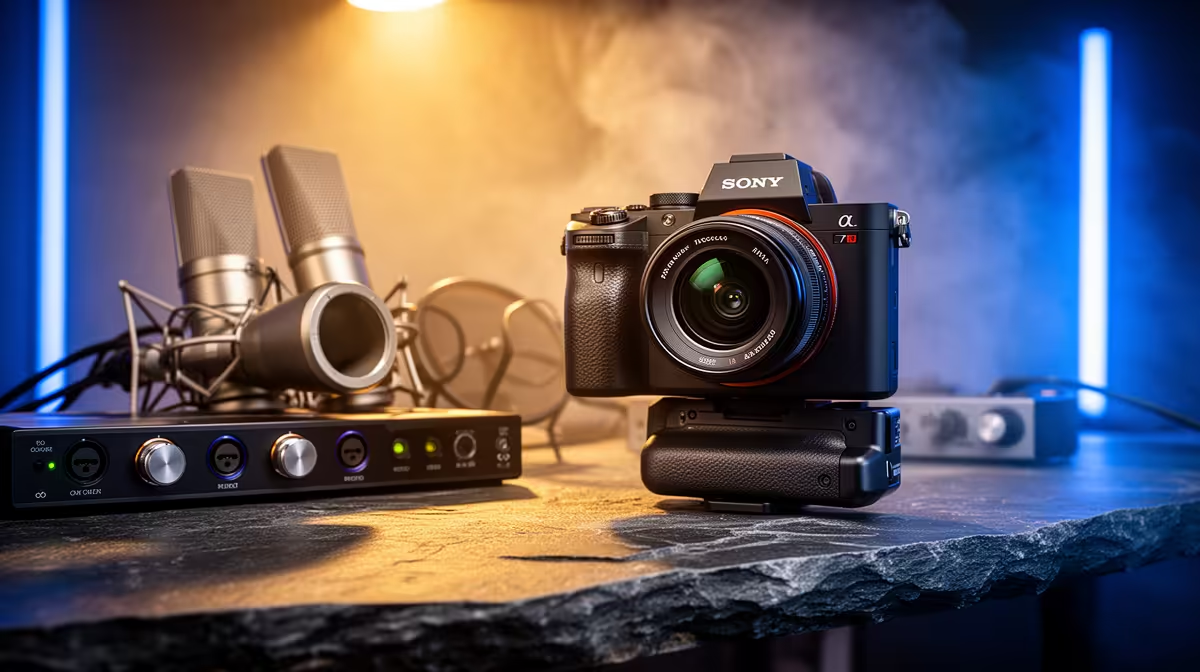
APS-C sensors are larger still and used in mirrorless cameras that double as podcast cameras through clean HDMI output. They perform well in dim podcast rooms with only a key light and ambient room fill, avoiding the need for heavy studio lighting to achieve a noise-free image. The trade-off is cost and size, but for a serious podcast setup expecting long recording hours, the image quality improvement across hours of footage is meaningful.
At ISO values above 800, the difference between a 1/2.3-inch sensor and a 1-inch sensor becomes clearly visible in the final export. If your podcast room uses a single R800 to R1,500 key light, sensor size is one of the most important specifications to check.
🔧 Autofocus for Multi-Host Recording
A podcast with two seated hosts is one of the more demanding autofocus scenarios for a single camera. Both subjects are in frame simultaneously, they may lean toward each other or toward the camera at different moments, and the session can run for 60 to 120 minutes without interruption for camera adjustments.
Basic contrast-detect autofocus was designed for single-subject photography and will hunt between subjects when two faces share the frame at similar distances. Phase-detect autofocus with face tracking is the standard worth looking for in podcast camera specs. This system identifies facial geometry independently of contrast and maintains separation between multiple detected faces, allowing the system to keep both hosts in acceptable focus even as they move.
Check whether the face-tracking system supports multiple simultaneous subjects, as some implementations track only a single primary face and switch unpredictably when that face is obscured. Cameras that maintain a focus zone covering a full-width seated position at 1.5 to 2 metres are the practical benchmark for a two-host podcast table.
🔌 Output, Connectivity, and Integration with Your Recording Chain
The camera's output path determines whether it integrates cleanly without additional software overhead.
Clean HDMI output means the camera sends its full video signal without on-screen overlays stamped into the image. A capture card connected to that feed gives your recording software the purest quality source. Confirm the spec sheet describes the HDMI as clean or overlay-free, since many consumer cameras default to displaying their settings in the signal.
UVC-compliant USB output lets the camera appear as a standard video device on any Windows machine without driver installation, recognised immediately by OBS, Zoom, and similar software. For a lean setup running on a single laptop, USB removes the need for a capture card while delivering solid 1080p quality.
Pro Tip ⚡
Before a long podcast record, white-balance the camera manually rather than leaving it on auto. South African indoor lighting, especially mixed incandescent and LED sources, can cause auto white-balance to shift between a warm orange and a cool blue during a 90-minute episode as the camera re-evaluates the scene. A locked manual setting stays consistent from first minute to last.
Frequently Asked Questions
What frame rate should a podcast camera record at?
30fps is the standard for podcast video and the right choice for most SA production setups. It is standard for web delivery, accepted natively by all podcast clip platforms, and produces manageable file sizes for long-form recording. 60fps doubles the file size with minimal perceptible benefit for seated talking-head content where smooth slow-motion is not needed. Shoot at 25fps if your lighting uses PAL-frequency dimmer-controlled LEDs to avoid flicker in the image.
Does lens focal length matter for a podcast camera?
Yes, significantly for the two-host scenario. A lens with a field of view equivalent to roughly 24mm to 35mm on a full-frame sensor frames a 1.5 to 2 metre wide table cleanly at a comfortable camera distance. Longer focal lengths require the camera to sit further back, which may not suit the room. Wider lenses below 18mm introduce visible distortion at the edges of the frame that makes faces appear stretched on the sides of a wide two-shot.
Is a mirrorless camera better than a dedicated streaming camera for podcasting?
A mirrorless with clean HDMI out offers the best sensors and low-light performance at a given price, but needs a capture card and careful configuration to handle long recording sessions without time limits. A dedicated streaming camera is simpler to deploy and often includes preset integration. The right choice depends on how much setup complexity the team is willing to absorb.
How should two hosts be positioned relative to a single camera?
Seat both hosts facing the camera at equal distances, ideally between 1.2 and 2 metres away depending on the lens field of view. Position them at a slight angle toward each other rather than facing straight forward, which creates a natural conversational composition and reduces the flat, interview-row appearance that straight-on seating produces. Ensure both faces receive roughly equal light from the key source.
What is the most common mistake when specing a podcast camera?
Over-investing in lens aperture at the expense of sensor size. A fast f/1.4 lens on a small sensor produces a shallow depth of field that leaves one host soft while the other is sharp, which compounds as positions shift over a long episode. A mid-aperture lens, around f/2 to f/2.8, on a larger sensor keeps both subjects within the depth of field while still separating them from the background.
Ready to spec the right camera for your SA podcast studio?
Browse the range of streaming and recording cameras built for South African creators and find the resolution, sensor, and output combination that keeps both hosts looking sharp every episode.