Quick Answer
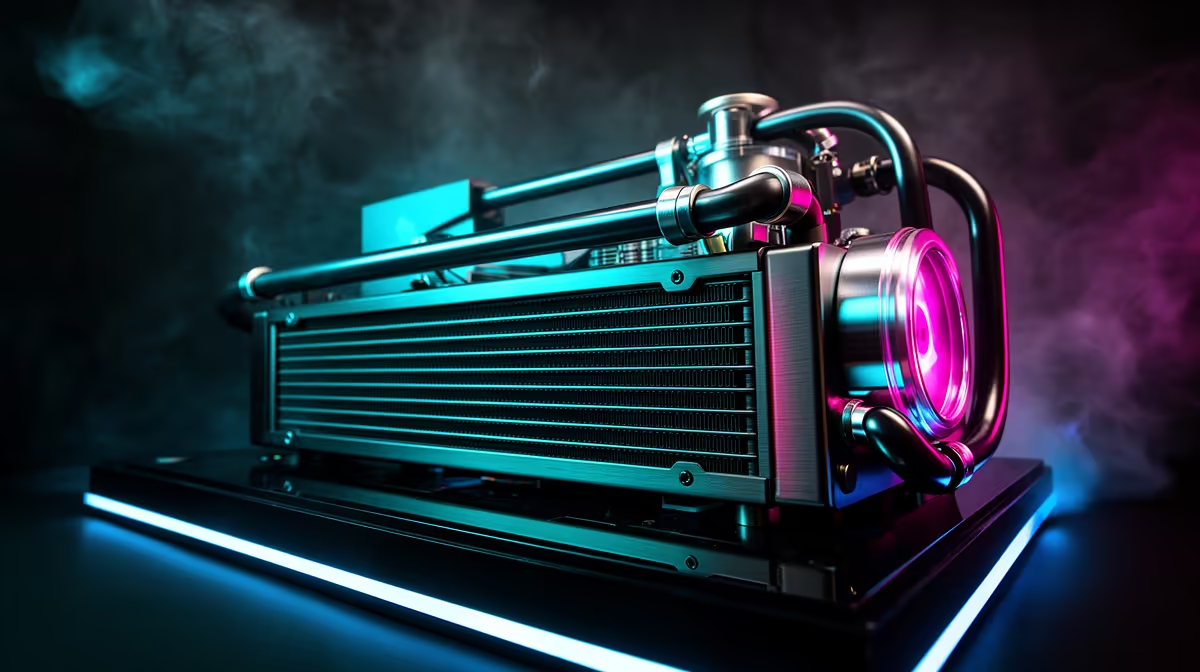
Yes, 420 mm radiator support meaningfully improves cooling in an overclocked gaming PC. The larger surface area allows the same heat rejection at lower fan speeds, which typically translates to a 5 degrees Celsius to 12 degrees Celsius drop in CPU temperatures compared to a 360 mm AIO under identical overclocking conditions.
Why Radiator Area Drives Cooling Performance 🌡️
A 420 mm radiator provides 420 x 140 mm of surface area, which is roughly 40 percent more than a 360 mm (360 x 120 mm) unit. Heat rejection in a liquid cooling loop depends on the temperature differential between coolant and ambient air, and on the total radiator surface area exposed to airflow. A larger area means each unit of surface needs to be only slightly warmer than ambient to reject the same wattage, so coolant temperatures stay lower. For an overclocked Ryzen 9 9950X running at 300 watts TDP, a 420 mm radiator holds coolant temperatures at 38 degrees Celsius to 42 degrees Celsius above ambient at low fan speeds, while a 360 mm unit at the same fan RPM reaches 45 degrees Celsius to 52 degrees Celsius above ambient.
Case Compatibility and the SA Market Reality 🔧
Not every PC case supports a 420 mm radiator. This form factor requires three 140 mm fan positions in a single radiator mount location, which constrains you to purpose-built full-towers or a small number of XL mid-towers. In the South African market, cases with verified 420 mm support are available in the R3,500 to R7,000 price range. The most important compatibility check is the VRM clearance: an EATX or large ATX motherboard with tall VRM heatsinks can physically block the top radiator mount that most 420 mm cases rely on. Confirm clearance between the top of your chosen motherboard and the radiator mount before purchase.
Noise Reduction: The Real Benefit for SA Builders 🎮
Beyond raw temperature numbers, the practical value of a 420 mm radiator for most SA builders is noise reduction. Three 140 mm fans at 800 RPM generate around 25 dBA to 28 dBA, which is effectively inaudible during gaming. By contrast, the 1,600 RPM to 1,800 RPM that a 360 mm AIO demands under an overclocked CPU load produces 38 dBA to 42 dBA, clearly audible over headset ambient audio. For builders in shared accommodation or a home office, this acoustic difference is often the primary motivation to invest in 420 mm support rather than a purely performance-driven upgrade.
Pre-Purchase Clearance Checklist ⚡
three dimensions before ordering a 420 mm AIO: (1) the distance from the top fan mounting holes to your motherboard's VRM heatsink top edge (needs at least 35 mm), (2) the front panel depth available for front-mounting (needs 55 mm to 65 mm), and (3) the GPU clearance remaining after a front-mounted radiator is installed (needs at least 320 mm). Confirming all three prevents an expensive return.
FAQ
Is a 420 mm AIO significantly more expensive than a 360 mm unit?
Locally, 420 mm AIOs typically cost R500 to R1,500 more than equivalent 360 mm models from the same brand. The case upgrade to support 420 mm is often the larger additional spend, ranging from R1,000 to R3,000 depending on the chassis.
Can I use a 420 mm radiator for GPU liquid cooling as well?
In a custom loop configuration, yes. Routing both CPU and GPU through a single 420 mm radiator is viable for gaming workloads, though sustained GPU loads at full power (300 watts plus) may require a second radiator for thermal headroom.
Does a thicker radiator improve performance as much as a longer one?
Thicker radiators (45 mm versus 25 mm) provide 8 percent to 12 percent more capacity for the same footprint, while going from 360 mm to 420 mm length adds 16 percent to 20 percent. Length upgrade offers better return on the size increase for most overclocked gaming builds.
Want to push your overclock further without the noise?
Evetech stocks 420 mm-compatible cases and a full range of AIO liquid coolers suited to overclocked gaming and workstation builds.