Quick Answer
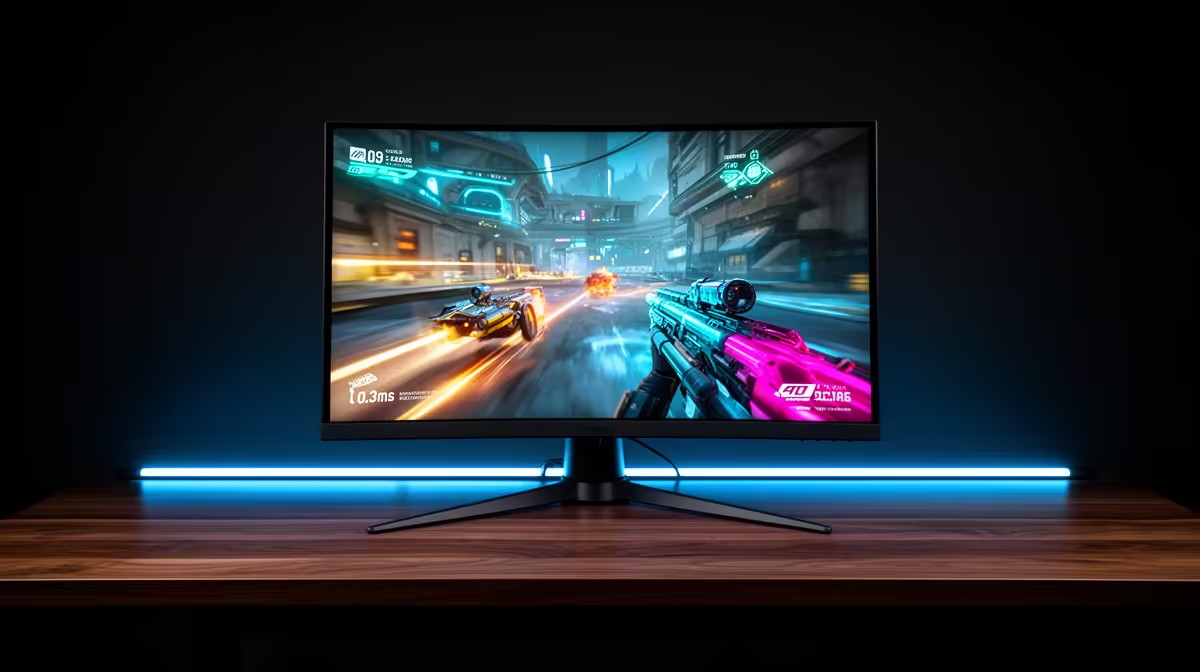
Yes. A 0.3ms Fast IPS panel completes pixel transitions before the next frame arrives at 160Hz, eliminating the trailing smear that slower panels leave behind fast-moving targets. The result is a sharper, more precisely defined target silhouette during fast mouse movement and high-speed in-game action.
The Physics of Pixel Response and Target Tracking 🔬
When you track an opponent moving rapidly across the screen in a competitive shooter, your monitor redraws their position every frame. On a 160Hz display each frame lasts 6.25ms. On a 6ms GTG standard IPS panel, the pixel is still mid-transition when the next frame demands a different value; the partially lit previous state bleeds into the current frame as a faint ghost trailing the object. On a 0.3ms GTG Fast IPS panel, the transition completes in 0.3ms, leaving 5.95ms of clean, stable pixel before the next frame instruction. That stability is what removes the ghost and sharpens the target edge. The improvement is most visible on targets that move across more than 20% of the screen width per second, which is common in CS2 and Valorant at competitive sensitivity settings.
Real-World Impact in Fast-Paced Games 🎮
In first-person shooters, a well-tracked moving target is easier to place a crosshair on and hold during continuous movement. A blurred target edge creates uncertainty around the opponent's true hitbox position, forcing micro-corrections during tracking that degrade accuracy. A 0.3ms Fast IPS panel narrows that uncertainty zone substantially. Combined with ELMB Sync (backlight strobing), the improvement is compounded: each frame presents a sharp snapshot of the game state, and the 0.3ms response ensures the pixel is in the correct state when the strobe fires. At 160Hz with ELMB active, target tracking clarity approaches what competitive players previously needed dedicated TN panels to achieve, while still delivering the accurate colour reproduction of IPS technology.
Limitations and When It Will Not Help ✅
A 0.3ms response time cannot compensate for low frame rates. If your GPU delivers only 60fps, each frame occupies 16.7ms and the eye's motion smoothing over that gap is the dominant blur source. The panel's pixel response is irrelevant at that frame rate. To benefit from Fast IPS response, you need 100fps or above, ideally 144fps or above. For SA gamers on mid-range GPUs around the RTX 5060 Ti running at FHD or 1440p, achieving 144fps in esports titles is realistic, and a Fast IPS monitor's response time advantage is then fully accessible.
Overdrive Level for Target Tracking ⚡
Set overdrive to the highest preset that does not introduce inverse ghosting (a bright halo ahead of fast objects). In most Fast IPS monitors this is the "Fast" preset rather than "Fastest." Run a pixel-response test online; the "Fastest" preset on some panels creates visible inverse ghosting that actually worsens target clarity at high frame rates.
FAQ
Does a 0.3ms monitor make you a better player?
It removes a hardware disadvantage but does not add mechanical skill. A 0.3ms Fast IPS panel ensures the monitor is not the bottleneck for motion clarity. Whether you improve depends on practice, sensitivity settings, and game knowledge.
How does 0.3ms Fast IPS compare to OLED for target tracking?
OLED panels achieve 0.03ms or below GTG, roughly 10 times faster than Fast IPS. In practice, both exceed the frame delivery rate at 160Hz, so neither leaves a trailing ghost during normal gameplay.
Is 0.3ms a marketing figure or a real measurement?
0.3ms GTG is a real measurement taken at an optimal overdrive voltage measuring a mid-grey-to-mid-grey transition. Real-world average response times across the full greyscale range are typically 1ms to 2ms on Fast IPS panels, still well below the frame duration at 144Hz or 160Hz.
Want a monitor that keeps fast targets sharp?
Evetech stocks 0.3ms Fast IPS gaming monitors with ELMB Sync and adaptive sync, available locally with South African warranty coverage.