Quick Answer
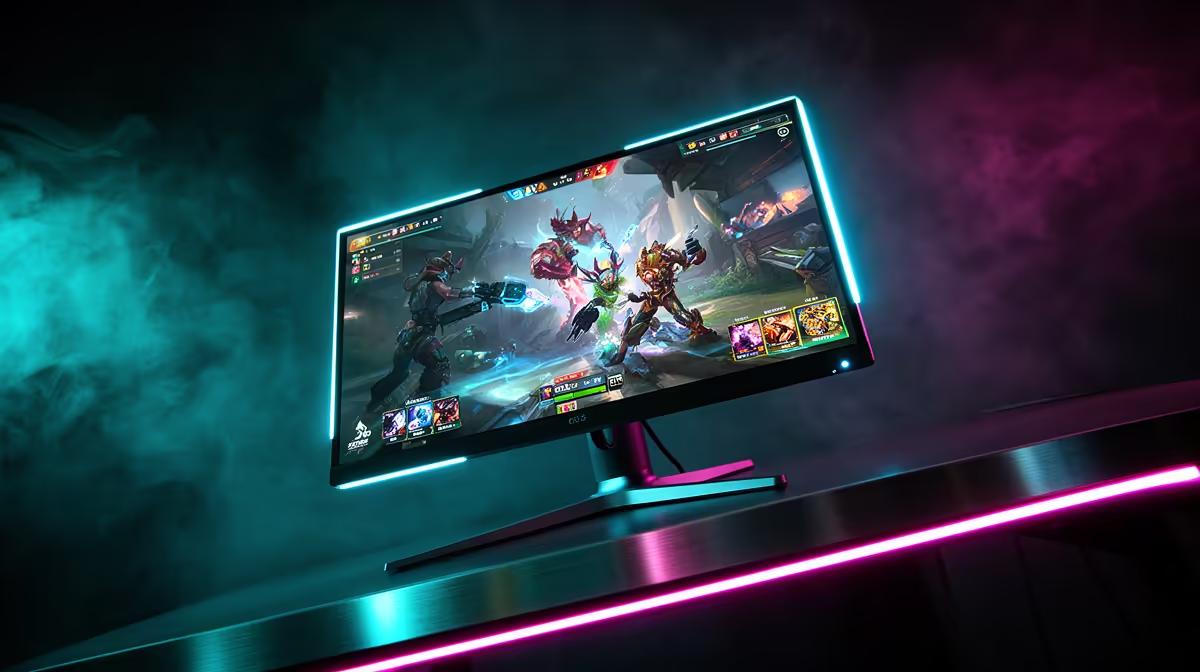
Yes, a 2560x1440 IPS monitor can run smoothly at 300Hz for FPS games. Modern fast IPS panels rated at 300Hz use 0.5ms to 1ms GTG response times that keep ghosting imperceptible during rapid aim movements, making them genuine competitors to TN panels for competitive play.
How Fast IPS Handles 300Hz Without Ghosting 🖥️
The concern that IPS panels cannot keep up at very high refresh rates applied to older display generations with 4ms to 8ms GTG response times. Current fast IPS technology, found in panels from AU Optronics and LG Display that power monitors across multiple brands, achieves 0.5ms GTG by applying pixel overdrive aggressively.
At 300Hz, each frame is displayed for just 3.3 milliseconds. An IPS panel rated at 0.5ms GTG transitions well within that window, meaning the frame it displays is accurate and blur-free. The practical experience in Valorant or CS2 is that crosshair movement tracks cleanly with no smearing, which was not achievable on IPS at 144Hz five years ago.
What Your GPU Needs to Deliver at This Resolution 🎮
Smooth 300Hz gameplay at 1440p depends on your GPU sustaining frame rates close to or above 300 fps in your target title. In Valorant at 1440p on medium settings, an RTX 5070 or RX 9070 will exceed 300 fps consistently. In CS2 at 1440p on competitive settings, an RTX 5080 hits 250 to 300 fps.
For South African builders, the sweet spot is pairing a QHD 300Hz IPS monitor (R7,000 to R12,000) with a current RTX 5070 Ti or RX 9070 XT, with the GPU ranging from R18,000 to R28,000. This combination covers both high-framerate esports titles and graphically demanding games at playable quality settings.
Overdrive Settings and Getting the Best Out of Your Panel 🔧
Most 300Hz IPS panels ship with overdrive pre-configured at a moderate level. In the on-screen display, you will typically find three to five overdrive settings. The default medium setting is usually the correct choice for 300Hz operation.
Test your overdrive setting by opening a motion blur UFO test at your monitor's native refresh rate. At the correct overdrive level, the test UFO should appear crisp with no trailing shadow and no bright leading edge. Spend five minutes on this calibration when the monitor is new and you will not need to revisit it.
Enable VRR Even at High Frame Rates ⚡
Keep G-Sync or FreeSync enabled even when your GPU regularly exceeds 200 fps. VRR does not add latency at high frame rates on modern panels, and it handles the occasional frame time spike that drops output momentarily below 300 fps far more smoothly than a fixed sync or uncapped output would.
FAQ
Does 2560x1440 reduce frame rates significantly compared to 1080p?
Yes, QHD increases the GPU workload by roughly 78 percent compared to 1080p. In practice, an RTX 5070 that achieves 400 fps in Valorant at 1080p will achieve around 280 to 320 fps at 1440p on similar settings, which is still well within the useful range of a 300Hz panel.
Is a QHD 300Hz IPS better than a 1080p 360Hz TN panel for FPS games?
For most players, yes. The image quality improvement from QHD over 1080p on a 27-inch screen is significant and aids target identification at range. TN panels still have a slight advantage in absolute response time, but the gap has narrowed enough that IPS is the more complete choice for the majority of FPS players.
How does South African climate affect monitor longevity?
SA's heat does not specifically harm IPS panels more than other display technologies, but dust ingress from open windows in summer can accumulate on bezels and ventilation slots. Keeping the monitor away from direct airflow from fans and cleaning the bezel monthly with a dry cloth is sufficient maintenance.
Looking for a fast IPS 1440p panel for competitive play?
Evetech stocks QHD 300Hz monitors with VRR support from brands with local warranty backing. Head to the monitors section to find a model that fits your GPU and budget.