Quick Answer
Yes, modern compact mATX cases can handle both 360mm liquid cooling and high-end graphics cards, but only when you verify GPU length clearance WITH the radiator installed, not just the empty-case spec. Cases like the DeepCool CH370 and Fractal Design Pop Mini confirm this combination for GPUs up to 340mm paired with front-mounted 360mm AIOs.
How Top Compact mATX Cases Make It Work 🔧
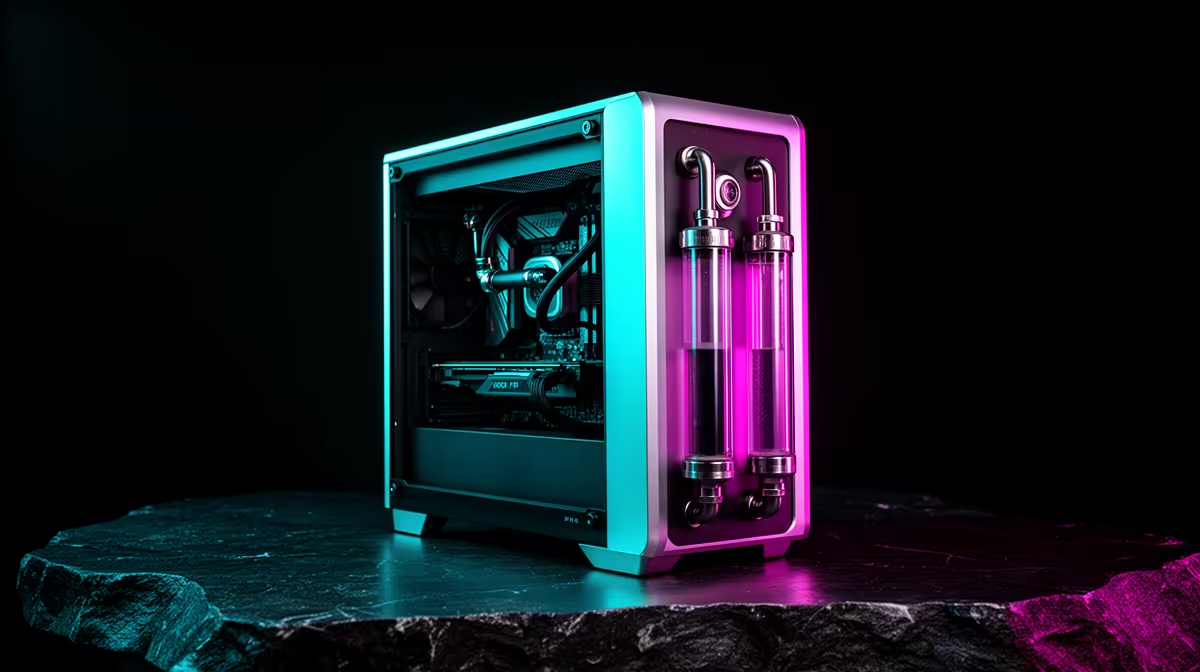
The engineering challenge in combining liquid cooling and a high-end GPU in an mATX chassis is space sequencing. A front-mounted 360mm radiator sits between the front panel and the GPU, consuming 60mm to 75mm of depth (30mm radiator, 25mm fans, 15mm bracket clearance). A case with an internal depth of 390mm and a 360mm front radiator mount leaves 315mm to 330mm of usable GPU clearance. This is sufficient for the RTX 5070 Ti at 320mm and the RX 9070 XT at around 310mm, but tight for triple-fan flagship variants exceeding 340mm. A top-mounted 360mm radiator avoids this trade-off entirely by removing the vertical dimension from the GPU clearance equation, though it requires RAM clearance of 35mm or less.
PSU, Cabling, and Thermal Density Management 💡
Packing a 360mm AIO plus an RTX 5070 Ti or better into an mATX case raises total system thermal output to 350W to 500W. This heat must leave the chassis through a relatively small exhaust area. Use an 850W to 1,000W fully modular PSU to minimise cable clutter in a space-constrained chamber. A single rear 120mm exhaust fan should pull directly behind the CPU cold plate or AIO pump. Configure intake fans at 1,200 RPM and exhaust at 1,000 RPM for mild positive pressure that keeps dust out of unfiltered case gaps. Budget around R15,000 to R25,000 for the complete mATX gaming system at this tier, with the case itself typically representing R1,500 to R2,200 of that total.
Component Selection for the Best Compact AIO Build 🎯
Choosing the right components makes this combination achievable. Select a GPU in Founders Edition or reference-style format where length is 336mm or less. Choose an mATX board where VRM heatsinks sit below 40mm from the PCB surface to clear a top-mounted radiator. Use DDR5 low-profile kits specifically marketed for AIO compatibility; Corsair Vengeance LPX DDR5 and G.Skill Flare X5 kits both sit under 34mm tall. These targeted choices eliminate the fitment conflicts that frustrate compact AIO builds without compromising any performance metric.
Confirm Both Specs Before You Order ⚡
Check the case spec for GPU clearance WITH front radiator installed, not just the empty-case figure. Then check the GPU manufacturer's exact length including connector overhang. Miscounting by even 20mm means a side panel that will not close. These two numbers must be confirmed before checkout, not after delivery.
FAQ
Can I run a 280mm AIO instead of a 360mm in a compact mATX case to save clearance?
Yes, a 280mm radiator is 140mm wide versus 120mm for a 360mm unit, which actually saves front-to-back depth since it uses only two fans in parallel rather than three in series. A 280mm AIO frees an extra 25mm to 40mm of GPU clearance, making it a strong alternative for cases where a 360mm setup is borderline.
Will an mATX build with liquid cooling and a high-end GPU run louder than a full ATX build?
Potentially yes, because the smaller chassis gives warm air less volume to dissipate passively, forcing fans to work harder. However, a well-tuned fan curve and a proper positive pressure setup can keep noise below 35dBA during standard gaming, which is indistinguishable from most ATX builds.
What is the minimum case interior depth needed for this combination?
Target a case with at least 380mm interior depth for a front-360mm-radiator plus 310mm GPU combination. Any shallower and you risk inadequate clearance between radiator fans and GPU intake vents, which creates thermal recirculation.
Planning a liquid-cooled compact build around a high-end GPU?
Browse Evetech's mATX cases with confirmed radiator and GPU clearance specs to find the right chassis before you commit to components.