Quick Answer
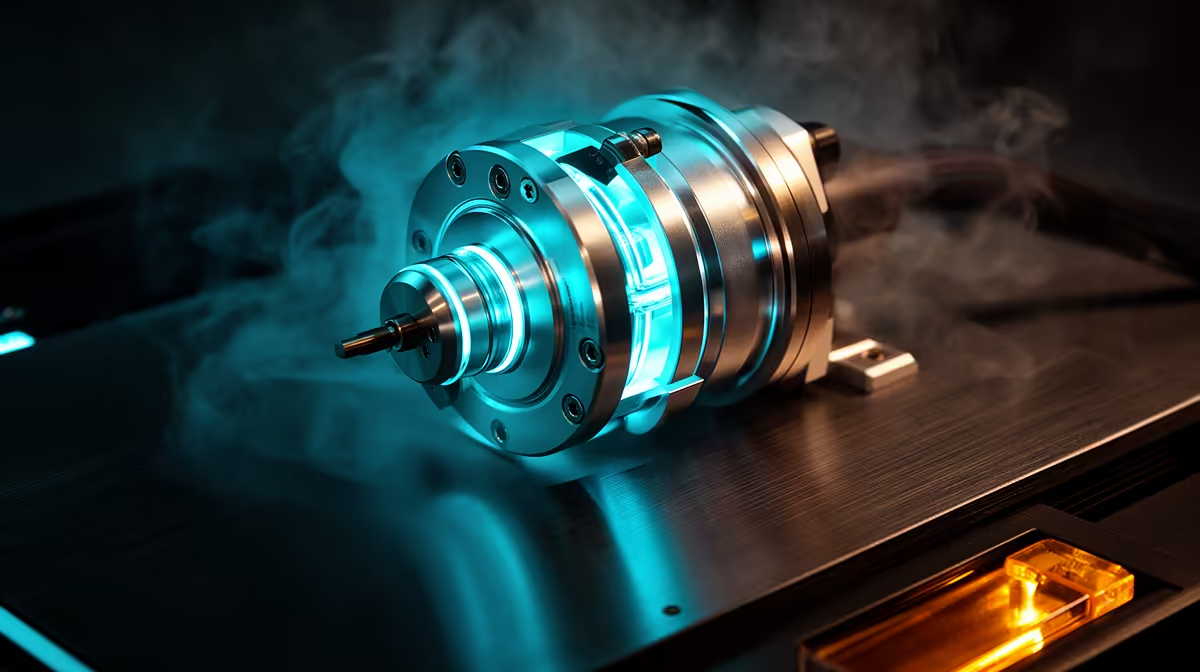
Yes, a high-performance pump improves CPU temperatures under heavy loads by increasing coolant flow rate through the loop, which reduces the temperature delta between the cold plate and the returning coolant. The improvement is most significant when the CPU is sustained above 150W, where coolant dwell time at the cold plate becomes the limiting factor in heat removal.
How Pump Flow Rate Affects Thermal Performance 🔬
An AIO's cooling loop works by circulating coolant between the cold plate and radiator.
When Pump Improvement Matters Most 💡
For gaming workloads where the CPU load fluctuates between 30% and 80% across frames, the pump performance difference between a budget and a premium unit is minimal (1 to 3 degrees Celsius). The flow rate benefit is most pronounced during sustained 100% multi-thread workloads: rendering, compilation, machine learning inference, or simultaneous gaming plus software encoding. If your use case includes any of these workloads regularly, a cooler with a proven high-flow pump platform is a worthwhile specification to check before purchasing. ASETEK's published Gen 8 flow rate specs and third-party teardown reviews are reliable sources for comparing pump performance across brands.
Pump Speed Control and Longevity Trade-offs 🔧
Running a pump at maximum speed continuously (3,600 RPM or higher) increases acoustic output and accelerates pump bearing wear slightly over multi-year use. Most AIO manufacturers recommend a "performance" pump preset (around 2,600 to 3,000 RPM) rather than the maximum setting for everyday use, reserving maximum pump speed for extreme workloads only. The pump is the most mechanically complex component in a sealed AIO, and controlling its operating range intelligently extends service life while maintaining the flow rate needed for effective cooling. A quality pump on a premium AIO should last five or more years even at performance preset speed.
Pump Speed Verification ⚡
After installation, confirm your pump is running in the correct mode by checking RPM readout in your AIO software or HWiNFO64. A pump showing 0 RPM or under 1,000 RPM during operation indicates either a wiring issue (3-pin tach header disconnected) or a software fault. A correctly connected pump running in standard mode should report 2,000 to 3,600 RPM depending on the preset selected.
FAQ
Is pump speed the most important factor in AIO cooling performance?
No. Radiator size and fan static pressure have a larger impact on sustained thermal performance than pump speed alone. Pump improvements provide the most benefit when the radiator is already operating efficiently; upgrading the pump alone in a system with inadequate radiator fans will not produce dramatic temperature reductions.
Can I increase pump speed beyond the manufacturer's maximum setting?
Most AIOs do not allow pump speed to be set above the factory maximum through official software. Third-party overclocking of pump voltage is not recommended as it risks pump failure and voids warranty.
Does pump noise increase significantly at higher speeds?
A pump transitioning from 2,000 to 3,600 RPM produces a noticeable increase in a mid-frequency whirring sound, though this is usually masked by fan noise at equivalent operating conditions. Most users run pump speed at the performance preset rather than maximum to balance acoustic output.
Need an AIO with a high-performance pump for your heavy-load build?
Evetech stocks premium AIOs with verified pump specifications so you can match flow rate and thermal capacity to your CPU's sustained power draw.