Quick Answer
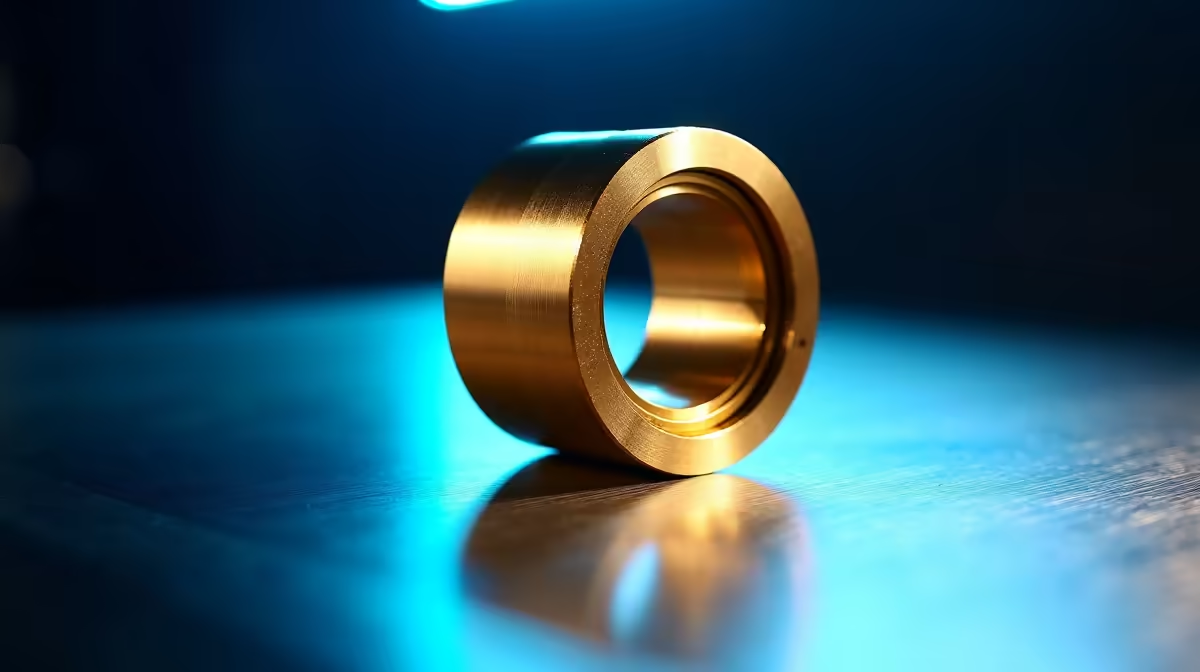
Yes. A CNC-milled brass bearing housing improves long-term fan reliability by providing tighter dimensional tolerances for the bearing bore, better wear resistance than injected aluminium or plastic, and superior heat dissipation from the bearing assembly, extending operational lifespan and reducing noise growth over time.
Why Housing Precision Determines Fan Longevity 🔧
The bearing housing determines how accurately the spindle is constrained during rotation. Even a 20-micron variation in bore diameter changes the oil film thickness in a fluid dynamic bearing, affecting load-carrying capacity and noise. Injection-moulded aluminium or die-cast zinc housings have dimensional tolerances of 50 to 100 microns. CNC-milled brass achieves tolerances of 5 to 10 microns, enabling tighter spindle-to-housing clearances that keep oil film pressure consistent across the full RPM range. This precision is why top-tier 120mm fans command prices of R400 to R550: the machining cost for a brass housing significantly exceeds the cost of a die-cast equivalent.
Brass Versus Alternatives: Material Properties 🖥️
Brass has three properties that favour bearing housing applications. First, a hardness of 60 to 90 on the Vickers scale, significantly harder than aluminium alloys at 30 to 60 HV, meaning the bore resists wear during startup and shutdown when oil film pressure is not yet fully established. Second, brass has a thermal conductivity of approximately 120 W/(m.K), roughly four times that of engineering-grade plastic, drawing heat from the motor coils into the wider fan frame. Third, brass does not oxidise at the temperatures and humidity levels present inside a PC case. In the dusty, humid conditions of South African coastal or inland homes, material stability is a tangible reliability advantage.
Real-World Impact on Noise and Longevity 💡
Fans with precision housings maintain their as-new noise rating within 1 to 2 dBA over 30,000 hours of operation, while fans with looser-tolerance housings exhibit 3 to 6 dBA of noise growth in the same period as bearing play increases. For a gaming PC used four to six hours daily, 30,000 hours represents roughly 14 to 20 years, suggesting a precision-housing fan could outlast two or three PC generations. For South African builders who value long upgrade cycles and want to reuse quality components across builds, this is a genuine long-term cost saving.
Ask for Housing Material in Spec Sheets ⚡
Few fan retailers feature bearing housing material in their primary listing. Search for "CNC", "brass housing", or "precision-machined" in the detailed specifications. If housing material is not listed, it is almost certainly die-cast or injection-moulded, which is fine for budget fans but not the precision tier.
FAQ
Does brass housing add noticeable weight to a 120mm fan?
A brass bearing housing typically adds 5 to 15 grams, bringing a standard 120mm fan from 120 grams to 130 to 135 grams. This is negligible for mounting and does not affect vibration balance.
Are CNC-machined brass housing fans available locally in SA?
Yes, premium cooling brand fans with precision housings are stocked at Evetech in the R380 to R550 per unit range, typically sold individually or in matched kits for radiator use.
Does a better housing alone justify a R200 premium over a standard FDB fan?
For a build expected to last seven or more years or to be reused across multiple platform upgrades, yes. For a build replaced within three years, the precision housing premium is harder to justify purely on longevity grounds, though the acoustic stability benefit remains.
Investing in fans built to last?
Evetech carries a selection of premium 120mm and 140mm fans with precision-machined components and fluid dynamic bearings. Browse the cooling section for long-lifespan options.