Quick Answer
Yes, separating your CPU and GPU into independent thermal zones genuinely lowers temperatures because hot air from one component no longer pre-heats the other. Builds using segregated chambers typically see GPU temps drop 5 to 10 degrees Celsius under sustained load.
How Cooling Zone Separation Works 🔧
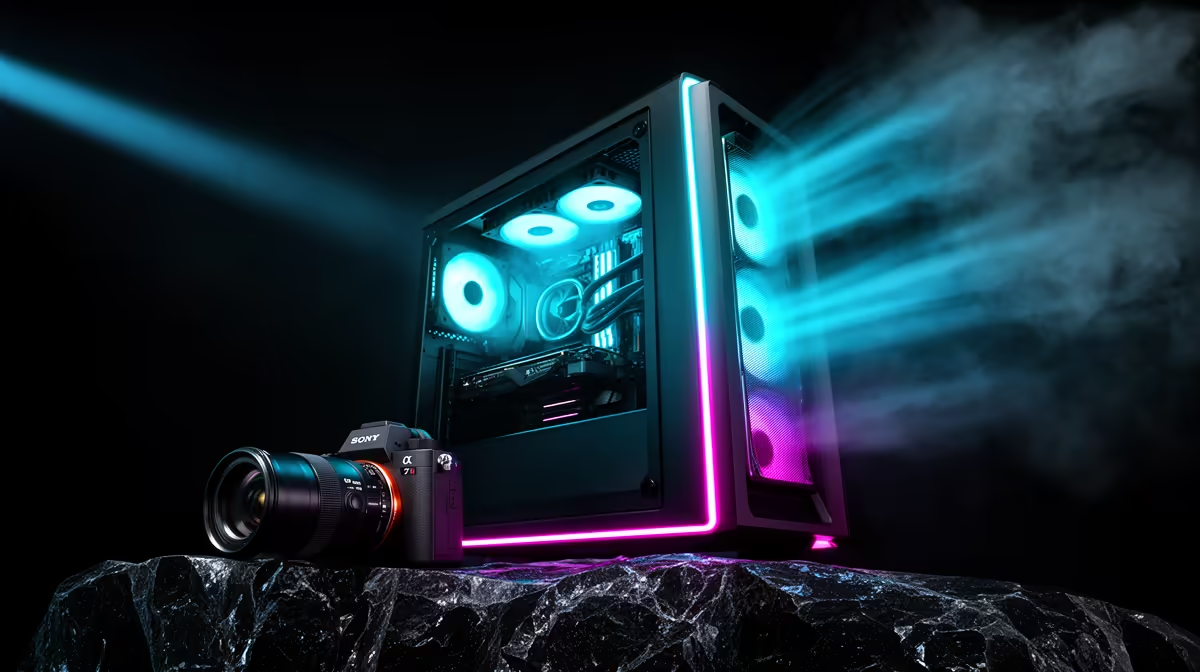
A traditional open-interior case treats the entire chassis as one shared airspace. Cool air enters the front, absorbs heat from the GPU, then continues toward the CPU. By the time it reaches the CPU, that air is already warm. Cases with independent zones install a dividing partition, routing dedicated fresh intake air to each component simultaneously. The GPU gets its own exhaust path while the CPU zone vents through the rear and top. This is especially effective with modern GPUs like the RTX 5090, which can dump over 575W into a conventional shared layout.
Real-World Temperature Gains 🌡️
Tests pairing a Core i9-14900K with an RTX 4090 showed moving from a single-zone Midi tower to a dual-zone full-tower dropped sustained GPU junction temps from 89 to around 79 degrees at the same fan curve. CPU package temps fell from 95 to 86 degrees under Prime95 combined load. For South African builders running longer gaming sessions in warmer climates, that margin translates directly into fewer thermal throttle events and more consistent frame rates.
Balancing Fan Configuration and Noise 🎮
The downside of zoned cooling is fan count. Each zone needs at least two fans to maintain positive pressure, so a dual-zone full-tower can require six to eight fans total. The better approach is fewer, larger fans per zone, specifically 140mm or 200mm units. A pair of 200mm front intakes feeding the GPU zone at 800 RPM is quieter than four 120mm fans at 1,200 RPM while pushing comparable volume. Match fan curves to component load in your BIOS so the CPU zone only spins up during rendering tasks.
Zone Pressure Setup ⚡
Keep both cooling zones at slight positive pressure by running one more intake fan than exhaust per zone. This prevents warm air being drawn in through unfiltered gaps, especially useful in dusty SA environments where filter maintenance might happen monthly rather than weekly.
FAQ
Do I need a special case to get independent cooling zones?
Yes. Standard ATX and Micro-ATX cases have a unified interior. Full-tower cases that specifically market dual-chamber or zoned-airflow designs include the physical partition needed. Check case specifications for terms like dual-chamber or compartmentalised airflow before buying.
Will a 420mm AIO fit in the GPU cooling zone?
Typically no. The GPU zone in a dual-chamber design is sized for component clearance, not radiator mounting. The 420mm AIO almost always mounts in the CPU zone at the top or front of the main chamber.
Is zoned cooling worth the extra case cost?
For builds in the R15,000 to R25,000 GPU range, yes. The premium for a dual-zone full-tower is typically R1,500 to R3,500 over a comparable single-zone case, which pays back quickly in sustained clock speed gains.
Ready to build with proper thermal separation?
Evetech stocks a range of full-tower PC cases with advanced airflow designs suited for high-end gaming and workstation builds. Browse the case category to find the right chassis for your setup.