Quick Answer
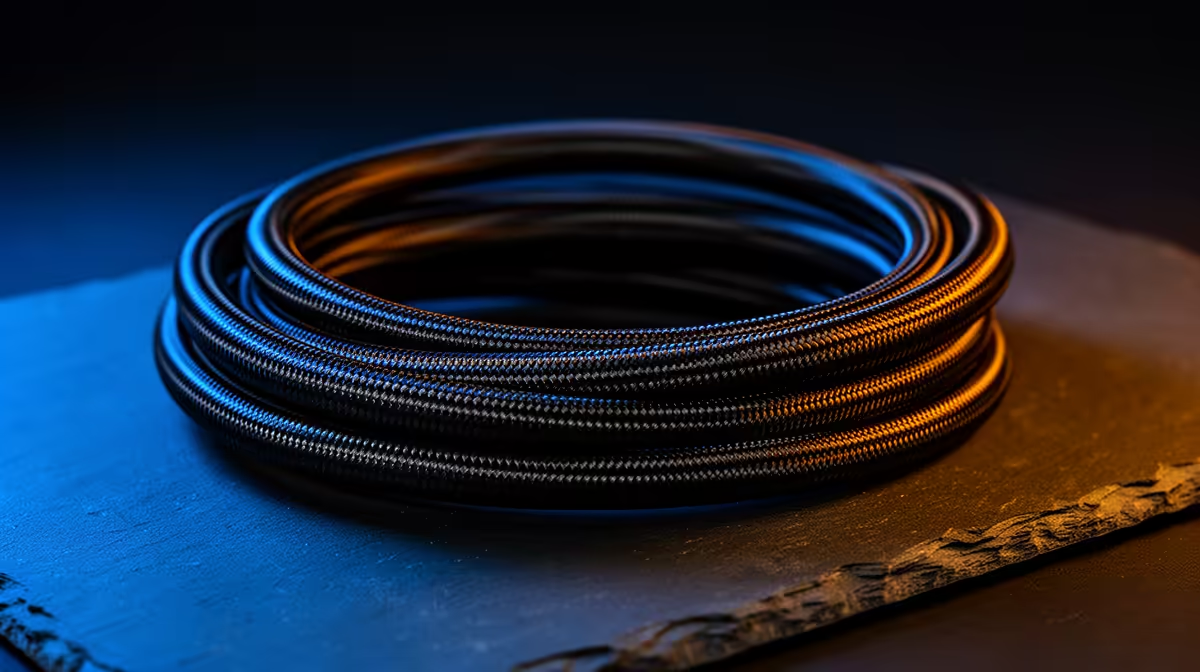
Yes, reinforced 400mm sleeved tubing meaningfully improves AIO fitment in larger full-tower cases by providing enough slack to route the radiator to the top or front without stressing the pump head or kinking the tubing. Standard 380mm to 400mm tubes are the sweet spot for most extended ATX and full-tower builds.
Why Tubing Length Matters for Large Cases 🔧
Most mid-tower cases are designed around 350mm to 380mm tube lengths, which works perfectly when the radiator mounts at the top of the case directly above a socket-mounted CPU. Full-tower cases like the Lian Li O11 Dynamic XL, Fractal Design Torrent XL, or be quiet! Silent Base 802 have motherboard trays positioned lower, increasing the distance from CPU socket to top radiator mount significantly. Tubes shorter than 380mm in these cases force a tight bend radius that either strains the pump head connection point or requires an awkward routing path that crosses cable runs and restricts airflow. A 400mm sleeved tube provides 20 to 50mm of extra slack, allowing natural curves rather than sharp bends.
What Sleeving Adds Beyond Length 🖥️
The sleeved exterior on AIO tubing serves two functions beyond aesthetics. First, it provides kink resistance: bare rubber tubing can collapse at tight bend angles above 90 degrees, restricting coolant flow and reducing pump efficiency. Reinforced sleeving maintains a minimum bend radius and prevents collapse entirely. Second, braided or paracord sleeving reduces long-term UV degradation, which matters in builds near natural light sources or under intense ARGB. Some premium AIOs available locally include pre-sleeved tubes as standard rather than as an upgrade.
Fitment Checklist for SA Full-Tower Builds 🎮
Before purchasing an AIO for a full-tower, confirm three measurements: the distance from your motherboard's CPU socket centre to the intended radiator mount position, the maximum radiator length the case supports (usually 360mm, sometimes 420mm), and any obstruction from RAM slots with tall heatspreaders near the CPU socket. In South African full-tower builds in the R50,000 to R80,000 range, cases are often chosen for cable management space and drive bays, not specifically for AIO compatibility. Checking those three figures takes five minutes and eliminates the most common fitment failure. Also verify that your case's top mount fan positions are spaced at 120mm intervals to accept a standard 360mm radiator.
Route Tubes Away From GPU Backplate Heat ⚡
In full-tower builds with a vertical GPU mount, AIO tubing often passes near the GPU backplate which runs warm under load. Position tubing at least 20mm from the GPU backplate surface to avoid heat soak into the coolant loop, which raises CPU temperatures by 3 to 7 degrees in sustained workloads.
FAQ
Can I extend AIO tubing myself if the stock length is too short?
Extending sealed AIO tubing voids the warranty and introduces leak risk at the splice point, so it is strongly discouraged for closed-loop units. If your case requires longer tubing, choose an AIO that ships with the correct tube length rather than modifying a sealed loop.
Does longer tubing reduce cooling efficiency?
Not significantly. Coolant volume increases slightly with longer tubes, but the temperature delta between CPU and coolant is determined primarily by pump flow rate and radiator surface area, not tube length. The performance difference between 350mm and 400mm tubes is negligible in real-world use.
Are 400mm tube AIOs widely available locally in South Africa?
Some models specify tube length in their product data, particularly units from Corsair (iCUE H115i and H150i lines), ASUS ROG Ryujin series, and Lian Li Galahad. Check the product spec sheet or ask Evetech's team to confirm tube length before ordering if your case is a full-tower with a deep motherboard tray.
Building in a full-tower and need the right AIO reach?
Check Evetech's AIO cooler range and filter by radiator size to find units with the tubing length your large case demands.