Road vibration is a constant on South African roads, and a phone mount that flexes with every ripple in the tar is more than annoying: it makes navigation unreadable and can loosen the clamp grip over time. Car phone mount stability at its core is a materials problem, and the gap between a metal-reinforced build and an all-plastic one becomes obvious within a few months of daily use.
Quick Answer
Metal-core arms and reinforced joint hardware reduce flex and dampen vibration better than equivalent all-plastic structures, because metal has a higher stiffness-to-weight ratio and resists elastic deformation under repeated load. A steel or zinc-alloy arm at R200 to R400 will hold steadier through a potholed stretch than a similar-looking polypropylene arm at half the price.
🔧 Why Metal Reinforcement Changes the Vibration Equation
Polypropylene and ABS plastics are flexible by nature. Under repeated small loads, like the constant micro-vibration from a car engine and uneven road surfaces, plastic arms develop play at their joints. This is not immediate failure; it is gradual loosening that compounds over weeks. Metal-core designs address this in two ways. First, the arm itself deflects far less under the same vibration load, so less movement reaches the device. Second, zinc-alloy or steel joints resist wear at pivot and lock points, meaning the tightness you set on day one is closer to what you get six months later. Some mounts use a metal spine inside a plastic overmould, which combines the rigidity of metal with a finished surface that will not scratch dash panels. These hybrid builds are often the best value in the R250 to R400 range.
🏗 Multi-Material Builds: The Best of Both
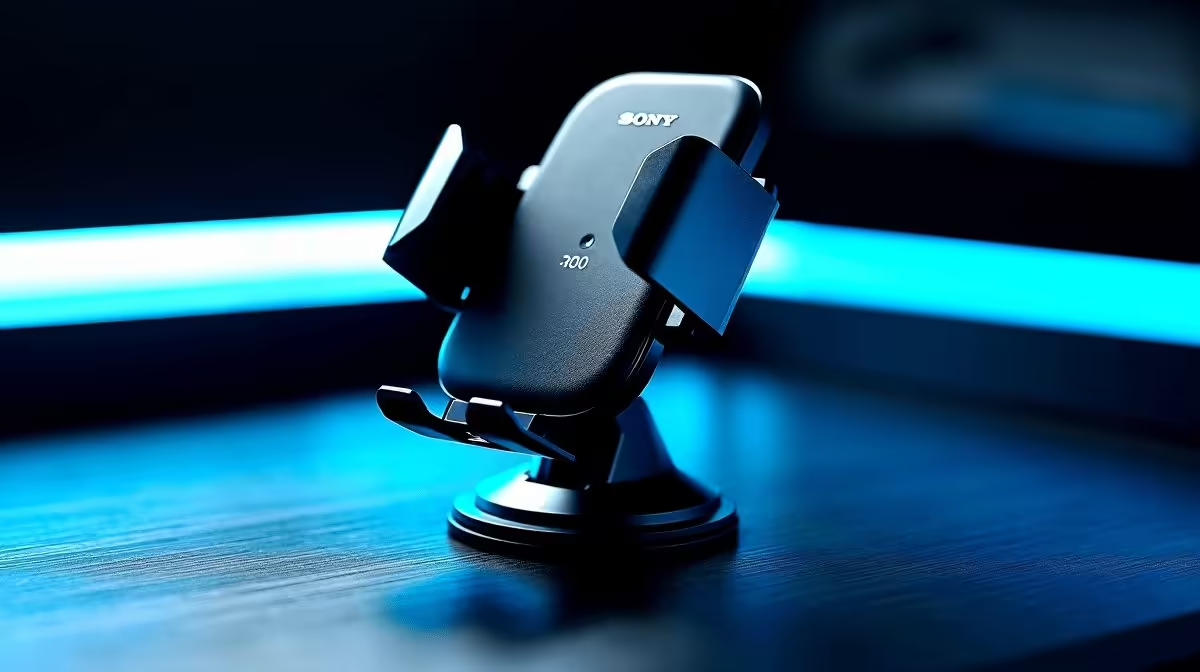
High-performing mounts combine materials strategically rather than using a single substance throughout. A typical well-engineered design uses a zinc-alloy or steel arm core for rigidity, a polycarbonate or ABS housing for the grip head to save weight, rubberised or silicone pads at the device contact points to absorb micro-vibration before it reaches the phone screen, and a metal locking screw or lever at the ball joint to prevent drift. Each material does a specific job. The rubber pads at the grip points are particularly underrated: they act as vibration isolators between the rigid arm and the phone body. Removing that layer, as cheap all-plastic mounts do, means road vibration transmits directly into the device. On Gauteng highway concrete joints or the gravel shoulders common on Cape Winelands routes, that distinction matters.
🛣 Durability Over Time: What SA Road Conditions Reveal
A metal-reinforced mount shows its advantage most clearly after six to twelve months of daily SA driving. All-plastic mounts develop joint play that no amount of re-tightening fully recovers, because the plastic thread or pivot point has already deformed. Metal pivot hardware resists this creep. Heat also matters: dashboards in direct sun can reach temperatures that soften plastic components at connection points, accelerating deformation. Metal hardware holds its form under the same thermal load. The practical result is that spending R50 more for a metal-reinforced mount almost always extends the useful life from six months to two or more years, which makes it the more cost-effective option over time even if the initial outlay feels higher.
Frequently Asked Questions
How do I identify whether a mount has a metal arm or a plastic one?
A metal-core arm is noticeably heavier and feels rigid when you flex it by hand with no mounting load. Plastic arms flex perceptibly when you apply side pressure. Packaging usually specifies zinc-alloy or steel construction; if it only lists "ABS" or "PP", the arm is plastic.
Does a heavier metal arm put more stress on the suction cup base?
Marginally, yes. A heavier arm shifts more load onto the suction cup during sudden stops or direction changes. Most quality suction cups rated for phone mounts handle this weight easily, but a very heavy extended arm combined with a budget suction cup can reduce suction reliability over time.
Are rubber pads on the arm joints effective at reducing vibration?
Yes. Silicone or rubber inserts at pivot points act as vibration absorbers, preventing road impulses from transmitting through the full length of the arm. This is a meaningful engineering detail, not marketing language, and its effect is measurable on rough surfaces.
Can I retrofit vibration dampening to an all-plastic mount?
To a limited extent. Self-adhesive silicone pads placed between the mount head and phone can reduce the vibration that reaches the device, but the arm flex itself is not addressable without replacing the arm. The dampening is partial rather than structural.
What is the typical lifespan of a metal-reinforced mount under SA driving conditions?
A metal-arm mount with quality suction cup or adhesive base typically lasts two to three years of daily use in SA conditions before the suction cup or grip head needs replacement. The arm and joints themselves rarely fail first when the core is metal.
Choose a mount built to handle every road between Cape Town and Joburg.
Evetech's car phone mount range includes reinforced and multi-material designs that stay solid, session after session, without the wobble.