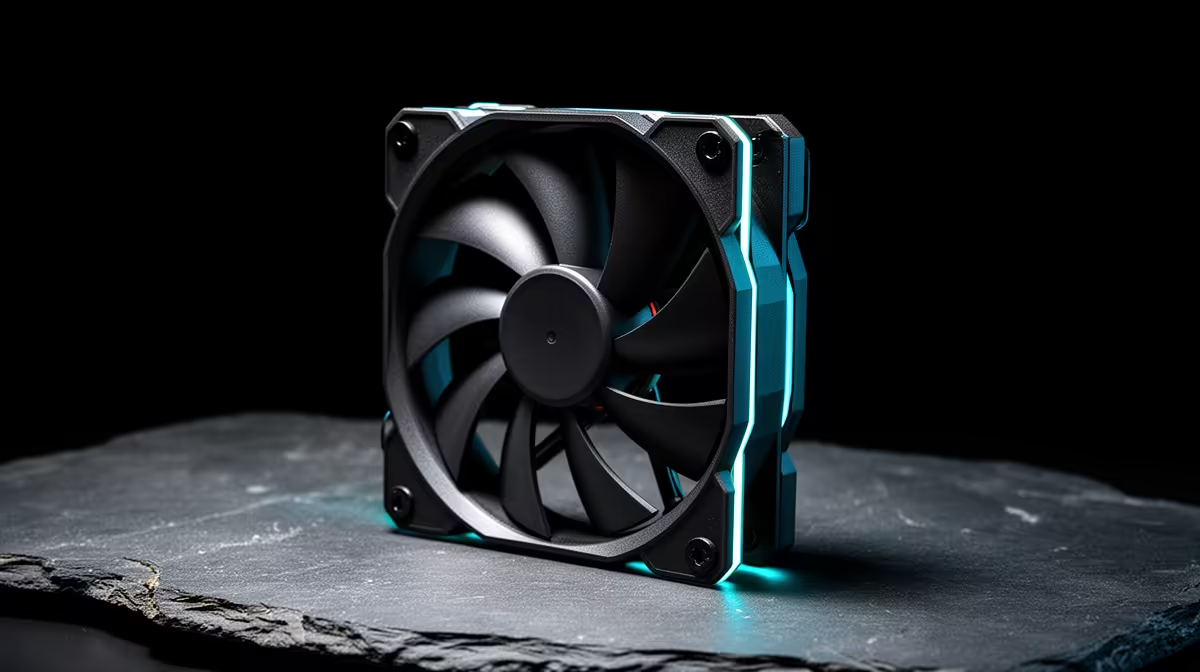
Two fans can share nearly identical airflow numbers on paper and still sound completely different once installed, which is why noise deserves its own close look rather than being treated as an afterthought to CFM. Working through case fan noise levels explained means looking past the maximum figure on a spec sheet to see how that number shifts across a fan's actual speed range during everyday use.
Quick Answer
40.7 dBA is the maximum noise level of the Einarex EX12A, priced at R249, reached only when PWM speed control pushes the fan to full speed under sustained load. Below that ceiling, the fan runs progressively quieter as PWM scales speed down, meaning most day-to-day use sits well under the rated maximum.
🔈 Understanding The dBA Scale
Why dBA Rather Than Raw Decibels
dBA is a weighted decibel measurement adjusted to reflect how the human ear actually perceives sound across different frequencies, rather than a flat measurement of sound pressure. This makes it a better indicator of perceived loudness than a raw decibel figure, which is why fan manufacturers use it as the standard noise rating across the industry.
Reading 40.7 dBA In Context
On its own, 40.7 dBA sits roughly at the level of a quiet conversation in a room, well below anything resembling a vacuum cleaner or a hair dryer. It is worth remembering this is a maximum figure tested at full fan speed, not a constant noise level the fan produces throughout its operation.
⚙️ How PWM Speed Curves Shape Real-World Noise
From Idle To Full Speed
Because the EX12A uses PWM speed control, it does not jump straight between silent and 40.7 dBA. Instead, the motherboard scales duty cycle gradually based on temperature readings, meaning the fan spends idle and light-load periods running well below its maximum noise output and only climbs toward the ceiling as thermal demand increases.
Custom Fan Curves And Noise Preference
Most motherboards allow a custom curve mapping case or CPU temperature to PWM duty cycle, letting builders prioritise either quiet operation or maximum cooling. Capping the top end of that curve trades some thermal headroom for a lower practical noise ceiling, useful for late-night sessions or shared living spaces where every decibel matters more.
🌡️ When The Fan Actually Reaches Its Noise Ceiling
Load Conditions That Push Toward 40.7 dBA
Sustained, graphically demanding gaming, the kind that keeps a graphics card and processor working hard for extended stretches, is what typically pushes case temperatures high enough for PWM control to drive the EX12A toward its rated maximum. Lighter use, browsing, video playback, or less demanding games, rarely asks enough of the system to bring the fan anywhere near that level.
Multiple Fans And Combined Noise
Running several EX12A units together does not simply multiply the rated 40.7 dBA figure, since decibels combine logarithmically rather than by simple addition, though a multi-fan setup will still sound noticeably louder than a single unit at the same speed. In practice, most builds notice combined fan noise less than they expect, since PWM keeps every fan scaling together with system load rather than all running flat out constantly.
🎧 Comparing Case Fan Noise To Everyday Sounds
Where 40.7 dBA Sits Against Familiar References
Everyday quiet environments, like a library or a calm room with a conversation happening across it, typically sit in a similar range to the EX12A's maximum rating, which helps put the number in perspective without needing specialist audio equipment to understand it. Anything markedly louder, like a running vacuum cleaner, sits well above this fan's rated ceiling even at full PWM speed.
Why Perceived Loudness Depends On The Room Too
The same 40.7 dBA fan can feel more or less noticeable depending on ambient room noise, distance from the case, and whether the case itself dampens sound through its panels. A fan running at its rated maximum in a quiet bedroom at night will stand out more than the same fan running in a busier room with background noise already present.
Frequently Asked Questions
Is 40.7 dBA loud enough to be distracting?
At its maximum it is comparable to a quiet conversation, noticeable but not disruptive for most people, and that ceiling is only reached under sustained heavy load rather than continuously.
Does noise scale evenly with fan speed?
Roughly, though noise tends to rise faster than airflow as a fan approaches its top speed, which is part of why PWM control at moderate speeds is often the more comfortable everyday setting.
Can I set a hard noise limit on my fans?
Yes, by capping the top end of a custom PWM fan curve in the motherboard BIOS or a fan control utility, trading some cooling headroom for a lower noise ceiling.
Do quieter fans always move less air?
Generally there is some tradeoff, though a well-designed PWM fan like the EX12A manages a wide range, running quiet at low speed while still reaching 82.9 CFM at full speed when needed.
How many fans can I run before noise becomes a real issue?
It depends more on case design and airflow layout than fan count alone, since a well-planned setup with two or three fans often sounds quieter overall than a poorly laid out setup with just one.
Does the room I am in change how loud the fan feels?
Yes. The same 40.7 dBA rating feels more noticeable in a quiet room at night than in a space with existing background noise, even though the fan itself is not actually louder.
Does fan age affect how loud it runs over time?
Bearings can wear over years of use and add noise beyond the original rating, though this happens gradually and is separate from the PWM-controlled range a new fan operates within.
Can case panels reduce noise from fans inside?
Solid side panels with sound dampening can noticeably reduce how much noise escapes a case compared to open mesh or glass panels, independent of the fan's own rated dBA figure.
The noise and speed figures quoted here all come from the EX12A's Evetech listing directly. Quieter or louder alternatives sit within Evetech's range of case fans, and Einarex's case catalogue rounds out the build with a complementary enclosure.
Ready to keep operation quiet up to 40.7 dBA?
Find the Einarex EX12A 120mm PWM fan for R249 on Evetech, a fan that stays reasonably quiet under load.