Quick Answer
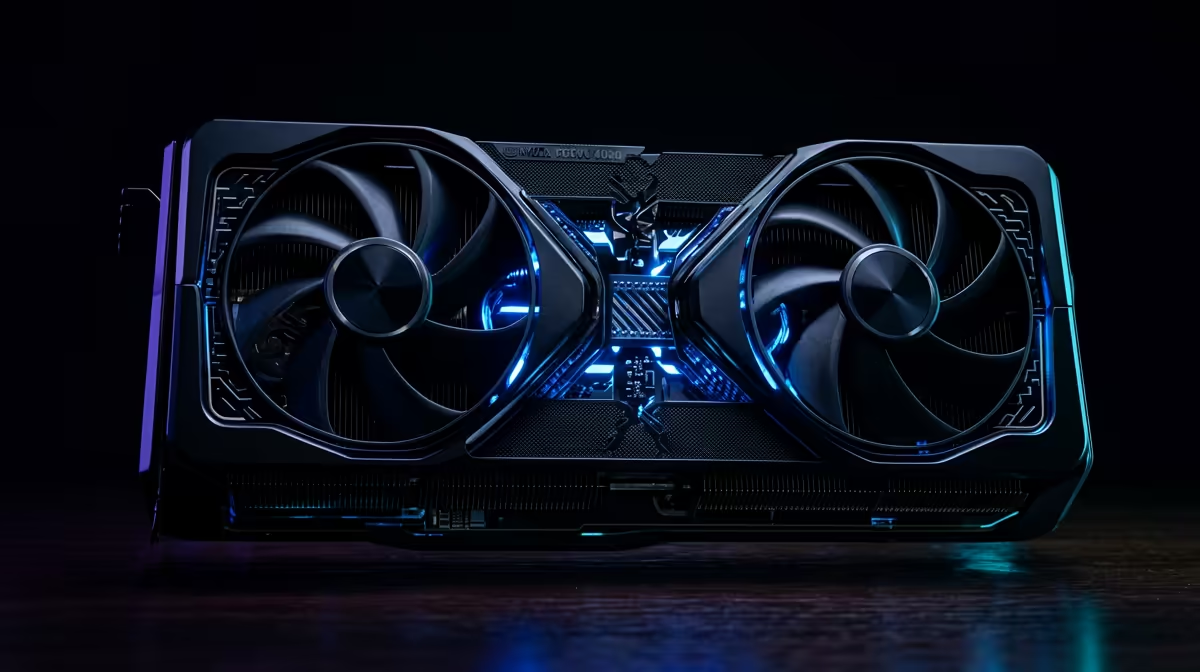
For combined gaming, streaming, and creative work, VRAM and encoder quality matter most. Aim for at least 16 GB VRAM (the RTX 5080 or RX 9070 XT tier) so you can run a game, an encoding session, and a viewport render simultaneously without swapping to system RAM.
Gaming Demands vs Creative Demands: Where They Overlap 🎮
Gaming workloads stress the GPU's rasterisation and ray-tracing pipelines. Creative work like 3D rendering, video colour grading, and AI upscaling stresses VRAM capacity and GPGPU compute. Streaming adds a third layer: a dedicated hardware encoder on the GPU handles H.264 or AV1 output without tanking your in-game frame rate. Cards like the RTX 5070 Ti carry NVENC AV1 dual-encoder support, which is critical if you stream to multiple platforms at once. For South African creators uploading to local platforms over Vumatel or Openserve fibre, AV1 encoding also reduces upload bitrate by roughly 40 percent versus H.264 at the same perceived quality.
VRAM: The Spec That Quietly Bottlenecks You 💾
A 8 GB card handles most 1080p games in 2026 but becomes a constraint the moment you open DaVinci Resolve with a 4K timeline alongside a running game session. Sixteen gigabytes is now the practical minimum for a three-role setup. The RTX 5080 at around R22,000 to R28,000 locally provides 16 GB GDDR7 and delivers over 100 fps in current-gen titles at 1440p. The RX 9070 XT also ships with 16 GB GDDR6 and trades blows at roughly R14,000 to R18,000. For pure rendering speed, CUDA and OptiX give Nvidia cards an edge in Blender and Unreal Engine 5, while AMD ROCm support has improved but remains less mature on Windows.
Streaming-Specific Encoder Considerations 📡
Intel Arc GPUs include AV1 encoders that punch above their price point for streaming-only workloads, but their gaming performance lags at the high end. For a triple-role setup, Nvidia's NVENC on RTX 50-series is currently the most mature option because the driver and OBS integration are battle-tested. AMD's AV1 encoder on RX 9000-series is competitive but slightly behind on bitrate efficiency according to published encoder benchmarks. If you stream at 720p60 or 1080p60 and also render short video loops for social content, a mid-range RTX 5070 around R10,000 to R14,000 covers all three workloads without thermal throttling on a well-ventilated South African desk setup.
Check Your PCIe Lane Count First ⚡
Before dropping R20,000-plus on a GPU, confirm your motherboard runs the card at PCIe 4.0 x16 or PCIe 5.0 x16. Running a high-end GPU at x8 or x4 due to a cheap motherboard cuts effective bandwidth and can reduce frame rates by 5 to 12 percent in bandwidth-hungry titles. SA builders on a budget sometimes overlook this when upgrading incrementally.
FAQ
Does ray tracing affect streaming performance?
Enabling ray tracing raises GPU load significantly, which can cause the encoder to compete for execution resources on budget cards. On RTX 50-series with dedicated encoder hardware, ray tracing and NVENC operate largely in parallel, so streaming quality holds even with RT enabled at medium settings.
Should I prioritise GPU or CPU for video rendering?
For GPU-accelerated renderers like Blender Cycles or Premiere Pro with GPU acceleration enabled, the graphics card dominates render time. For CPU-native tools like Handbrake software encoding or certain audio mastering plugins, the CPU matters more. Most creators benefit from balancing both rather than maxing out one.
Is 8 GB VRAM enough for a streaming and gaming build in 2026?
Eight gigabytes is tight for a combined workload. You will likely encounter VRAM spillover in texture-heavy games while OBS runs in the background. Spending the extra R3,000 to R5,000 to reach 16 GB is worthwhile if you stream regularly and do any creative work beyond basic photo editing.
Building a setup that handles gaming, streaming, and creative work all at once?
Explore Evetech's GPU range to find cards with the VRAM, encoder tech, and compute power your three-role rig needs.