Quick Answer
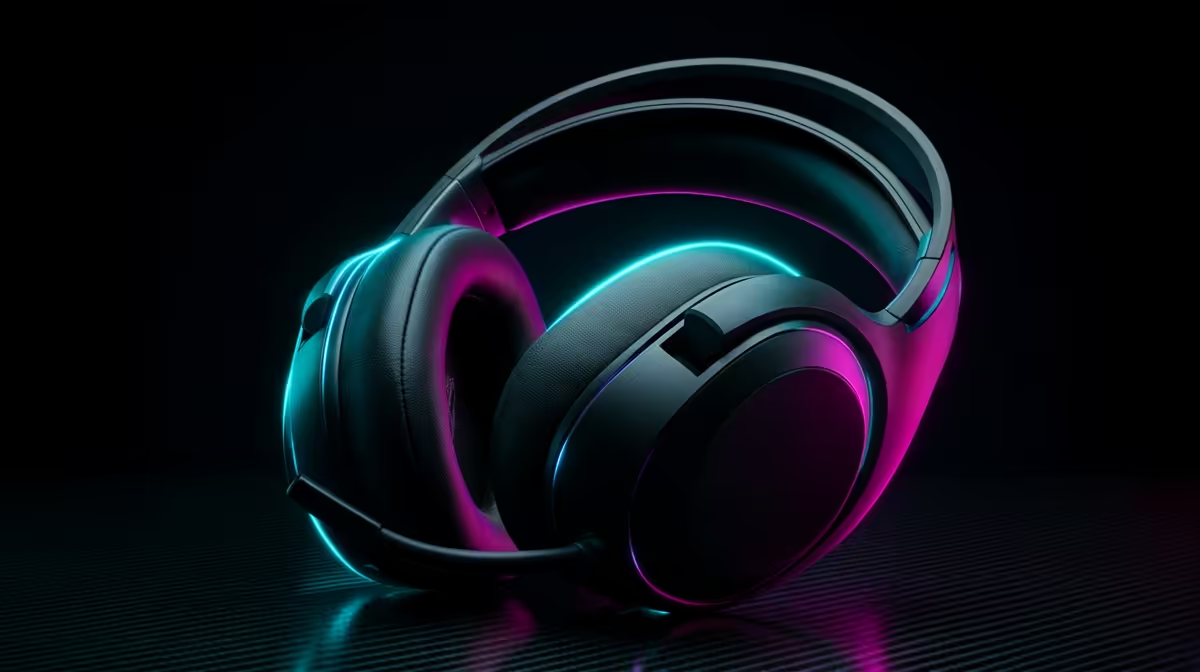
For South African gaming setups centred on a desktop PC or PS5, choose 2.4GHz wireless for its 12 to 20 ms latency and full stereo audio quality. For setups built around a laptop, phone, or mixed mobile use, Bluetooth 5.3 covers more devices more conveniently. For most SA gamers who own both a PC and a smartphone, a dual-wireless headset removes the compromise entirely.
Why 2.4GHz Wins for Dedicated Gaming Rigs 🖥️
The 2.4GHz RF protocol used by gaming headsets operates on a dedicated channel managed by the USB dongle, with frequency hopping to avoid interference. Latency sits at 12 to 20 ms across all tested models, functionally indistinguishable from a wired headset in gaming. Full 48 kHz stereo audio transmits without codec compression. On a Vumatel or Frogfoot fibre connection with 10 to 20 ms server ping, keeping audio latency in the same range ensures sound cues are genuinely synchronised with gameplay. This matters acutely in FPS titles where footstep audio arriving 150 ms late on a Bluetooth headset is late enough to affect decision-making.
Where Bluetooth Makes More Practical Sense 📱
Bluetooth's strength is universal compatibility without a dongle. It pairs to every smartphone, tablet, smart TV, and modern laptop. For a South African gamer whose primary audio use is music during commutes, WhatsApp calls, and casual mobile gaming on Android, Bluetooth covers all of that without carrying a USB dongle. Bluetooth 5.3 also handles multiple paired devices, making it easy to switch between a phone and a tablet. The latency compromise matters least for music, podcasts, and casual mobile gaming where sub-50 ms audio is not a requirement.
Making the Dual-Wireless Decision in South Africa 🔄
Headsets like the Razer Barracuda Pro at approximately R3,000 to R3,500 at Evetech run 2.4GHz and Bluetooth simultaneously, combining the latency advantage of 2.4GHz gaming with Bluetooth's phone compatibility. For a South African household where the PC handles serious gaming and the phone handles daily calls, the dual-wireless model is the most efficient purchase. The price premium over a single-protocol model is typically R500 to R800, recovered quickly compared to managing two separate audio devices.
Router Channel Affects Both 2.4GHz Protocols ⚡
Set your home router's 2.4GHz band to channel 1 or 11 rather than the default channel 6. This minimises overlap with both your gaming dongle and Bluetooth, reducing interference for your headset and gaming mouse dongle simultaneously without changing any peripheral settings.
FAQ
Does 2.4GHz wireless work in a sectional title complex with many Wi-Fi networks?
Yes. Gaming headset dongles use frequency hopping spread spectrum that automatically avoids occupied channels. In a densely populated Johannesburg apartment block with 20 or more visible Wi-Fi networks, 2.4GHz gaming headsets still maintain stable connections because their channel management adapts to crowded spectrum conditions.
Can Bluetooth headsets be used competitively in South African esports?
At major LAN events like VS Gaming or the DGL, 2.4GHz wireless or wired headsets are standard. Bluetooth latency is too variable for competitive tournament use. Some players use Bluetooth headsets for casual play and switch to a 2.4GHz or wired model for ranked matches.
Is the 2.4GHz dongle safe to leave plugged into a PC permanently?
Yes. The dongle draws minimal power (under 0.5 W) and has no negative effect on the PC when left plugged in. Most gamers leave the dongle permanently installed and power the headset on and off as needed. The headset disconnects automatically after the configurable inactivity timeout.
Deciding between 2.4GHz and Bluetooth for your South African gaming setup?
Evetech stocks the full range of wireless gaming headsets from single-protocol to dual-wireless, with honest specs and local support.