


PCIe 5.0 vs PCIe 4.0 for Video editing in 4k in SA
PCIe 5.0 vs PCIe 4.0 for video editing in 4k is mainly about fit, features, compatibility, cost, and upgrade path, not one automatic winner. SA buyers should match the choice to the setup.
Read moreDual Mode panels remove the choice between 5K clarity and 330Hz speed by toggling between both on one display. It covers SA pricing, local availability at Evetech, and warranty support for buyers across Johannesburg, Cape Town, and Durban.
For competitive South African gamers, 330Hz is the correct choice. For creators or immersive single-player players, 5K is the better long-term investment. The two profiles rarely overlap enough to make 5K 180Hz universally better than QHD 330Hz for someone who prioritises ranked multiplayer.
SA's competitive gaming scene is centred around Valorant, CS2, Apex Legends, and FIFA. These titles prioritise frame rate: top-ranked SA players in Valorant regularly play at 200fps-plus and describe 144Hz as the minimum, 240Hz as standard, and 360Hz as the current ceiling they aspire to. The SA esports scene hosts tournaments through organisations like VS Gaming and Mettlestate, where 240Hz to 360Hz panels are common at LAN events. Investing in 330Hz aligns your practice setup with what you encounter at competitive events. A 330Hz monitor in the R8,000 to R12,000 range, paired with an RTX 4070 Super, is a more competitive-focused setup than a R18,000 5K monitor with an RTX 5070.
Content creation, streaming, and video editing represent a large and growing portion of the SA gaming community's adjacent activities. If you stream on YouTube or produce Twitch content for SA audiences and need your thumbnail and banner graphics to be sharper than your competitors, editing on a 5K monitor versus a QHD monitor makes a visible difference in the output file. At 218 PPI, JPEG compression artefacts and sub-pixel colour variations are visible at 100% zoom on a 5K screen, letting you catch problems before export that would be missed on a QHD panel.
A QHD 330Hz setup requires a GPU capable of sustaining 300fps-plus in esports titles. An RTX 4070 Super or RX 7800 XT handles this comfortably in CS2 and Valorant, currently stocked at Evetech in the R8,000 to R12,000 range. A 5K 180Hz setup requires at minimum an RTX 5070 (around R14,000 to R18,000) for meaningful 5K gaming. Total setup cost: QHD 330Hz comes in at R16,000 to R24,000 for monitor plus GPU. 5K 180Hz comes in at R29,000 to R40,000. The QHD route is the more accessible and immediately competitive option for most SA gamers.
In South Africa, Vumatel and Openserve fibre connections typically offer 50Mbps to 1Gbps packages. At high frame rates above 240fps, your monitor is ahead of your ping unless you have a sub-20ms connection. Prioritise a wired ethernet setup from your router before upgrading from 240Hz to 330Hz, because network latency is often the binding constraint in competitive SA lobbies.
CS2 and Valorant see the most benefit, as both are highly optimised and can reach 300fps-plus on mid-range hardware at QHD. Apex Legends at QHD also crosses 200fps on strong mid-range GPUs. These three titles represent the majority of SA competitive gaming activity.
Not currently at true 330Hz in QHD binned mode. Some dual-mode 5K monitors reach 240Hz in their lower-resolution mode. If 330Hz is the goal, a dedicated QHD panel remains the reliable path.
At 27 inches, the jump from 4K (163 PPI) to 5K (218 PPI) is visible in static content like text and interface elements but less apparent during fast gameplay where the display is constantly refreshing. For gaming alone the 4K-to-5K improvement is modest; for static creative work it is clearly visible.
Building your South African competitive gaming setup? Browse Evetech's range of high-refresh and high-resolution gaming monitors stocked locally, and pair your chosen panel with a compatible GPU from the current RTX or RX range.
PCIe 5.0 vs PCIe 4.0 for video editing in 4k is mainly about fit, features, compatibility, cost, and upgrade path, not one automatic winner. SA buyers should match the choice to the setup.
Read more
Wi-Fi 7 vs Wi-Fi 6e for competitive esports comes down to router support, latency goals, device compatibility, and coverage. SA buyers should match the choice to the real network setup.
Read more
ATX 3.1 vs ATX 3.0 for mMO and live-service games buyers - what changes is mostly about compatibility, budget, upgrade path, and setup fit. SA buyers should check device support and real needs before expecting a clear win from either option.
Read more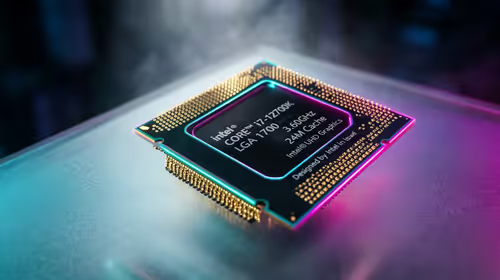
LGA 1851 vs LGA 1700 can affect Twitch and YouTube streaming when gaming and encoding share CPU resources. For SA creators, the real-world difference depends on encoder choice, memory support, motherboard cost, thermals, and upgrade plans.
Read more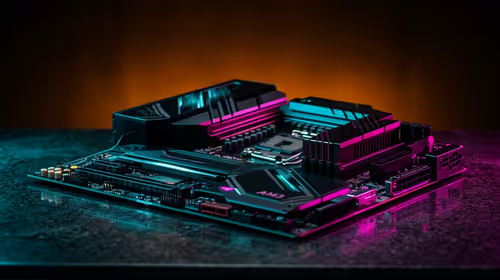
X870E vs X670E for aaa single-player gaming is mainly about fit, features, compatibility, cost, and upgrade path, not one automatic winner. SA buyers should match the choice to the setup.
Read more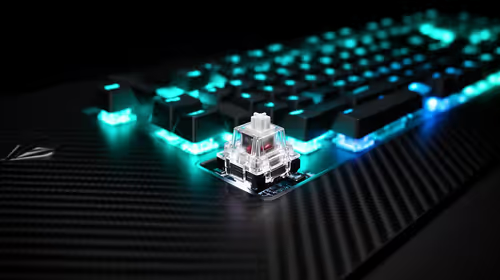
Hall Effect switches vs Mechanical switches for mMO and live-service games is mostly about compatibility, budget, upgrade path, and setup fit. SA buyers should check device support and real needs before expecting a clear win from either option.
Read more
A fake 113GB GTA VI ISO reportedly used empty padding around a small malware payload. SA gamers should delete unofficial builds, keep Windows security active and wait for official channels.

Wi-Fi 6E vs Wi-Fi 6 matters for 4K video editing when files move across a network. The real-world difference between Wi-Fi 6E and Wi-Fi 6 for video editing in 4K depends on NAS access, cloud uploads, router range, and SA creator workflows.

The difference between PCIe 5.0 and PCIe 4.0 for SA gamers is mostly bandwidth headroom. Compare GPU slot needs, NVMe speed, motherboard support, and upgrade timing before paying extra for a newer platform.

Gaming PC stuck pixel checks in South Africa should confirm the monitor fault first. Use colour tests, screenshot comparison, cable swaps, display menu checks, and clear photos before deciding on support.

Shokz OpenFit Air 2 earbuds weigh 7.2g each and use a redesigned dual-driver open-ear layout. SA buyers should choose them for comfort and awareness, not maximum isolation.

AMD's current driver now lists a Radeon RX 9050 4GB, while product coverage details a narrowed memory system. SA buyers should weigh the low VRAM ceiling against current local Radeon options.

Samsung Display has demonstrated a 16-inch 2.5K OLED laptop panel running at 300Hz. SA buyers should wait for a named notebook, full panel specifications and a local price before planning an upgrade.

Microsoft says some Windows 11 game crashes after recent updates are linked to RGB-related drivers. Affected SA gamers should confirm the update and driver before using the published registry workaround.
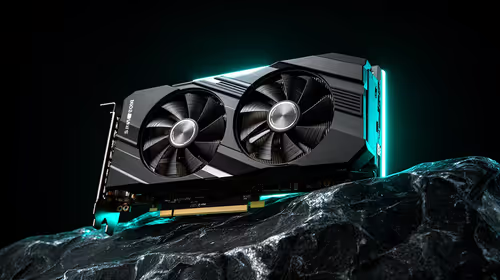
RTX 5090 on a 650W PSU is a tight pairing with very limited headroom. For SA gaming PCs, focus on total system draw, PSU quality, connector support, CPU choice, and avoid OC plans unless the full build is carefully power-limited.
PCIe 5.0 vs PCIe 4.0 for video editing in 4k is mainly about fit, features, compatibility, cost, and upgrade path, not one automatic winner. SA buyers should match the choice to the setup.
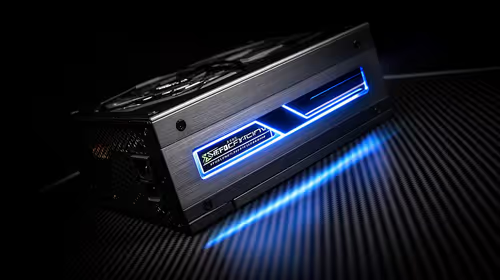
850W PSU safety for RTX 5090 is plausible with a quality unit and balanced parts. In SA, confirm connector support, CPU power draw, case airflow, PSU age, and spare capacity before building around 850W.
Wi-Fi 7 vs Wi-Fi 6e for competitive esports comes down to router support, latency goals, device compatibility, and coverage. SA buyers should match the choice to the real network setup.