Quick Answer
For SA gaming rooms and studios, choose a cooler with at least 20% more thermal headroom than your CPU's sustained power draw, and factor in local room temperatures when sizing: a poorly insulated Johannesburg highveld room in summer adds 3 to 5 degrees Celsius of ambient thermal load compared to a climate-controlled studio, which directly affects how hard your cooling solution must work.
The SA Climate Variable in CPU Cooling Decisions 🌡️
CPU cooling decisions made in European countries assume ambient temperatures of 18 to 22 degrees Celsius as a baseline. In South African gaming rooms, the story differs significantly by region and season. Gauteng in summer regularly sees uninsulated room temperatures of 28 to 32 degrees Celsius without air conditioning, and coastal KwaZulu-Natal rooms add humidity to the thermal equation. Each degree Celsius of room ambient temperature feeds directly into your CPU's thermal ceiling.
Studio and Work-From-Home Cooling Priorities 🎧
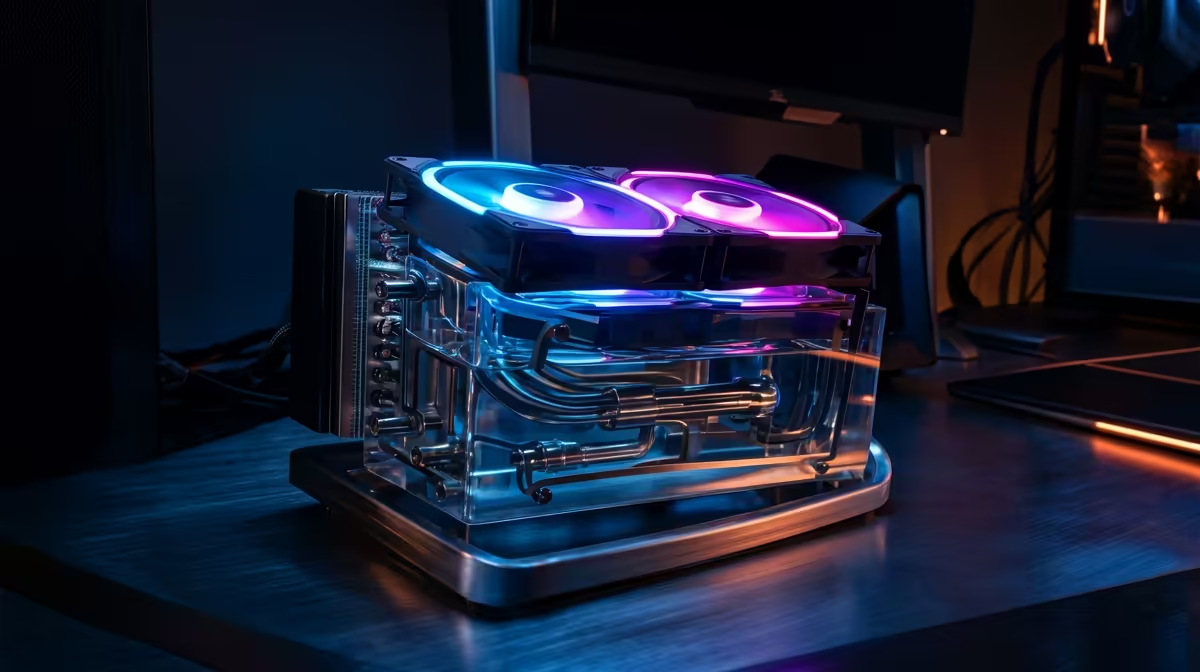
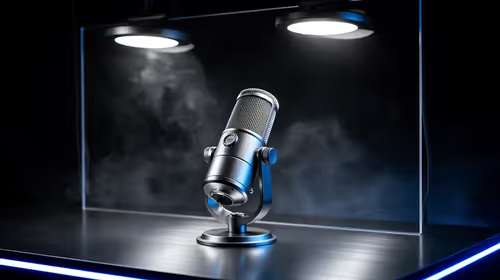
Content creators and remote workers who run audio recording or video calls on the same PC have a different set of priorities to pure gamers. Fan noise picked up by a condenser microphone is a real problem for SA-based streamers, podcasters, and remote employees on video calls. Prioritising a cooler with low RPM at typical creative workload temperatures, whether that is a premium 360mm AIO with FDB fans or a dual-tower air cooler with 140mm slow-spin fans, directly improves audio quality without needing noise gates or software suppression.
Gaming Room Builds and Acoustic Considerations 🔊
A dedicated gaming room in an SA home, whether it is a converted spare room at a Cape Town property or a sectioned-off loft space in Pretoria, generally has more acoustic flexibility than a shared open-plan work-from-home setup. This gives gaming room builds more latitude to run fans at higher RPM during intensive gaming without impacting others in the house. However, if the gaming room doubles as a streaming studio, the same noise discipline applies.
Account for Seasonal Temperature Swings When Choosing Cooler Size ⚡
seasonal variation is significant: a cooling solution that handles your CPU at 28 degrees Celsius ambient in January may run noticeably hotter at the same workload in December. Size your cooler for your hottest expected ambient temperature, not average conditions, especially if your gaming room lacks consistent air conditioning.
FAQ
Is air cooling or liquid cooling better for humid coastal SA environments like Durban?
Air coolers are preferable in very humid environments because they have no loop, pump, or fittings that could be affected by condensation forming on cold surfaces. A quality tower cooler running at moderate ambient humidity presents no moisture-related risk. AIO coolers are generally safe at normal indoor humidity levels, but in rooms with unusually high humidity, air cooling eliminates any marginal concern entirely.
Does a gaming room with dedicated air conditioning need a larger cooler?
No. A climate-controlled room at a stable 22 to 24 degrees Celsius reduces the ambient thermal load significantly, meaning a 240mm AIO or quality dual-tower air cooler is fully adequate for most gaming CPUs even at full sustained load. Air conditioning is the most effective thermal upgrade for a gaming room and reduces the required cooler specification simultaneously.
Can I run a 360mm AIO in a compact SA home studio setup?
Yes, provided your case supports the radiator size. Many compact ATX and mid-tower cases accommodate a 360mm front-mounted radiator without issues. A front intake position provides cool external air directly to the radiator, which is the ideal configuration for a warm room scenario where recycled warm case air would reduce cooling efficiency at a top-mounted position.
Building a gaming room, studio or home office setup in South Africa?
Browse the full CPU cooler range at Evetech to find options suited to SA ambient conditions and your specific workload.