Quick Answer
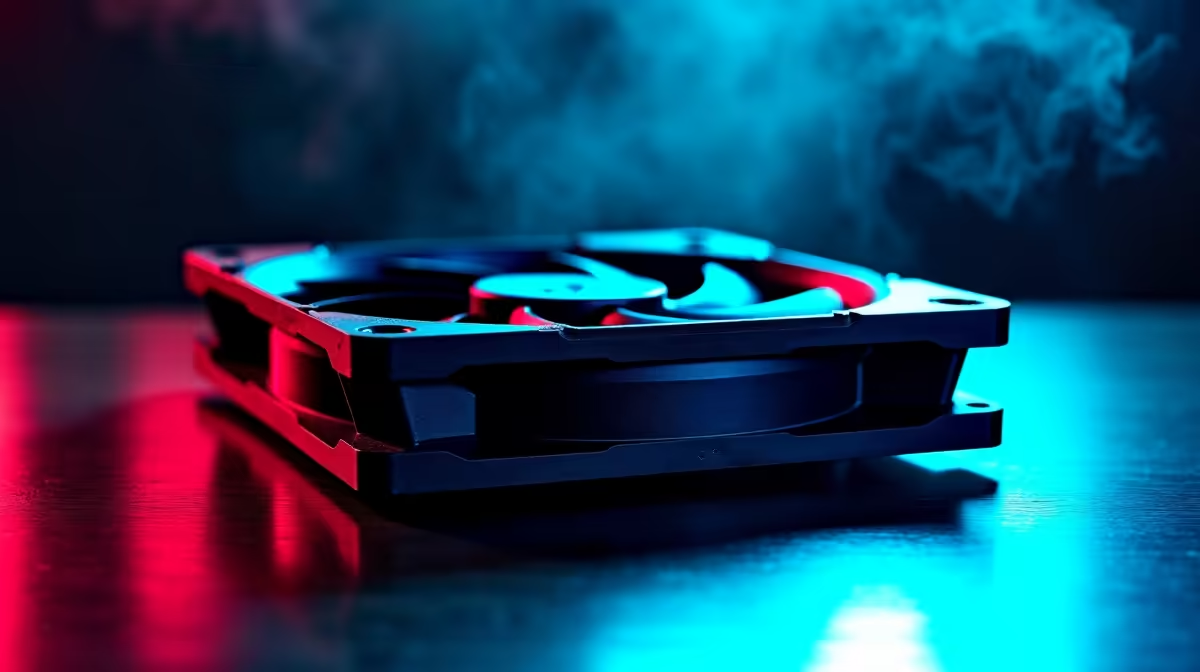
CNC-milled brass bearing housings reduce transmitted vibration and acoustic resonance compared to plastic mounts by increasing mass and rigidity at the bearing interface, which lowers the amplitude of vibration conducted to the fan frame and case. The difference is most perceptible at high RPM and on hard-mounted installations where plastic mounts allow micro-movement that creates audible rattling or hum.
Why Bearing Housing Material Matters for Acoustics 🔬
A fan's bearing housing holds the rotating shaft in alignment and transfers bearing forces to the fan frame. In standard fans, this housing is injection-moulded plastic with low mass and a resonant frequency that can align with vibrational frequencies from the motor and bearings at certain RPM ranges. When the housing's resonant frequency matches the motor's vibration frequency, sympathetic resonance amplifies noise. CNC-milled brass housings have higher mass (brass density is roughly 8.5 g/cm3 versus ABS at 1.05 g/cm3) and significantly different mechanical damping properties.
CNC Machining vs Injection Moulding: Dimensional Precision ⚙️
Beyond material properties, CNC machining produces tighter dimensional tolerances than injection moulding. A shaft bore in a CNC-milled brass housing can be held to within 5 to 10 micrometres, compared to 50 to 100 micrometres for a standard injection-moulded part. Tighter shaft bore tolerance means bearing clearance is more precisely controlled, reducing shaft wobble at high RPM. In a hydrodynamic FDB bearing, shaft wobble directly affects oil film stability, and a more stable film produces lower vibration amplitudes.
Cost and Availability in South Africa 🇿🇦
Fans featuring CNC-milled brass bearing mounts are at the premium end of the case fan market. Expect to pay R400 to R900 per fan, with a three-fan or six-fan build set totalling R1,200 to R5,400. For SA builders focused on performance-per-rand, the premium is most justified for AIO radiator fan positions where acoustic performance matters most, while standard plastic-housed fans are adequate for non-critical case ventilation positions.
Use Anti-Vibration Mounts Alongside Any Fan Type ⚡
Regardless of bearing housing material, installing fans with rubber anti-vibration mounts or silicone pin mounts isolates the fan frame from the case panel, breaking the vibration transmission path. Most premium fan packs include rubber mounts, but aftermarket anti-vibration pin sets cost under R80 locally and can meaningfully quieten even budget plastic-housed fans when hard-mounted to thin steel case panels.
FAQ
Is the noise reduction from a brass bearing housing audible in a typical SA home build?
At high RPM (2,000 RPM or above), yes. The difference between brass and plastic housings is perceptible to most people in a quiet room. At low to mid RPM (below 1,500 RPM), both housing types are quiet enough that other noise sources such as the GPU cooler or PSU fan dominate.
Do CNC brass housings affect the fan motor's magnetic field?
Brass is non-magnetic, so the housing material does not interfere with the fan motor's magnetic field. Brass is chosen specifically because it is non-magnetic, thermally conductive, and machinable, with no electrical or magnetic interaction with the motor components.
Can I identify a CNC brass housing from a product listing?
Look for the terms CNC-machined, precision-milled, brass bearing mount, or metal bearing housing in the product specifications. Some manufacturers photograph the disassembled bearing housing. If unclear, check the product weight: a fan with a brass housing weighs measurably more, typically 10 to 20 grams heavier per fan than an equivalent plastic-housed unit.
Building a near-silent PC in South Africa?
Evetech stocks premium 120mm and 140mm fans with advanced bearing and housing technologies designed for minimum acoustic signature. Visit the cooling section to compare specifications and find the quietest fans for your build.