The phrase coding kits covers everything from a chunky button robot a four-year-old pushes around the kitchen floor to a programmable board a teenager flashes with Python. Buying the wrong one wastes money and, worse, puts a child off coding entirely because the kit was either baffling or babyish. The right match comes down to three things: the child's age, whether they can read fluently yet, and whether you want screen-free learning or are happy with a tablet or laptop in the mix.
Quick Answer
For under-8s, choose a screen-free button or block robot that teaches sequencing without reading. For ages 8 to 11, a screen-paired robot like the Makeblock mBot bridges blocks and the physical world. For 10-plus and confident readers, the BBC micro:bit v2 is the standout: it runs both MakeCode block coding and MicroPython, so a learner can graduate from drag-and-drop to real text code on the same board.
Match the kit to the child, not the marketing age
Box ages are optimistic. A more reliable guide is what the child can already do. A pre-reader needs a kit that communicates through buttons, lights and sound, because any kit that relies on reading on-screen instructions will stall. A fluent reader who has outgrown drag-and-drop blocks needs a path into text-based code, or boredom sets in fast.
The second axis is screens. Plenty of South African parents want a first coding experience that does not mean more tablet time, and screen-free kits deliver real computational thinking without one. Older learners, though, benefit from a screen because that is where block editors and Python live, and where the jump to professional tools eventually happens.
Screen-free kits for the youngest coders
For children roughly 4 to 7, the goal is the idea of code rather than code itself: giving a sequence of instructions, seeing them run, and fixing them when the result is wrong. Button-driven floor robots do this beautifully. The child presses forward, turn, forward, and the robot follows the recipe. When it ends up in the wrong place, they debug by changing the buttons. No reading, no login, no screen.
These kits build the mental model that underpins all later coding: that a computer does exactly what you tell it, in order, and that mistakes are found by testing. That foundation matters more at this age than any specific language.
Block coding kits for the middle years
Around 8 to 11, children are ready to connect on-screen logic to a physical machine. This is where the Makeblock mBot has become the most accessible entry point. The child builds a small robot, then programs it in a Scratch-style block editor to follow lines, avoid walls, or react to light. Because the code is blocks, there is no syntax to trip over, but the behaviour is real and in the room rather than trapped on a screen.
A robot you can see respond to your code is far more motivating at this age than a purely on-screen project, and the build step adds a satisfying hardware element. Kits at this level pair well with the broader smart home and learning hardware range if a child later wants to wire sensors into home projects.
The BBC micro:bit v2: the long-runway choice
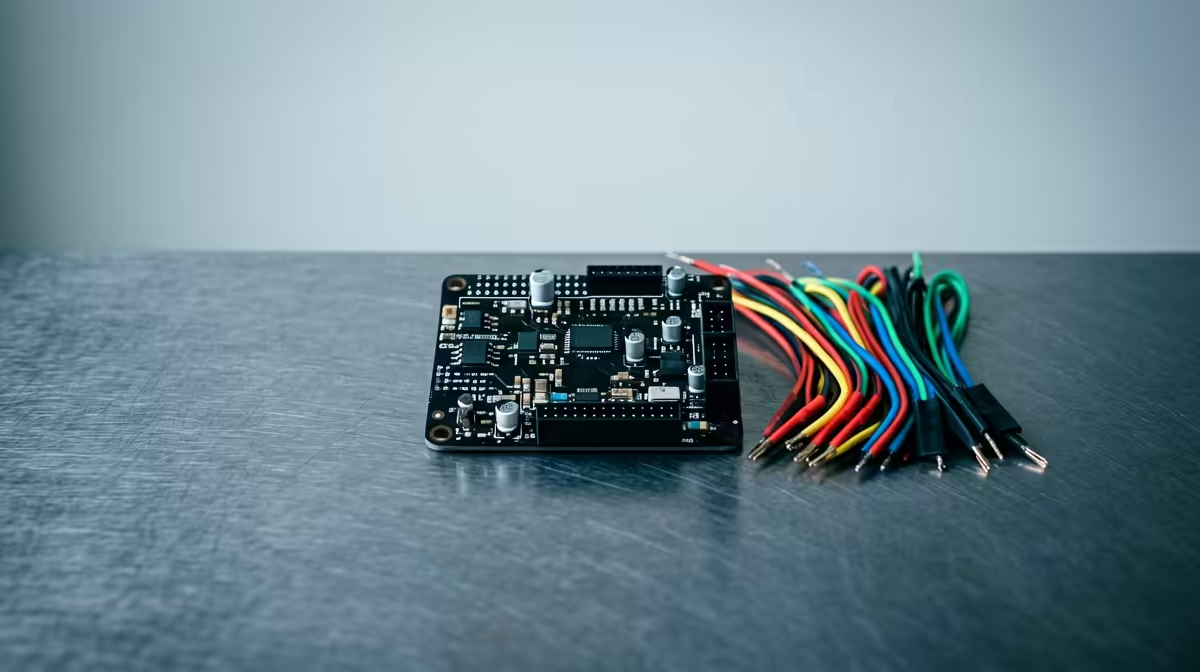
If you buy one kit that a child will not outgrow for years, make it the micro:bit v2. The board itself is a pocket-sized microcontroller with a 5x5 LED display, buttons, a speaker, a microphone, and motion and touch sensing built in. What makes it special for families is the smooth gradient of difficulty.
From blocks to real Python on one board
A beginner programs the micro:bit in MakeCode, dragging the same kind of blocks they used on an mBot. When they are ready, the identical project can be rewritten in MicroPython, real text-based Python running on the same hardware. That continuity is rare. The learner is not throwing away a kit and starting over; they are levelling up on equipment they already understand.
Why v2 specifically
The v2 added a speaker, microphone and more memory over the original, which opens up sound projects, voice-triggered code and more ambitious programs without running out of room. Starter bundles usually add a battery pack, cable and a few sensors so a child can build something physical on day one rather than just blinking the LEDs.
What a coding kit teaches beyond coding
It is worth being clear about what these kits actually develop, because it is rarely a head start on a programming career. The real payoff at every age is computational thinking: breaking a problem into ordered steps, predicting what those steps will do, and systematically finding the one that went wrong. That habit transfers to maths, science and everyday problem solving far more than any specific language a child learns at seven.
Debugging deserves special mention. When a young coder's robot turns the wrong way, the kit teaches them to investigate calmly rather than give up, change one thing, test, and try again. That resilience in the face of something not working is arguably the most valuable thing a coding kit instils, and it is why the physical, in-the-room feedback of a robot or a micro:bit beats purely abstract screen exercises for younger children. They can see the cause and effect.
Budgeting and avoiding common mistakes
A few buying mistakes recur. The first is overbuying: handing a four-year-old a micro:bit and a soldering-adjacent sensor kit guarantees frustration, because the gap between the hardware and the child is too wide. The second is underbuying: giving a capable twelve-year-old a button robot they master in an afternoon and then abandon. Matching the kit to reading ability and patience avoids both.
The third mistake is forgetting the supporting bits. A board with no cable, dead batteries, or a missing adaptor stops a project before it starts, and a stalled first session can sour a child on the whole idea. Spend a little on spare cables, batteries and a couple of extra sensors up front so the first build succeeds. The cost of a coding kit is modest relative to most tech, and the difference between a kit that gets used and one that gathers dust is usually those small extras and the right age match, not the headline price.
Putting together a kit that lasts
A sensible progression for a younger child is a screen-free robot now, an mBot-class kit around age eight, and a micro:bit when reading and patience are solid. For an older child who reads well, you can often skip straight to the micro:bit and grow into MicroPython over a year or two. Whatever the entry point, add the cables, batteries and a few extra sensors up front, since a project that stops because a cable is missing kills momentum. Those bits sit in the everyday accessories best sellers and are worth grabbing alongside the board.
Frequently Asked Questions
What age should a child start with coding kits?
As young as four with a screen-free button robot that teaches sequencing through play. Reading is not required at that stage. Text-based coding on a board like the micro:bit suits roughly age ten and up.
Is the micro:bit too advanced for a beginner?
No. It starts in drag-and-drop MakeCode blocks, which a complete beginner can use, and only moves to MicroPython when the learner chooses to. That range is exactly why it suits a wide age band.
Do I need a computer to use these kits?
Screen-free robots need nothing extra. mBot and micro:bit need a computer, tablet or Chromebook to program from, since the block and Python editors run in a web browser. Any modest machine works.
What is the difference between block coding and MicroPython?
Block coding snaps visual blocks together so there is no typing or syntax to get wrong, ideal for starting out. MicroPython is real text-based Python, the same language used professionally, which the micro:bit also runs so a learner can graduate to it.
Will my child outgrow a coding kit quickly?
A screen-free robot is outgrown in a year or two, which is fine for the age. The micro:bit has a much longer runway because it spans blocks through to real Python and supports increasingly ambitious projects on the same board.
Pick the kit that matches your child's reading and age today, and choose one with room to grow into real code tomorrow. Explore coding boards, robots and the supporting learning hardware at Evetech and set a young coder up to keep climbing.