


80+ Gold vs 80+ Platinum for Couch co-op gaming in SA
80+ Gold vs 80+ Platinum for couch co-op gaming is about PSU efficiency, heat, fan behaviour, quality, and wattage headroom, not direct FPS. SA buyers should compare the whole build.
Read moreDual XLR combo jacks accept both XLR mics and 6.35mm line plugs in one socket, while 48V phantom power feeds the voltage condenser capsules need. Together they run two studio mics on balanced, noise-rejecting connections.
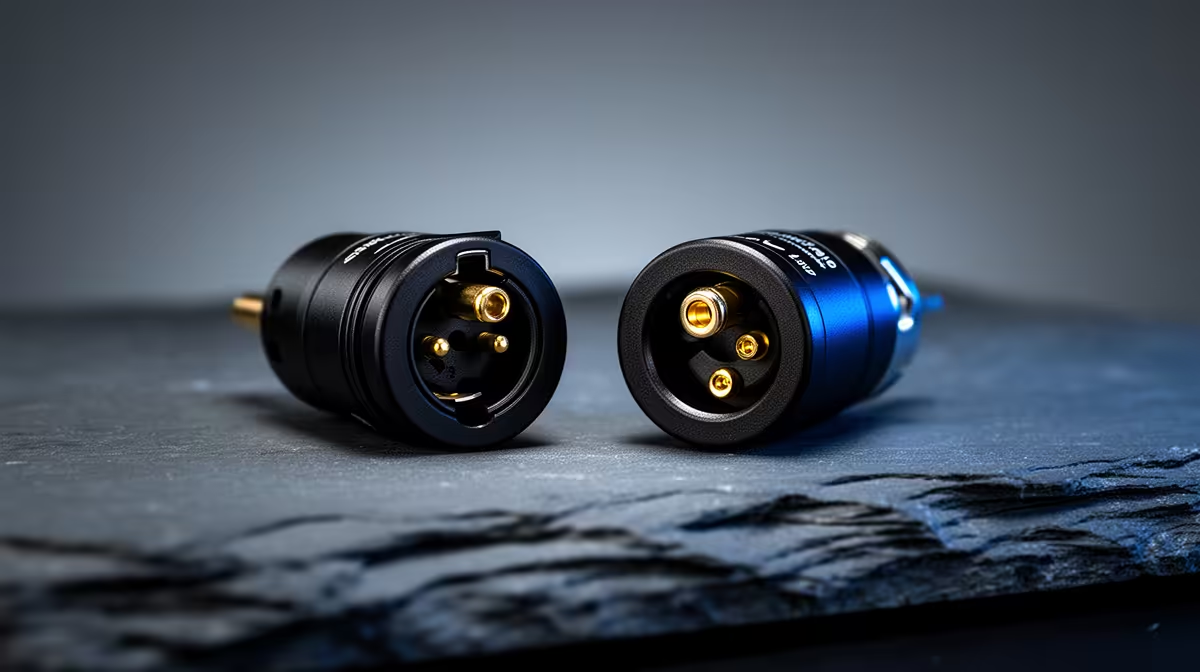
The socket that accepts both a three-pin microphone cable and a large mono plug looks unremarkable from the outside, but it is doing two jobs at once. Dual XLR combo jacks embed a 6.35mm instrument sleeve inside the standard XLR barrel, so a single opening on the mixer handles whichever connector you bring. Pair that with 48V phantom power flowing to your condenser capsule, and you have a pro-grade signal chain compressed into a box small enough to sit beside your keyboard.
A combo jack nests a 6.35mm plug socket inside an XLR shell, letting one input accept either. 48V phantom power travels the XLR pins to energise condenser capsules. Together they give a two-mic setup balanced, low-noise connections from a single compact unit.
Picture a standard XLR socket: three pins arranged in a D-shaped ring with a locking collar. Now imagine that same collar, but with a 6.35mm hollow cylinder machined into the dead centre. A three-pin mic cable slots into the outer ring and makes contact normally. A large mono jack slides into the inner cylinder and connects its tip and sleeve to the channel's line circuitry instead.
The two plug formats share the socket body but route to different gain stages. When a microphone cable lands, the channel sees the XLR pins and knows to apply mic-level gain. When a 6.35mm jack slides in, the ring contact triggers a different path, one calibrated for line or instrument-level signals. The switching happens automatically, with no button to press.
This matters in practice because it halves the number of physical inputs a compact mixer needs. A four-input unit with four combo jacks can run four condenser mics, four keyboards, or any mixture of both. For a two-host podcast or a creator who also plays guitar on stream, that flexibility is not theoretical.
Both the XLR and the 6.35mm TRS (tip-ring-sleeve) version of the large jack carry balanced signals. Balanced means the audio travels on two wires carrying mirror-image versions of the same signal, plus a ground. Any interference that sneaks onto the cable affects both wires equally, and the input stage cancels it by comparing the pair. The longer the cable run, the more this matters, and in a home studio with power bricks and screens nearby it matters quite a bit.
An unbalanced cable, like a standard guitar lead with a two-contact TS plug, carries the signal on one wire. There is nothing to compare it against, so interference arrives at the input unchecked.
A dynamic microphone generates its own signal from coil movement. A condenser does not. The condenser capsule is a charged plate that changes capacitance as sound moves it, and it needs a voltage source to function at all. Phantom power supplies that voltage.
The 48V travels up pins 2 and 3 of the XLR cable simultaneously, arriving at equal voltages on both signal conductors. Because both carry the same DC voltage relative to pin 1, there is no differential signal added. The capsule draws what it needs to charge its diaphragm and the signal path stays clean. This is not accidental: the phantom standard was designed specifically so that the DC supply voltage produces no audible artefact in a properly balanced circuit.
Most condensers draw somewhere between 1mA and 10mA, with large-diaphragm models sitting toward the top of that range. A quality mixer holds 48V steady across both channels even when two condensers are drawing simultaneously. Budget units sometimes droop, which raises the noise floor on both inputs.
Dynamic microphones tolerate phantom power without damage, provided they are properly wired. The voltage appears equally on both signal pins and cancels at the transformer inside the dynamic. Ribbons are a different matter. Some vintage ribbon designs are vulnerable to phantom power through a capacitor failure or wiring fault, so it is worth verifying your ribbon is rated for phantom before enabling it.
Where budget mixers apply phantom power to every XLR channel from a single rail, better units switch it per channel. That independence matters when your two inputs differ: one condenser needing 48V alongside a dynamic that does not need it, or a guitar plugged into the 6.35mm portion of one jack while a condenser sits on the other.
A per-channel switch also protects your signal chain during mic swaps. If you pull an XLR cable with phantom enabled, the disconnection event sends a sharp click through the channel. Turning phantom off on that one channel before unplugging prevents the click without disturbing the other input.
Before any mic swap, mute the relevant channel fader first, then disable phantom on that channel, then unplug. That sequence kills any audible click through monitors or stream. Two seconds of procedure saves clipping your audience's ears.
With dual combo jacks and per-channel phantom, a two-mic recording is straightforward. Both channels get their XLR cables, phantom is enabled on the condensers and left off on any dynamics. Each fader sets relative levels, and the gain trim on each channel is set independently, so a louder guest does not drag the quieter host's level down.
The USB output then carries a stereo mix to the computer, or in multi-track units it sends two separate mono channels so the hosts can be processed independently in post. That second option is worth the price premium for any creator who edits audio seriously: editing around someone's cough on a split track is simple, and on a blended stereo track it is not.
The centre of the socket contains a second contact ring sized for a 6.35mm plug. When nothing is inserted, the XLR pins are active. When a large jack slides in, its sleeve contacts an inner ring that routes to the line input stage instead. One opening, two independent input paths, selected by whichever cable you use.
It rides pins 2 and 3 at identical voltages, so the differential amplifier at the mixer input sees no difference between them on the DC side. The audio signal is a difference voltage between pin 2 and pin 3, so it passes through unaffected. The phantom is essentially invisible to a balanced circuit looking for differences.
Yes, though you need to switch the channel to its Hi-Z or instrument setting, not leave it on mic level. A guitar pickup produces a very high source impedance, and a mic-level input stage will load it down, killing high frequencies. Hi-Z mode raises the input impedance to match the pickup and the guitar sounds as it should.
When two condensers draw simultaneously and the mixer's phantom rail cannot hold 48V steady, both capsules get less voltage than they expect. That reduces the capsule's charge, which lowers sensitivity and pushes the self-noise figure up. The result is a slightly hissy recording at higher gain settings, which is why checking EIN specs on budget units before buying two condensers is worth doing.
Per channel is preferable because it gives you control over what each input receives. A single shared switch forces you to either power both channels or neither. If your second input has a dynamic or an instrument, that restriction costs you flexibility and can require turning phantom off entirely to swap cables safely on one channel without touching the other.
Ready to connect two studio mics and get a clean balanced signal from both? Browse the USB audio mixer range built for South African content creators and find a dual combo jack unit with per-channel phantom power to run your full setup.
The centre of the socket contains a second contact ring sized for a 6.35mm plug. When nothing is inserted, the XLR pins are active. When a large jack slides in, its sleeve contacts an inner ring that routes to the line input stage instead. One opening, two independent input paths, selected by whichever cable you use.
It rides pins 2 and 3 at identical voltages, so the differential amplifier at the mixer input sees no difference between them on the DC side. The audio signal is a difference voltage between pin 2 and pin 3, so it passes through unaffected. The phantom is essentially invisible to a balanced circuit looking for differences.
Yes, though you need to switch the channel to its Hi-Z or instrument setting, not leave it on mic level. A guitar pickup produces a very high source impedance, and a mic-level input stage will load it down, killing high frequencies. Hi-Z mode raises the input impedance to match the pickup and the guitar sounds as it should.
When two condensers draw simultaneously and the mixer's phantom rail cannot hold 48V steady, both capsules get less voltage than they expect. That reduces the capsule's charge, which lowers sensitivity and pushes the self-noise figure up. The result is a slightly hissy recording at higher gain settings, which is why checking EIN specs on budget units before buying two condensers is worth doing.
Per channel is preferable because it gives you control over what each input receives. A single shared switch forces you to either power both channels or neither. If your second input has a dynamic or an instrument, that restriction costs you flexibility and can require turning phantom off entirely to swap cables safely on one channel without touching the other.
80+ Gold vs 80+ Platinum for couch co-op gaming is about PSU efficiency, heat, fan behaviour, quality, and wattage headroom, not direct FPS. SA buyers should compare the whole build.
Read more
80+ Platinum or 80+ Titanium for competitive should be shortlisted around the job it must do. South African buyers should compare fit, performance, compatibility, and upgrade room, warranty path, and upgrade room before treating any pick as best.
Read more
The real world difference between IPS and OLED for AAA single-player gaming is immersion versus versatility. OLED lifts contrast and dark scenes, while IPS can suit bright rooms, mixed PC use, and SA buyers watching total setup cost.
Read more
HDMI 2.1 vs HDMI 2.0 for SA MMO needs a workload-first comparison. For SA buyers, judge real performance, platform fit, warranty path, power needs, and upgrade timing before choosing either side.
Read more
USB4 and Thunderbolt 4 differ for competitive esports through dock, display, and capture consistency. Use this real world difference between usb4 and thunderbolt 4 for competitive guide to keep SA tournament desks tidy without assuming better ping.
Read more
Magnetic switches vs Mechanical switches depends on Competitive esports needs, platform limits, and budget fit. Compare compatibility, latency, upgrade path, and real setup constraints before choosing for an SA build.
Read more
NVIDIA lists 550W required system power for the RTX 5060 reference specification, based on a high-end test system. A quality 550W unit can be enough, but CPU draw, transient load, connectors and ageing decide real headroom.
80+ Gold vs 80+ Platinum for couch co-op gaming is about PSU efficiency, heat, fan behaviour, quality, and wattage headroom, not direct FPS. SA buyers should compare the whole build.
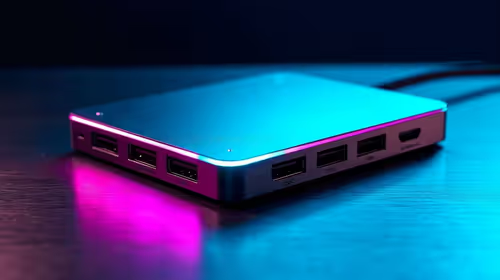
Upgrade your setup with the best USB-C hubs for creators. Discover why high-capacity card readers and dual 4K output are essential for professional South African content production. 🚀💻

B850 motherboard FPS drops needs a methodical troubleshooting pass. Review drivers, thermals, power settings, background apps, cables and game settings before replacing parts in an SA gaming setup.
NVIDIA lists 550W required system power for the RTX 5060 reference specification, based on a high-end test system. A quality 550W unit can be enough, but CPU draw, transient load, connectors and ageing decide real headroom.

OpenRGB's master branch now carries changes labelled for 1.0 final, including translation and platform work, but the official tags page still lists 1.0rc3.1 as the newest packaged release. Stable users should wait for the signed release channel.
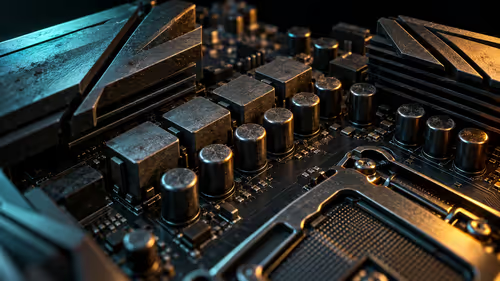
A motherboard can remain useful for many years when power, cooling and connectors stay healthy. Replace it for confirmed faults, damaged power delivery or a blocked platform need, not simply because the calendar reaches a fixed age.

The VAIO T combines a 13.3-inch display with a multi-flip mechanism for laptop, tablet and outward-facing viewing modes. Orders begin in Japan on 18 September; South African availability is unconfirmed.
NVIDIA lists 550W required system power for the RTX 5060 reference specification, based on a high-end test system. A quality 550W unit can be enough, but CPU draw, transient load, connectors and ageing decide real headroom.
The VAIO T combines a 13.3-inch display with a multi-flip mechanism for laptop, tablet and outward-facing viewing modes. Orders begin in Japan on 18 September; South African availability is unconfirmed.
OpenRGB's master branch now carries changes labelled for 1.0 final, including translation and platform work, but the official tags page still lists 1.0rc3.1 as the newest packaged release. Stable users should wait for the signed release channel.

The Cooler Master GPU Shield Adapter monitors current on individual 12+4-pin contacts, adds visual and audible warnings, and can reduce system power during a severe abnormality. Local availability is unconfirmed.