Quick Answer
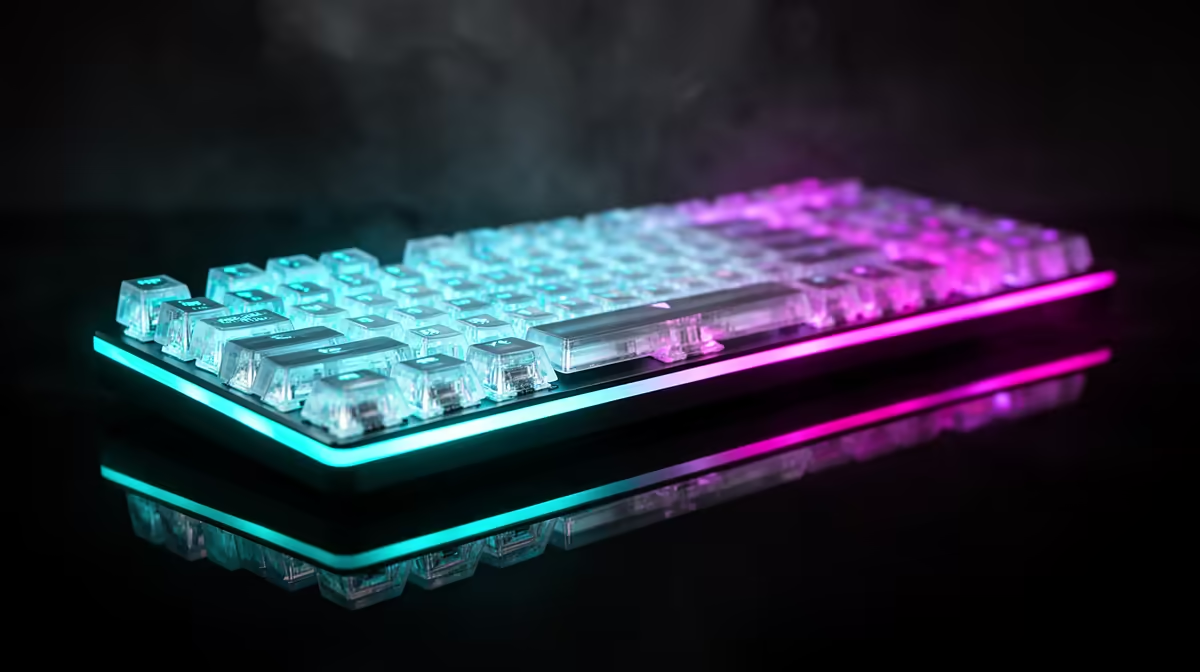
Analog optical switches in gaming keypads use infrared light beams to detect exact key travel depth, outputting a continuous value instead of a binary on/off. This allows variable-speed movement, dual-actuation per key, and adjustable sensitivity curves that standard mechanical switches cannot replicate.
How Analog Optical Switches Work From Top to Bottom 🔬
A standard optical switch fires one signal when the key stem interrupts the light beam at a fixed depth. An analog optical switch goes further: the sensor reads the intensity of reflected or partially blocked light across the full travel range, converting that reading into a position percentage from 0 to 100. The keypad firmware maps this value to an analog axis in the driver, identical to a USB gamepad thumbstick. Travel range on most analog optical switches is 1.5 to 3.6 mm, and the actuation threshold is software-adjustable anywhere within that range.
Configuring Analog Output for Different Game Types 🎮
The driver interface for analog optical keypads presents each key's travel zone as a graph. For FPS movement, set a sharp linear curve: any press past 1.0 mm outputs 100 percent velocity, giving crisp digital-style response while retaining the option to walk by pressing shallowly. For racing and driving games, set a gradual S-curve: the first 40 percent of travel covers 0 to 30 percent throttle, then the curve steepens for the final travel section, mimicking real pedal feel. For RPG and MMO ability keys, keep the curve linear and use the two-zone feature to map a buff ability to a shallow press and an ultimate ability to a full press.
Longevity, Maintenance, and Value in the SA Market 💰
Analog optical switches have no metal contacts to oxidise or spring fatigue to develop over time. The common failure modes of mechanical switches (double-clicking, sticky actuation, creep in the return spring) are structurally absent. A gaming keypad with analog optical switches in the R1,500 to R2,200 range will likely outlast two or three standard mechanical keyboards used as input alternatives. The higher upfront cost amortises quickly for players who game four or more hours daily. Maintenance is limited to occasional compressed air cleaning of the key cap wells to remove dust that can settle on the optical sensor, which is a two-minute process.
Calibrate After Cleaning ⚡
After cleaning dust from your keypad, run the sensor calibration utility in your keypad driver before your next session. Dust accumulation can slightly offset the baseline light reading, causing a perceived shift in where analog actuation begins. A fresh calibration resets the zero-point and restores precise actuation accuracy.
FAQ
Are analog optical switches compatible with all games?
Digital mode (standard key output) works in every game. Analog mode requires the game to accept DirectInput or XInput controller signals. Most modern games support this; check the game's input settings for controller support. Games with strict keyboard-only requirements disable analog output automatically.
How do I know if my keypad uses true analog optical switches?
True analog optical keypads explicitly advertise adjustable actuation points and variable output in their spec sheet. Look for phrases like analog mode, adjustable actuation, or dual-zone actuation in the product listing. Standard optical switches without analog capability register only at a fixed point.
Can I use analog optical switches for productivity and not just gaming?
Yes. The keypad functions as a standard USB HID device in digital mode, making it a conventional input device for any productivity application. Many creative professionals use gaming keypads for shortcut-heavy workflows in Photoshop, Premiere, and DaVinci Resolve.
Interested in full analog control from a keyboard layout?
Evetech carries gaming keypads with analog optical switches, adjustable actuation, and cloud profile support. Browse the keypad category to compare features and pricing in ZAR.