Quick Answer
For high-performance SA builds, size the radiator to exceed your CPU's sustained TDP by at least 20%, cap fan speeds at 1,200 RPM during everyday use through a custom curve, and prioritise case airflow over cooler brand name for the most effective noise-to-performance trade-off.
Radiator Size Selection for High-Performance CPUs 🌡️
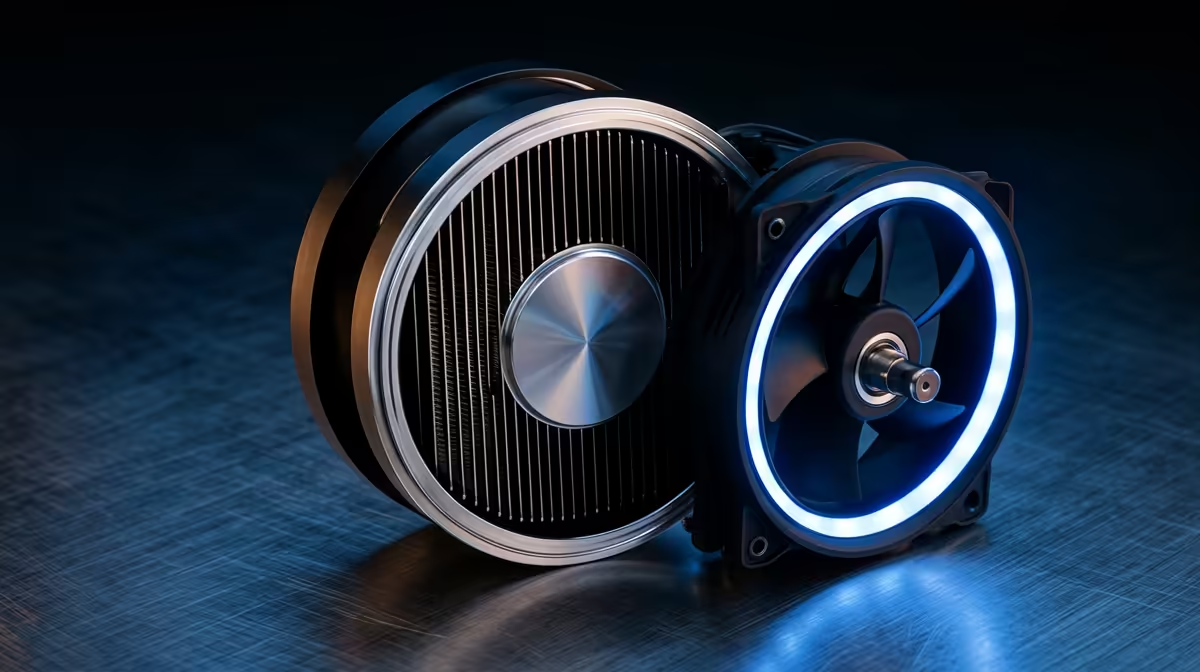
High-performance CPUs like the AMD Ryzen 9 9950X and Intel Core i9-14900KS sustain 150 to 170W under all-core workloads, which requires a radiator capable of dissipating that thermal load continuously without coolant temperature rising beyond 40 degrees Celsius. A 360mm radiator achieves this comfortably when paired with three 120mm fans running at 1,000 to 1,200 RPM. A 240mm radiator on the same CPU forces the fans to spin above 1,600 RPM to maintain equivalent temperatures, which roughly doubles the noise output.
Fan Speed Targets for Daily Use and Peak Gaming 🎮
A noise-optimised fan curve for a high-performance SA gaming build targets 800 to 1,000 RPM at idle and light browsing, stepping to 1,000 to 1,200 RPM during active gaming, and reaching 1,600 RPM or above only during CPU stress events like extended rendering or compiling. At 1,000 RPM, most quality 120mm fans produce around 20 to 22 dB, which is below the ambient noise floor of most home and office environments. Setting this curve in BIOS takes under 10 minutes and immediately separates an audibly noisy PC from a near-silent one without changing any hardware.
Noise Priorities Across Different SA Use Contexts 🔊
The acceptable noise level for a PC varies significantly across SA use cases. A dedicated gaming room at a suburban Johannesburg home has more acoustic tolerance than a Wits university residence room shared between two students, where PC fan noise interferes with a roommate's studying. A home office setup doubling as a video call workstation requires near-silent operation during business hours, while the same machine can run at higher fan speeds during after-hours gaming.
Prioritise Front-Intake Radiator Placement in Warm SA Rooms ⚡
A front-mounted radiator intake draws cooler external air directly from outside the case before it has been heated by the GPU or PSU, which is a thermal advantage in warm ambient conditions. Top-mounted radiator exhaust pulls from air that has already passed over hot components, typically running 3 to 5 degrees Celsius warmer than a dedicated front intake on the same build.
FAQ
Is a 420mm AIO worth considering for extreme high-performance SA builds?
A 420mm AIO, using three 140mm fans, offers greater airflow at lower RPM compared to a 360mm unit with three 120mm fans. This is a genuine quiet-build advantage for extreme CPU cooling loads. The limiting factor is case compatibility; fewer SA-available cases support a 420mm radiator position compared to 360mm, so verify case specs before committing.
Does high SA summer ambient temperature permanently harm CPU cooling ability?
No. CPU cooling systems are dynamic: fans adjust speed to compensate for higher ambient temperature. The consequence is louder fans during summer, not component damage. The CPU's thermal shutdown protection activates before any permanent heat damage occurs. Proactive airflow management, such as improving room ventilation, addresses the root cause.
Should I use push, pull, or push-pull fan configuration on a 360mm radiator?
For most builds, a single row of three push fans (fans pushing air through the radiator) is sufficient and requires no additional hardware. Adding a pull row of three additional fans (fans pulling air through the opposite side of the radiator) reduces temperatures by an additional 2 to 4 degrees Celsius at the cost of R600 to R1,200 for the extra fans. Push-pull is a worthwhile upgrade for the highest-TDP processors in warm ambient environments.
Ready to cool your high-performance SA build properly?
Browse the full CPU cooler range at Evetech to find radiator sizes and fan configurations matched to your processor and room conditions.