Quick Answer
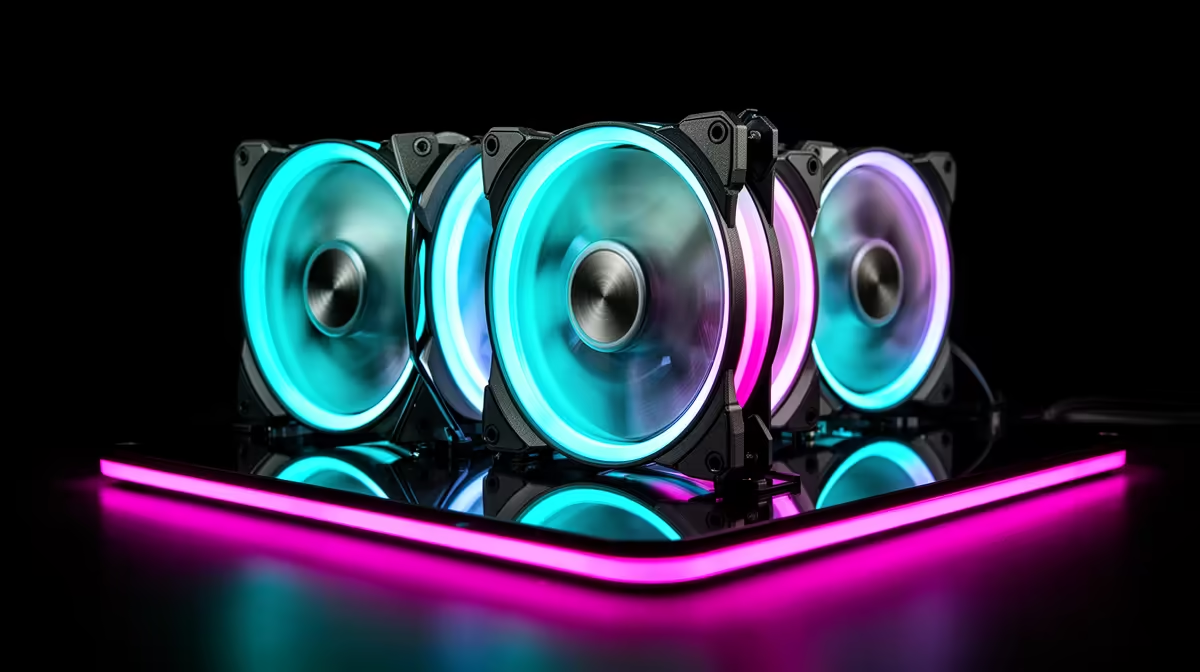
Yes, four pre-installed ARGB fans provide adequate airflow for the vast majority of gaming builds, including those with an RTX 5080 and a Ryzen 9 9900X, provided they are configured in a balanced intake and exhaust pattern. The configuration matters more than the fan count: three intakes and one exhaust, or two intakes and two exhausts, both outperform four fans all pushing the same direction.
How Fan Count and Configuration Affect Temperatures 🔧
A typical mid-tower gaming build generates substantial heat from two sources: the GPU, which can output 300W to 480W at full load, and the CPU, which contributes 65W to 170W. Effective case cooling requires fresh cool air entering the case, flowing past heat sources, and exhausting warm air out. Four 120mm fans at adequate total throughput handle this comfortably for single-GPU builds without extreme overclocking. The typical pre-installed fan setup on R2,000 to R3,500 cases includes three front intakes and one rear exhaust, creating positive pressure that limits dust ingress. This configuration keeps an RTX 5080 at around 70 to 78 degrees Celsius under sustained gaming load in a 25-degree room, within the card's safe operating range.
When You Might Need More Than Four Fans 🖥️
Four fans becomes the limiting factor in specific scenarios. If your case houses a 360mm AIO radiator, those three fans are assigned to the cooler, leaving only one chassis fan. Adding one or two additional chassis fans restores proper case airflow. For an RTX 5090 running at 575W TDP with a top-tier CPU in a South African summer room at 30 to 35 degrees Celsius, additional rear and top exhaust fans improve thermal headroom. ARGB fan hubs bundled with many mid-tower cases support six or more fans, so adding two more later is straightforward and costs R300 to R700 for a quality pair.
Do ARGB Fans Perform as Well as Plain Fans? 💡
The LED components in ARGB fans have no measurable effect on airflow compared to equivalent plain fans. Airflow and static pressure ratings are determined by blade design, motor speed, and hub geometry. Premium ARGB fans match plain fans at identical RPM. Budget ARGB fans bundled with low-cost cases sometimes prioritise LED diffusion over blade efficiency. Replacing stock fans in a R1,000 to R1,500 budget case with quality aftermarket ARGB fans at R150 to R250 per unit is a cost-effective upgrade if noise or thermal performance is a concern.
Set a Custom Fan Curve for SA Summer ⚡
Use your motherboard's fan control software to create a temperature-responsive fan curve rather than running fans at a fixed speed. A curve that ramps fans from 800 RPM at idle to 1,400 RPM above 75 degrees GPU temperature keeps the system quiet during web browsing and responsive during gaming without constant high-RPM noise.
FAQ
Does fan brand matter for ARGB lighting sync?
ARGB fans synchronise via 5V 3-pin ARGB headers on the motherboard or a hub. Most major motherboard brands support standard 5V ARGB protocol, so any ARGB fan using that protocol syncs correctly. Fans using proprietary connectors require their own controller.
How loud are four ARGB fans during gaming?
At 1,000 to 1,200 RPM, four 120mm fans produce 28 to 33 dB, quieter than most GPU coolers at full load. Many mid-tower cases pre-install PWM-controlled fans that automatically reduce speed when temperatures drop.
Will SA summer temperatures require extra fans in my gaming PC?
For extreme builds in uncooled rooms reaching 35 degrees Celsius, two additional fans provide useful thermal buffer. Standard mid-range builds with an RTX 5070 and Ryzen 7 9700X manage adequately with four well-configured fans even in SA summer.
Need a case that comes ready to perform with ARGB lighting included?
Evetech stocks mid-tower cases with pre-installed ARGB fans across a range of budgets, all available for delivery across South Africa.