Quick Answer
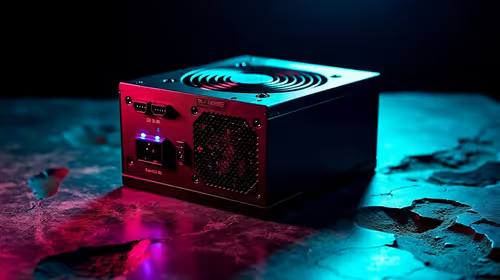
Yes. GaN MOSFETs reduce switching losses at high frequencies, which means the PSU converts more mains power to usable DC and dissipates less as heat. In gaming scenarios where load fluctuates rapidly between 200W and 600W, a GaN-based PSU maintains high efficiency across the load range rather than peaking only at a specific wattage.
The Physics Behind GaN's Thermal Advantage 🔬
Silicon MOSFETs have a property called gate charge (Qg) that determines how much energy is wasted with every switching cycle. At the 50 to 200 kHz switching frequencies used in PC PSUs, silicon's Qg losses add up to several watts of continuous heat generation inside the unit. GaN has a gate charge roughly ten to twenty times lower than silicon, so switching losses are dramatically reduced. A typical 1000W silicon Gold PSU might dissipate 80 to 90W internally at full load. A GaN-based equivalent at Titanium rating can drop internal dissipation to 50 to 55W, a 35 to 40 percent reduction in waste heat at the same output power.
Thermal Impact on Fan Behavior and Case Temperatures 🌡️
Fewer watts wasted as heat inside the PSU directly translates to lower PSU exhaust temperature. Many GaN PSUs extend their zero-RPM fan mode to higher load thresholds, sometimes staying fanless up to 40 to 50 percent of rated load, which on a 1000W unit means near-silent operation below 400 to 500W. During gaming sessions on an RTX 5070 Ti build where average load stays around 350 to 450W, a GaN PSU can run silently for extended periods. Additionally, a cooler PSU means slightly less heat being exhausted into the case through the PSU intake fan when it does spin, which helps overall chassis thermal management.
Efficiency Across the Partial Load Range 💡
Standard 80 Plus ratings measure efficiency at 20 percent, 50 percent, and 100 percent of rated load. Gaming workloads frequently land in the 30 to 60 percent range, which is between the 20 percent and 50 percent test points. GaN PSUs tend to maintain high efficiency across this intermediate range because the switching losses are proportional to switching frequency rather than load percentage, unlike conduction losses in silicon. Practically, a GaN 80 Plus Titanium unit running a system at 45 percent load might achieve 93 to 94 percent efficiency where a standard Gold unit hits 89 to 90 percent at the same point. Over a gaming year of 1,500 hours, that gap translates to roughly R120 to R200 in electricity savings at South African Eskom residential rates.
GaN PSUs Pair Well With High-Airflow Cases ⚡
A GaN PSU's extended silent fan mode means your case fans do more of the overall system exhaust work. Pairing a GaN unit with a case that has strong front-to-rear airflow ensures the reduced PSU heat output does not create stagnant warm zones inside the chassis. Evetech stocks mesh-front cases purpose-built for high-airflow builds.
FAQ
Are GaN PSUs noticeably quieter than traditional silicon models?
In light to moderate gaming loads (under 500W), yes. The extended zero-RPM threshold on GaN designs keeps the PSU fan off for longer periods. At full load, fan noise is similar between GaN and high-quality silicon units.
Do GaN MOSFETs affect PSU compatibility with any hardware?
No. GaN is a manufacturing technology for the internal switching components. The output connectors, voltage rails, and compatibility with GPUs, CPUs, and motherboards are identical to conventional designs.
How much more do GaN PSUs cost in South Africa compared to Gold silicon units?
Premium GaN units carry a R600 to R1,500 premium over comparable wattage 80 Plus Gold silicon units in SA. The gap is narrowing as GaN becomes more mainstream, with several 850W GaN Platinum options entering the R3,200 to R3,800 range in 2025 and 2026 production runs.
Want a quieter, cooler, and more efficient PSU for your gaming PC?
Evetech stocks GaN-equipped and high-efficiency power supplies for every build tier, with local warranty coverage across South Africa.