Quick Answer
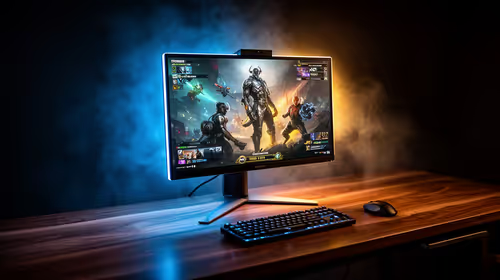
Yes, 250 Hz produces measurable reductions in display latency and motion blur versus 144 Hz. The advantage over 165 Hz or 240 Hz is incremental but real in competitive shooters where players can sustain 200+ FPS consistently.
The Physics Behind Higher Refresh Rates 🎮
At 144 Hz, a new frame arrives every 6.94 ms. At 250 Hz that interval drops to 4 ms. In CS2 or Valorant, a 2.94 ms faster frame delivery keeps moving targets' positions more current on screen, reducing aim correction lag. Combine this with a 0.5 ms GtG Fast-VA or IPS panel and total display-side latency sits well under 5 ms. The catch: your GPU must sustain 250+ FPS. An RTX 5070 or RX 9070 XT clears this easily in Valorant at 1080p; demanding AAA titles at 1440p may not.
What SA Competitive Players Report 🏆
South African esports players consistently rate the jump from 144 Hz to 240/250 Hz as the most impactful refresh rate upgrade in ranked CS2 and Valorant. The community consensus across SA Discord servers is that 250 Hz makes opponent movement distinctly easier to track in close duels. For casual players averaging below 150 FPS, the benefit is largely placebo. For ranked players with capable hardware, 250 Hz is a genuine upgrade.
Hardware Requirements to Fully Utilise 250Hz ⚙️
For Valorant at 1080p, even an RTX 4070 Super comfortably exceeds 250 FPS. In CS2 at 1080p, the RTX 5070 clears it with headroom. At 1440p in demanding titles, consistent 250 FPS becomes harder and 165 Hz or 240 Hz may be more practical. A 250 Hz monitor in South Africa ranges from around R5,500 for entry IPS models to R12,000 for premium Fast-VA options, stocked at Evetech.
Enable VRR Alongside 250Hz ⚡
A 250Hz monitor with FreeSync Premium or G-Sync Compatible gives you smooth performance when your GPU hits 250 FPS and tear-free variable sync when it dips. Always enable the VRR range in the monitor OSD alongside the high refresh mode for full benefit.
FAQ
Does 250Hz matter for casual gaming?
For casual single-player or media use, 250 Hz offers negligible advantage over 144 Hz. The benefit is specific to competitive multiplayer where reaction time and target tracking affect match results.
Can mid-range GPUs drive 250Hz in esports titles?
Yes. RTX 50-series and RX 9000-series mid-range GPUs from Evetech's lineup sustain 250+ FPS comfortably in Valorant and CS2 at 1080p.
Is 250Hz worth the premium in South Africa?
If competitive gaming is your primary use and your GPU supports the frame rates, yes. The price gap over 144 Hz has narrowed considerably and the in-game difference in ranked play is real.
Want the edge in competitive play?
Evetech stocks 250Hz gaming monitors across panel types and price points. Head to the gaming monitor section to compare specs and find your next display.