Quick Answer
No. HDMI Ethernet Channel (HEC) is a largely unused feature that virtually no consumer device or TV in South Africa actually implements. It has no effect on 4K video or audio quality, and you should not factor it into your cable buying decision.
What HDMI Ethernet Channel Actually Is 📡
HEC was introduced in HDMI 1.4 as a way to share a single internet connection across multiple HDMI-connected devices using a dedicated 100Mbps data channel embedded in the cable. The idea was that one device with a wired internet connection could distribute that connection to other HDMI devices, eliminating extra Ethernet cables. In practice, TV manufacturers, streaming devices, and AV receivers almost universally ignored HEC in their firmware and hardware implementations. As of 2026, no mainstream SA-market TV, PS5, Xbox, or streaming stick actually uses HEC. The feature exists in the spec but not in the field.
What Actually Matters for 4K Cable Buying 🔧
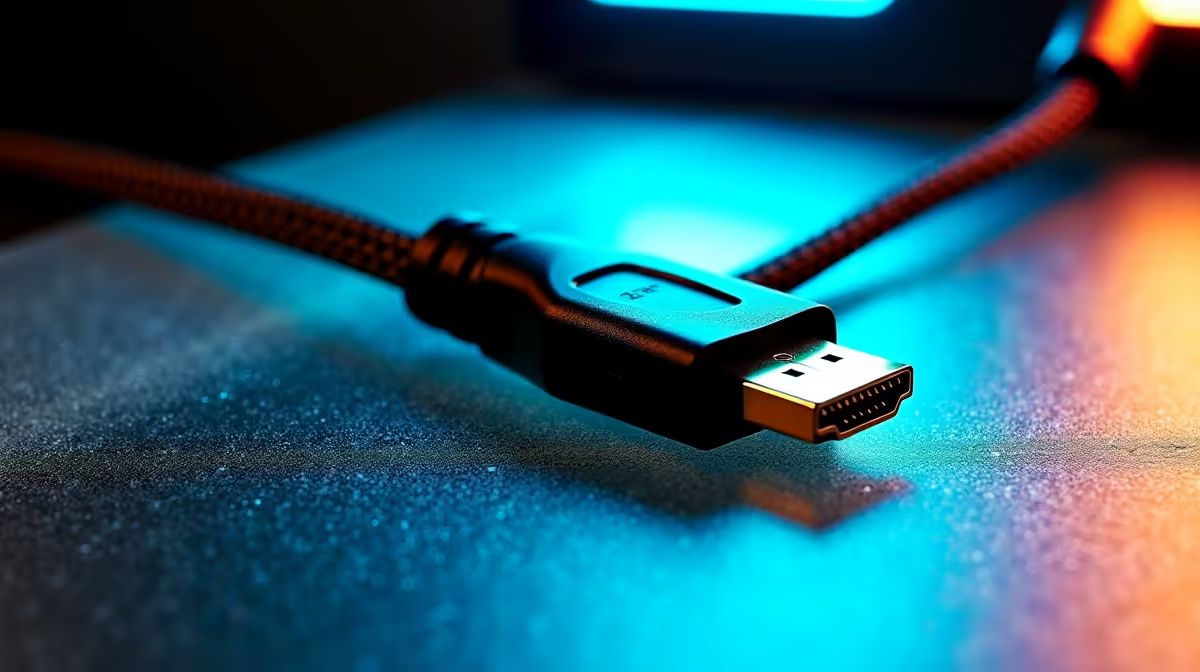
Instead of chasing HEC, focus on three real variables. First, bandwidth: an 18Gbps (HDMI 2.0) rating for 4K 60Hz, or 48Gbps (HDMI 2.1) for 4K 120Hz. Second, cable length: passive copper cables are reliable up to 5m at 18Gbps; beyond that, active cables are required. Third, build quality: look for gold-plated connectors and braided shielding, which reduce signal interference in environments with many wireless devices. South African fibre providers like Vumatel and Openserve deliver internet over a home router via Wi-Fi or Ethernet, not via HDMI, so HEC is irrelevant to your connectivity setup.
HEC vs ARC vs eARC: Understanding the Difference 🔊
HEC, ARC, and eARC are three distinct HDMI channel features and are often confused. ARC (Audio Return Channel) lets a TV send audio back to an AV receiver or soundbar over the same HDMI cable used for video, avoiding a separate optical cable. eARC is the enhanced version, supporting lossless Dolby TrueHD and DTS:X audio formats at higher bandwidth. Both ARC and eARC are genuinely useful and widely implemented in SA-market TVs and soundbars. If you are buying a cable to connect a soundbar via HDMI, confirm it supports eARC. HEC, by contrast, can be safely ignored. All HDMI 2.0 cables support ARC; eARC requires an HDMI 2.1 cable.
Use the eARC Port for Soundbar Connection ⚡
modern SA-market TVs have one dedicated eARC port, usually HDMI port 1 or 2, clearly labelled on the back panel. Connect your soundbar or AV receiver to this port rather than a standard HDMI port to unlock Dolby Atmos and DTS:X passthrough without a separate optical cable. This is far more useful than the theoretical HEC feature.
FAQ
Can HEC replace my Wi-Fi or Ethernet connection to my TV?
In theory, HEC could supply internet to a TV from a connected device. In practice, no SA-market TV or connected device implements HEC, so your TV will still require its own Wi-Fi or Ethernet connection.
Will buying an HDMI cable without HEC labelling hurt my 4K setup?
Not at all. HEC is absent from almost all consumer HDMI cables on the market regardless of labelling, and its absence has zero effect on 4K video, HDR, or audio performance.
Does ARC work on all HDMI ports on my TV?
No. ARC and eARC are only active on one or two designated HDMI ports, usually labelled on the TV's rear panel. Plugging your soundbar into a non-ARC port disables the audio return function even if your cable supports it.
Looking for the right cable for your 4K TV or soundbar?
Evetech stocks HDMI 2.0 and 2.1 cables that support ARC and eARC, suited to SA lounge and gaming setups with same-day dispatch options.