


PCIe 5.0 vs PCIe 4.0 for Video editing in 4k in SA
PCIe 5.0 vs PCIe 4.0 for video editing in 4k is mainly about fit, features, compatibility, cost, and upgrade path, not one automatic winner. SA buyers should match the choice to the setup.
Read moreFor home studio upgrades the dynamic microphone specs that matter most are sensitivity, frequency response and the gain your interface can supply, since dynamics need 60dB. A cardioid dynamic rejects room noise a sensitive condenser would capture.
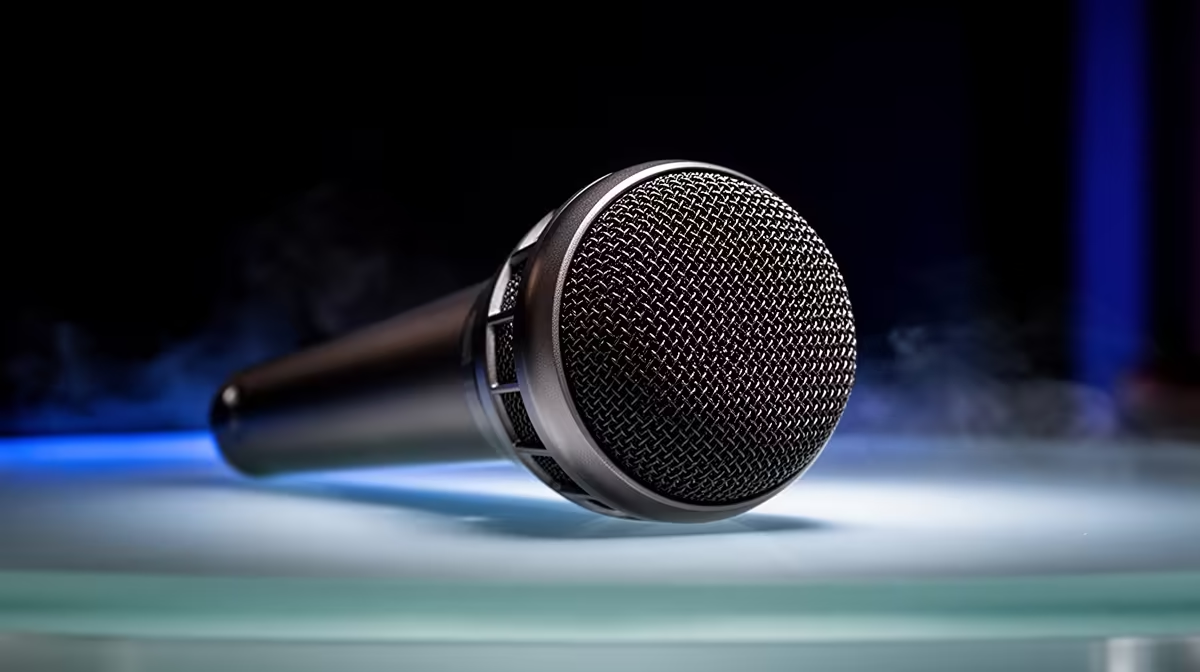
Dynamic microphones are often described as forgiving, and that description is accurate but incomplete. They are forgiving of loud sources and noisy rooms, but they are demanding of the rest of the signal chain in ways the spec sheet does not always make obvious. Dynamic microphone specifications for home studios matter because a wrong purchasing decision here does not announce itself immediately. The mic arrives, sounds a little quiet, and the creator spends weeks blaming the room when the real issue is a mismatched interface preamp. Knowing which numbers to check before buying saves that frustration entirely.
For a home studio dynamic mic, the specs that matter most are sensitivity rating, frequency response curve and the amount of clean gain your interface provides. Dynamics need at least 55 to 60dB of clean gain. A tailored frequency response with a presence lift near 5kHz improves vocal clarity. Polar pattern and max SPL are secondary concerns for most home applications.
Sensitivity is the spec that catches the most home studio buyers off guard. It measures how much output voltage the microphone produces for a given input sound level, and dynamic mics produce significantly less output than condenser mics at the same source volume.
A typical dynamic microphone has a sensitivity rating between -55dBV and -60dBV. A condenser might sit at -32dBV to -38dBV. That gap of 20 to 25dB means the dynamic mic needs proportionally more gain from the interface preamp to reach a usable signal level. On a preamp that maxes out at 40 to 45dB of gain, a quiet dynamic mic will produce a thin, hissy recording regardless of how the room sounds.
The practical minimum for a dynamic mic in a home studio is 55 to 60dB of clean gain from the preamp. "Clean" is the second keyword: gain that is technically present but accompanied by hiss from a weak preamp circuit is not usable gain. Check the interface specifications for both the maximum dB figure and the noise floor rating, expressed as equivalent input noise (EIN). A lower EIN number is better. Aim for under -127dBu EIN if the interface spec sheet provides it.
Some popular broadcast-style dynamic mics, the deep-capsule cardioid types used widely in professional audio, have sensitivity figures below -55dBV and genuinely need 60dB of gain to sit at a comfortable level without boosting the noise floor. Pairing one of these with a basic entry-level interface is an expensive mistake.
Mid-range audio interfaces in the R800 to R1,200 price range are common entry points in the South African market. Many of these provide 40 to 48dB of gain, which is sufficient for condenser mics. For dynamic mics it leaves the signal underdriven unless the voice source is very close to the capsule and the recording environment is very quiet. A two-channel interface in the R1,500 to R2,000 range typically delivers 60 to 65dB of clean gain, which is the floor for dynamic mic use.
A flat frequency response, one that reproduces all frequencies at equal level, is the target for measurement microphones and instrument recording. For vocals, particularly for streaming and broadcast applications, a shaped response is often the better choice.
The feature to look for is a presence lift, which is a broad rise in sensitivity between roughly 4kHz and 8kHz. This range is where the consonants that carry intelligibility sit, the sharp edges of "s", "t", "k" and "f" sounds. A mic with a lift in this region makes spoken voice sound cleaner, more forward and more distinct. In a home studio without acoustic treatment, this added clarity helps the voice cut through room reflections that would otherwise muddy it.
The counterpoint is that a presence lift can make sibilant voices harsher. If a recording already has too much "ss" sharpness, a flat or slightly rolled high-frequency response is the better match. Look at the full datasheet graph when available and note whether the lift is gradual or steep.
The low-end response is worth checking too. Many dynamic mics exhibit proximity effect, a bass boost that grows closer to the capsule. At 10 to 15cm it adds warmth, but on some voices it muddies the low end. A high-pass filter at around 80 to 100Hz addresses this.
the microphone manufacturer publishes a frequency response graph, look at the 150Hz to 300Hz range in the curve. A broad dip in this area on a broadcast-style dynamic is intentional: it reduces the boxy midrange resonance that home studios often struggle with. A mic that shows a lift in that range rather than a dip will sound noticeably more nasal and coloured in an untreated room.
Cardioid is the polar pattern for almost all home studio dynamic applications, and it is specified on most studio dynamics. The cardioid pattern listens forward and rejects sound from the rear by roughly 20dB or more at the 180-degree position. In a home studio where the rear null can be pointed at the primary noise source, whether that is a PC tower, a window facing a street, or a noisy neighbour, that rejection is meaningful.
The depth of the rear null varies between models. Some cardioid dynamics achieve 25dB of rear rejection or better. Others offer closer to 15 to 18dB at the nominal 180-degree point but have a wider null zone that tolerates inexact positioning. If a spec sheet does not specify rear rejection precisely, checking the published polar diagram is worth the extra minute.
Hypercardioid and supercardioid dynamics exist, and they offer stronger side rejection at the cost of a small rear lobe. These are worth considering in rooms where the main noise sources are beside the desk rather than behind it, but for most home studio setups with a PC at the rear of the desk, the clean rear null of a standard cardioid is more practically useful.
Two specs that appear prominently in dynamic mic datasheets are maximum SPL (sound pressure level) and self-noise. For home studio use, neither is typically a meaningful differentiator.
Maximum SPL on a dynamic mic is usually rated at 140dB or above. A vocalist at typical home recording levels, even a loud one close to the capsule, does not approach 130dB at the capsule surface. Unless you are recording a live kick drum or placing the mic inside a loud amplifier cabinet, SPL handling is not a constraint you will encounter.
Self-noise is the mic's own electronic noise floor in the absence of any sound source. Dynamic mics have no active circuitry, so their self-noise is intrinsically lower than condenser mics. The noise you hear in a quiet dynamic recording almost always originates from the interface preamp rather than the mic itself, which brings the discussion back to the gain and EIN figures that matter most.
Dynamic mics produce far less output voltage than condensers at the same input volume, typically 20 to 25dB less. That means the interface preamp has to apply significantly more gain to reach a usable level. If the preamp cannot deliver 55 to 60dB of clean gain, the signal will be quiet or visibly noisy on the recording. Sensitivity is not adjustable on the mic itself, so matching it to an interface with adequate clean gain is the critical purchase decision.
A tailored curve with a gentle presence lift between 4kHz and 8kHz is preferred for broadcast and streaming vocals, since this range carries consonant intelligibility and adds clarity in untreated rooms. Check the full frequency response graph, particularly the midrange character around 150 to 300Hz where some mics are voiced darker than others.
A minimum of 55 to 60dB of clean gain. Mid-range interfaces in the R800 to R1,200 range often provide 40 to 48dB, enough for condenser mics but short of what most dynamics need. Moving to the R1,500 to R2,000 tier typically delivers the 60 to 65dB required.
Yes. A cardioid dynamic rejects around 20dB or more from the rear, which in a home studio you can point at the primary noise source, a PC fan, a window, a loud neighbour. The depth and width of the rear null varies between models, and a mic with a clean 25dB rear null is more useful than one with a shallow 15dB null. For most home studio setups, standard cardioid is the right choice over supercardioid or hypercardioid alternatives.
Required interface gain is by far the most overlooked specification. Most buyers read the frequency response and sensitivity figures, then pair the mic with an entry-level interface that technically provides gain but cannot deliver enough of it cleanly for a quiet dynamic capsule. The combination produces a thin, slightly hissy recording that is easy to misdiagnose as a room problem or a poor mic choice, when the actual constraint is an underpowered preamp.
Ready to match your dynamic microphone to a signal chain that does it justice? Browse the full range of XLR dynamic microphones and matching audio interfaces and build a home studio setup where the specs actually line up.
Dynamic mics produce far less output voltage than condensers at the same input volume, typically 20 to 25dB less. That means the interface preamp has to apply significantly more gain to reach a usable level. If the preamp cannot deliver 55 to 60dB of clean gain, the signal will be quiet or visibly noisy on the recording. Sensitivity is not adjustable on the mic itself, so matching it to an interface with adequate clean gain is the critical purchase decision.
A tailored curve with a gentle presence lift between 4kHz and 8kHz is preferred for broadcast and streaming vocals, since this range carries consonant intelligibility and adds clarity in untreated rooms. Check the full frequency response graph, particularly the midrange character around 150 to 300Hz where some mics are voiced darker than others.
A minimum of 55 to 60dB of clean gain. Mid-range interfaces in the R800 to R1,200 range often provide 40 to 48dB, enough for condenser mics but short of what most dynamics need. Moving to the R1,500 to R2,000 tier typically delivers the 60 to 65dB required.
Yes. A cardioid dynamic rejects around 20dB or more from the rear, which in a home studio you can point at the primary noise source, a PC fan, a window, a loud neighbour. The depth and width of the rear null varies between models, and a mic with a clean 25dB rear null is more useful than one with a shallow 15dB null. For most home studio setups, standard cardioid is the right choice over supercardioid or hypercardioid alternatives.
Required interface gain is by far the most overlooked specification. Most buyers read the frequency response and sensitivity figures, then pair the mic with an entry-level interface that technically provides gain but cannot deliver enough of it cleanly for a quiet dynamic capsule. The combination produces a thin, slightly hissy recording that is easy to misdiagnose as a room problem or a poor mic choice, when the actual constraint is an underpowered preamp.
PCIe 5.0 vs PCIe 4.0 for video editing in 4k is mainly about fit, features, compatibility, cost, and upgrade path, not one automatic winner. SA buyers should match the choice to the setup.
Read more
Wi-Fi 7 vs Wi-Fi 6e for competitive esports comes down to router support, latency goals, device compatibility, and coverage. SA buyers should match the choice to the real network setup.
Read more
ATX 3.1 vs ATX 3.0 for mMO and live-service games buyers - what changes is mostly about compatibility, budget, upgrade path, and setup fit. SA buyers should check device support and real needs before expecting a clear win from either option.
Read more
LGA 1851 vs LGA 1700 can affect Twitch and YouTube streaming when gaming and encoding share CPU resources. For SA creators, the real-world difference depends on encoder choice, memory support, motherboard cost, thermals, and upgrade plans.
Read more
X870E vs X670E for aaa single-player gaming is mainly about fit, features, compatibility, cost, and upgrade path, not one automatic winner. SA buyers should match the choice to the setup.
Read more
Hall Effect switches vs Mechanical switches for mMO and live-service games is mostly about compatibility, budget, upgrade path, and setup fit. SA buyers should check device support and real needs before expecting a clear win from either option.
Read more
A fake 113GB GTA VI ISO reportedly used empty padding around a small malware payload. SA gamers should delete unofficial builds, keep Windows security active and wait for official channels.

Wi-Fi 6E vs Wi-Fi 6 matters for 4K video editing when files move across a network. The real-world difference between Wi-Fi 6E and Wi-Fi 6 for video editing in 4K depends on NAS access, cloud uploads, router range, and SA creator workflows.

The difference between PCIe 5.0 and PCIe 4.0 for SA gamers is mostly bandwidth headroom. Compare GPU slot needs, NVMe speed, motherboard support, and upgrade timing before paying extra for a newer platform.

Gaming PC stuck pixel checks in South Africa should confirm the monitor fault first. Use colour tests, screenshot comparison, cable swaps, display menu checks, and clear photos before deciding on support.

Shokz OpenFit Air 2 earbuds weigh 7.2g each and use a redesigned dual-driver open-ear layout. SA buyers should choose them for comfort and awareness, not maximum isolation.

AMD's current driver now lists a Radeon RX 9050 4GB, while product coverage details a narrowed memory system. SA buyers should weigh the low VRAM ceiling against current local Radeon options.

Samsung Display has demonstrated a 16-inch 2.5K OLED laptop panel running at 300Hz. SA buyers should wait for a named notebook, full panel specifications and a local price before planning an upgrade.

Microsoft says some Windows 11 game crashes after recent updates are linked to RGB-related drivers. Affected SA gamers should confirm the update and driver before using the published registry workaround.
Shokz OpenFit Air 2 earbuds weigh 7.2g each and use a redesigned dual-driver open-ear layout. SA buyers should choose them for comfort and awareness, not maximum isolation.
A fake 113GB GTA VI ISO reportedly used empty padding around a small malware payload. SA gamers should delete unofficial builds, keep Windows security active and wait for official channels.

The ROG Flux Charger Dock combines 260W total output, 140W laptop charging and HDMI 2.1. SA buyers should check laptop USB-C limits, display needs and local warranty first.

ASRock's Rock 360 Digital AIO adds a 1.05-inch CPU temperature display, 360mm radiator and simplified wiring. SA builders should check case fit, socket support and local warranty.