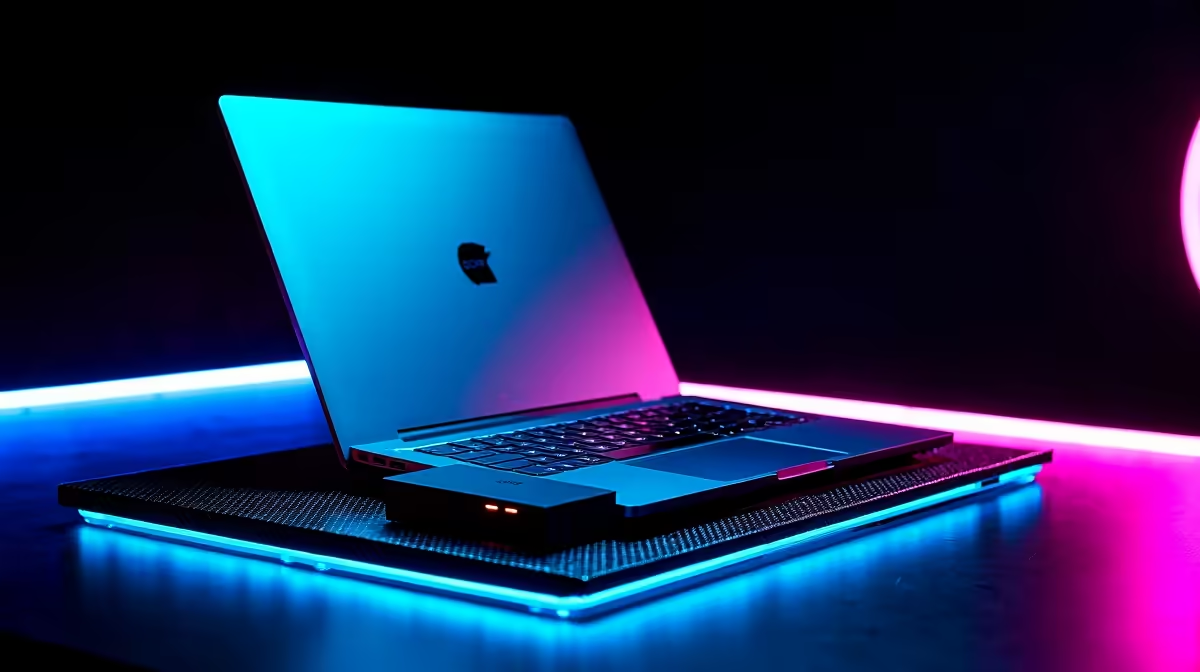
Two paths promise serious gaming from a portable machine, and they pull in opposite directions. A gaming laptop packs everything into one chassis you can carry anywhere. An eGPU keeps a thin, light laptop and adds a full desktop graphics card in an enclosure on your desk. Which one games harder for the money depends entirely on whether you play at a desk or on the move, and the honest answer surprises people on both sides.
Quick Answer
For raw performance per Rand at a desk, an eGPU paired with a thin laptop wins, because it runs a full desktop GPU you can upgrade later, while a gaming laptop's mobile GPU is power-capped and soldered in. But the eGPU only works at the desk: the enclosure and its power supply are not portable. A gaming laptop games anywhere. Choose by where you actually play.
The core trade-off: soldered mobile versus upgradeable desktop
This is the heart of it. A gaming laptop uses a mobile GPU that is soldered to the board. You cannot replace it, and it runs at a lower power limit than the desktop card of the same name to fit the laptop's cooling and battery. A mobile version of a card is meaningfully slower than its desktop namesake.
An eGPU sidesteps both limits. You drop a full desktop graphics card into an external enclosure, connect it to a thin laptop, and that laptop suddenly drives desktop-class graphics. Better still, when a new generation lands you swap the card rather than replacing the whole machine.
So on pure performance and longevity, the eGPU has structural advantages. The catch is everything around that performance.
Where the eGPU loses: portability and the connection tax
The eGPU's strengths come with real costs.
It is not portable
The enclosure houses a full graphics card and its own power supply. It is a box that lives on your desk and plugs into mains power. You do not carry it to a friend's place or a coffee shop. A thin laptop plus an eGPU is a desktop replacement that happens to free your laptop when you leave the desk, not a portable gaming rig.
The connection costs performance
An eGPU connects over Thunderbolt or USB4, and that link has less bandwidth than the direct connection a desktop or a built-in laptop GPU enjoys. The result is an overhead: a desktop card in an enclosure loses some performance compared to the same card inside a desktop tower. It still beats a mobile GPU comfortably, but you do not get the full desktop number.
The total cost adds up
You are buying three things: the thin laptop, the enclosure, and the desktop graphics card. Add them up and an eGPU setup can cost more than a gaming laptop of similar headline power. The value comes later, when you upgrade only the card instead of the whole machine.
Where the gaming laptop wins: one box, anywhere
A gaming laptop's case is simple. Everything is integrated and tuned to work together, and it games on a plane, in a lecture hall, or on the couch with no desk required. There is no connection overhead, because the GPU sits right next to the CPU.
For students moving between res and home, for anyone short on desk space, or for people who genuinely game in different places, that portability is worth more than the last slice of performance. A capable gaming laptop is the simpler, more flexible buy.
The downside is the ceiling. When the mobile GPU ages, your only upgrade is a new laptop. You trade long-term upgradeability for all-in-one convenience today.
Which setup is right for you
Decide on your real habits, not the spec you wish you used.
- You play almost entirely at a desk and want the most power per Rand over years: an eGPU with a thin laptop. You get desktop-class graphics now and a card you can upgrade later. To see what enclosures and connectivity options exist, the docking and dock station range at Evetech is a useful starting point for the link between laptop and card.
- You game in more than one place, or want simplicity: a gaming laptop. One machine, no enclosure, plays anywhere.
- You are unsure and mostly mobile: lean gaming laptop. The eGPU rewards a desk-bound life specifically.
If you go the eGPU route, the card is where most of your money and performance live, so it is worth seeing which models are popular right now in the best-selling graphics cards at Evetech before you commit.
The thunderbolt requirement people miss
One detail catches eGPU buyers off guard: the thin laptop has to support the connection in the first place. An eGPU needs a Thunderbolt or USB4 port with the right protocol, and not every thin and light laptop has one. A USB-C port alone is not enough, since it may lack the data lanes an eGPU needs. Before committing to this path, confirm the exact port on your laptop, because the whole setup depends on it.
There is also a driver and compatibility layer to consider. eGPUs generally work well now, but hot-plugging the enclosure, juggling the laptop's own integrated graphics, and getting games to run on the external card rather than the internal one can take a little setup. It is far less plug-and-play than a gaming laptop, where everything is configured out of the box. For a confident user that is a minor speed bump, but it is worth knowing the eGPU route asks slightly more of you.
A note on longevity and resale
The upgradeability argument deserves weight because it changes the long-term maths. With a gaming laptop, the day the soldered GPU feels slow, your only move is selling the whole machine and buying another. With an eGPU, you keep the laptop and the enclosure and swap only the card, spending money on the one part that actually aged.
Over several years and a couple of GPU generations, that difference can be substantial. The eGPU owner rides each new card generation for the cost of the card alone, while the laptop owner faces a full machine replacement each cycle. If you are a desk-bound gamer who plans to stay current, that compounding saving is the strongest argument in the eGPU's favour, well beyond the headline performance number.
Frequently Asked Questions
Is an eGPU faster than a gaming laptop?
At a desk, usually yes, because it runs a full desktop GPU rather than a power-capped soldered mobile one. There is some performance lost over the Thunderbolt or USB4 link, but it still beats a mobile GPU of the same name.
Can I take an eGPU with me like a laptop?
No. The enclosure holds a full graphics card and power supply and needs mains power, so it stays on your desk. The thin laptop travels, but the eGPU does not, which is the main reason to choose a gaming laptop if you move around.
Why is a laptop GPU slower than the desktop version?
Because it is power-capped to fit the laptop's cooling and battery, and it is soldered in so it cannot be upgraded. A mobile card runs at lower wattage than its desktop namesake, which is why the two perform differently despite sharing a name.
Does an eGPU lose performance over the cable?
Yes, some. Thunderbolt and USB4 carry less bandwidth than a direct internal connection, so a desktop card in an enclosure runs a little slower than in a tower. The loss is real but modest, and the card still outpaces a mobile GPU.
Which is cheaper overall?
A gaming laptop is often cheaper up front. An eGPU setup costs more initially because you buy a laptop, an enclosure, and a card, but it saves money long term since you upgrade only the card instead of the whole machine.