Quick Answer
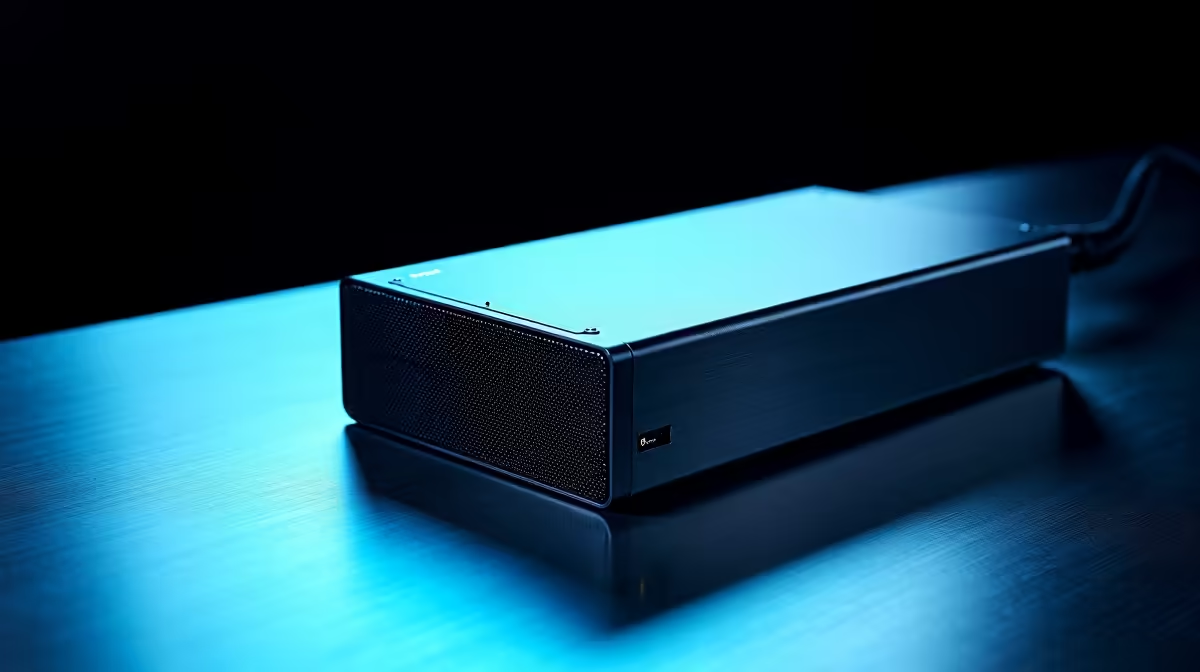
A PSU with 0dB fan mode runs the internal fan at zero RPM when system load stays below roughly 30% to 40% of rated wattage. For a 1,000W unit in a typical desktop gaming session at 400W to 500W draw, the fan stays off entirely, making the PSU acoustically invisible. At full load, intelligent fan curves spin up gradually rather than snapping to maximum speed.
How 0dB Mode Works in Practice 🔧
Modern PSUs implement 0dB (also called Fanless, Zero RPM, or Hybrid mode) through a thermal controller that monitors internal component temperatures rather than just load percentage. Below a set junction temperature, typically 40 degrees C on the PSU internals, the fan signal is cut completely. The fan switches on smoothly once either the temperature threshold or the load threshold is crossed. Units like the ASUS ROG Thor use a Dual Ball Bearing fan with a custom 135mm impeller that spins as slowly as 200 RPM when it does activate, generating under 20 dBA. Comparing that to an aging PSU fan running at 1,500 RPM (around 35 dBA) makes the difference immediately apparent in a quiet room.
Intelligent Cooling Fan Curves 🌡️
Beyond simple 0dB thresholds, intelligent PSU cooling uses NTC thermistors placed at hotspot locations (primary capacitors, main transformer, and output rectifiers) to feed a microcontroller that maps fan speed to the highest temperature reading rather than load alone. This matters in South Africa's summer months, when ambient temperatures in Gauteng and the Western Cape can reach 35 degrees C or higher. A unit that ramps fan speed to 600 RPM when ambient hits 35 degrees C keeps internals safely below 60 degrees C without audible intrusion. Check that any PSU you buy lists a maximum operating temperature of at least 50 degrees C, which confirms the thermals are rated for warm South African rooms.
Case Layout and PSU Noise 💨
Case orientation affects PSU fan noise more than most builders realise. In a standard mid-tower with a bottom-mounted PSU bay, the fan faces downward and draws air through a mesh intake, isolating fan noise from the open panel. Fan-facing-up orientations push hot air through the main case interior and run hotter, which means the PSU fan spins faster for longer. Pair a 0dB PSU with a case that has a good PSU shroud and a filtered bottom intake to get the full acoustic benefit. At idle the result is a system where the CPU and GPU coolers are the only audible noise source.
Toggle Hybrid Mode Correctly ⚡
Most 0dB PSUs include a physical switch or software toggle to enable or disable hybrid mode. Leave it enabled for everyday desktop work and gaming. Disable it (forcing the fan to run continuously) only during sustained workstation loads above 70% rated wattage to give the PSU extra thermal margin during hours-long render jobs.
FAQ
Is it safe to run a PSU fan at 0 RPM?
Yes, at low to moderate loads. The 0dB threshold is engineered so internals stay within safe temperature limits without the fan. The controller activates the fan automatically before any component reaches a damaging temperature.
Will a 0dB PSU run hotter over time?
Not significantly. The thermal headroom built into the passive threshold means internal temperatures during 0dB operation are conservatively managed. Over years of use, capacitor aging has a larger effect on lifespan than brief high-temperature excursions during gaming.
Do all high-end PSUs have 0dB modes?
Most premium 80 Plus Platinum and Titanium units above 750W include 0dB or hybrid modes. It is rare on Gold-rated units under 650W. Check the specifications before purchasing.
Want a whisper-quiet build without sacrificing performance?
Evetech stocks premium PSUs with 0dB hybrid fan modes from leading brands. A silent PSU is the foundation of a low-noise build, and the range at Evetech covers 850W through 1,600W.