Quick Answer
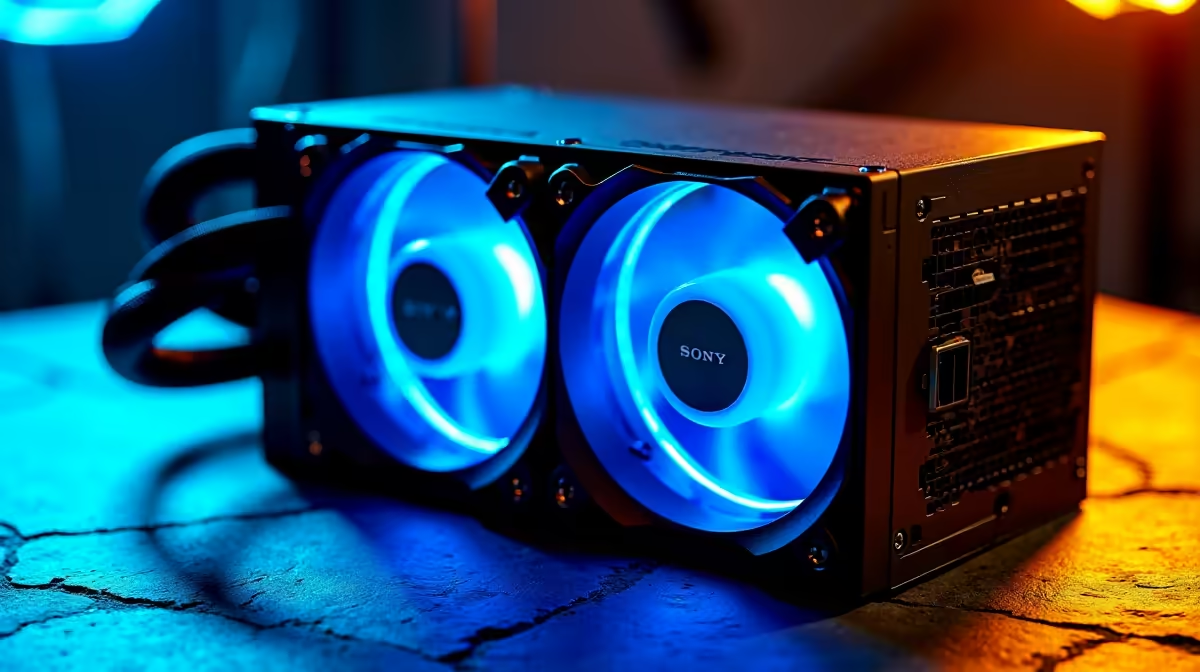
Dual ball bearing fans outlast sleeve-bearing fans by a factor of two to three in PSU applications, with rated lifespans of 80,000 to 100,000 hours versus 30,000 to 50,000 hours. They maintain consistent noise and airflow across temperature extremes, making them the right choice for PSUs in South African conditions where summer ambients push operating temperatures well above lab norms.
How Dual Ball Bearings Differ From Sleeve Bearings 🔧
A sleeve bearing fan uses a lubricated metal sleeve around the shaft, relying on oil film separation between shaft and bearing surface. Over time, heat vaporises the lubricant and the shaft contacts the sleeve directly, accelerating wear and increasing noise. A dual ball bearing fan replaces the sleeve with two precision ball races, one at each end of the shaft. Steel balls support the shaft mechanically, making the design indifferent to orientation and far less sensitive to operating temperature. For a PSU expected to run in a mid-tower for seven or more years, bearing type is one of the most reliable longevity predictors you can confirm before purchase. Quality 850W to 1200W PSUs with dual ball bearing fans start from around R3,200 to R5,800 locally at Evetech.
Noise Consistency and SA Summer Performance 🖥️
Sleeve bearing fans typically become noisier as lubricant degrades, often producing a low-frequency grinding sound within three to five years in warm environments. A dual ball bearing fan maintains its noise signature within a narrow band for most of its rated lifespan: the noise level at year seven is measurably similar to year one, assuming the fan stays clean. For South African users cleaning systems every three to four months during dusty winters, a dual ball bearing PSU fan will reliably remain under 25 dBA at gaming loads across a normal ownership cycle. Ball bearings operate effectively from below zero to above 70 degrees Celsius internal fan temperature, versus sleeve bearings that become sluggish below 10 degrees and degrade faster above 50 degrees. At the 45 to 55 degrees common inside a South African PSU during summer gaming, a ball bearing fan is well within specification while a sleeve bearing fan has already consumed a meaningful fraction of its lubrication life.
Listen at Startup for Early Bearing Wear ⚡
A healthy dual ball bearing PSU fan produces a brief, smooth spin-up at boot with no ticking or grinding. Early bearing wear often appears as a soft rhythmic clicking in the first few seconds before settling into normal rotation. If you hear this at boot, assess the PSU before the bearing seizes and causes overheating.
FAQ
Are fluid dynamic bearings better than dual ball bearings for PSU fans?
Fluid dynamic bearings have lower noise floors and comparable lifespan in moderate temperature environments. At very high operating temperatures, dual ball bearings hold an advantage. For PSUs facing the highest system temperatures, ball bearings are the more robust long-term choice.
Does fan bearing type correlate with PSU warranty length?
PSU manufacturers investing in dual ball bearing fans typically also use higher-quality capacitors, which correlates with longer warranty periods. Units offering seven-to-ten-year warranties almost invariably use ball or FDB fans rather than sleeve bearings.
Can a PSU fan be replaced if the bearing fails before the unit does?
PSU internals carry mains voltage and should only be serviced by qualified technicians. Opening the unit voids the warranty in most cases. If a PSU fan fails early, claiming under warranty or replacing the unit is the appropriate action rather than a DIY fan swap.
Investing in a PSU that lasts?
Evetech stocks power supplies with dual ball bearing and FDB fans across 650W to 1600W ratings. Browse the power supply range for units built for long-term reliability.