Spec sheets for creator graphics cards read like a foreign language until someone explains what each line actually means for your work. VRAM, bus width, clock speed, and dedicated AI hardware all sound impressive side by side, but each one solves a different problem. This breakdown walks through every major spec on a 24gb creator graphics card, one at a time, using real numbers rather than vague claims.
Quick Answer
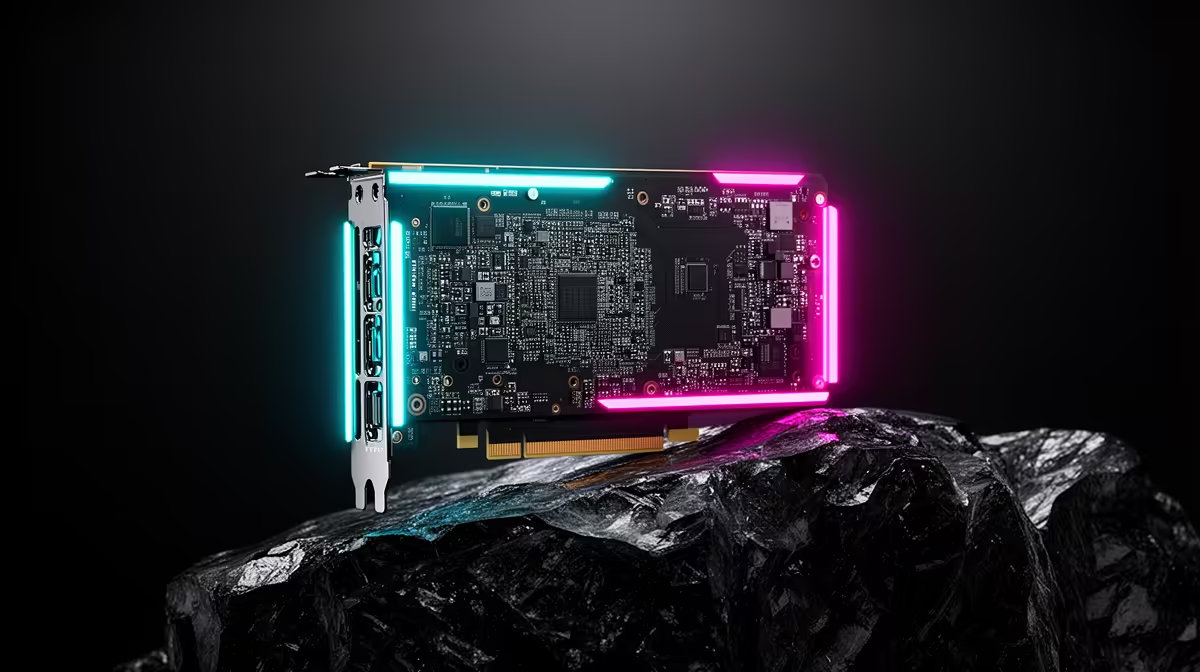
The specs that matter most on a creator GPU are VRAM capacity, memory bus width, clock speed, and dedicated AI acceleration, each solving a distinct part of a creative workload. Carrying a R14,399 asking price, the ASRock Intel Pro B60 Creator brings 24GB of GDDR6, a 192-bit bus, a 2400 MHz clock, and XMX AI engines together on a single card built for exactly this mix of needs.
💾 VRAM Capacity: Why 24GB Is the Headline Number
VRAM is the GPU's own dedicated memory, separate from your system's regular RAM, and it holds everything the graphics card needs immediate access to while working, textures, geometry, cached frames, and more. Run out of it, and the GPU starts shuffling data back and forth with slower system memory, which shows up as stutters, dropped frames, or a viewport that suddenly feels sluggish.
What 24GB Actually Buys You
Twenty-four gigabytes puts real distance between this card and entry-level options that top out at 8GB or 12GB, which matters once a project scales up. A layered 4K or 6K video timeline with multiple colour grades, or a 3D scene carrying several 4K texture maps across dozens of objects, can consume VRAM quickly, and having capacity in reserve means the GPU keeps more of that data close at hand rather than constantly reloading it.
🚌 Memory Bus Width and Clock Speed, Working Together
Capacity is only half of the memory equation. Bandwidth, how quickly data actually moves in and out of that 24GB pool, comes from multiplying bus width by clock speed, and both numbers on this card were chosen to work as a pair rather than in isolation.
The 192-Bit Bus Explained
Think of the memory bus as the width of a highway between the GPU chip and its memory. A 192-bit bus is wider than what you would find on many budget cards, letting more data move per clock cycle. On its own, a wide bus without enough capacity behind it, or a large capacity pool moving data too slowly, would each create a different bottleneck; here the two are matched.
The Role of a 2400 MHz Clock
Clock speed determines how many operations the GPU's execution units complete every second, directly affecting how fast shading, ray tracing, and compute tasks get processed once data has arrived. Running at 2400 MHz, this card keeps that side of the equation moving fast enough that the bandwidth from its 192-bit bus does not go to waste sitting in a queue.
🧮 Architecture and AI Engines Explained
Beyond raw memory numbers, the underlying architecture and any dedicated AI hardware determine how efficiently the card turns its specs into actual output.
Intel Xe2-HPG Architecture
This card runs on Intel's Xe2-HPG architecture, which organises execution units, ray tracing hardware, and cache to handle mixed rasterisation, ray tracing, and compute workloads rather than optimising purely for gaming frame rates. That distinction matters for creators, since real-world projects rarely stress just one of those workloads in isolation.
XMX Engines for AI-Driven Tasks
Sitting alongside the main architecture, XMX engines accelerate the matrix math behind AI-driven features, denoising, upscaling, and smart object detection among them, that increasingly appear inside editing and 3D software. Offloading that work to dedicated hardware frees the rest of the GPU to keep processing the primary render or edit without interruption.
DirectX 12 Ultimate Support
Full DirectX 12 Ultimate compatibility ties these pieces together at the software level, letting compatible applications call on ray tracing, mesh shading, and variable rate shading directly, rather than falling back to older, less efficient rendering paths.
💵 Matching These Specs to a Real Workload and Budget
None of these numbers matter in isolation; what matters is whether they line up with what you actually do day to day. A video editor working primarily in 1080p and 4K may lean more heavily on the VRAM capacity and bandwidth, while a 3D artist doing complex lighting work will value the dedicated ray tracing hardware more directly. At R14,399, this 24GB GDDR6 card positions itself for buyers who need genuine capacity rather than just a fast clock speed on paper. Comparing it against the workstation GPU range helps confirm whether this particular balance of specs suits your workload, and checking more from ASRock's lineup shows how it sits within the brand's broader creator-focused options.
Frequently Asked Questions
Which spec matters most for video editing, VRAM or clock speed?
VRAM capacity tends to matter more for editing, since running out of it causes stutters, while clock speed affects how quickly processed frames get delivered once data is already loaded.
Does a wider memory bus always mean better performance?
Only when paired with enough capacity and clock speed to use that bandwidth. A wide bus alone does not compensate for insufficient VRAM.
What do XMX engines do that the main GPU cannot?
They accelerate AI-specific matrix calculations separately from general shading and compute work, so AI-driven features do not slow down the rest of the render pipeline.
Is 2400 MHz a high clock speed for a creator GPU?
It is a solid, workload-appropriate clock speed for this card's architecture and intended use, rather than a number chased purely for gaming benchmarks.
Do I need to understand all these specs before buying?
Not in full depth, but knowing that VRAM handles capacity, bus width and clock speed handle bandwidth, and architecture plus AI engines handle processing helps you judge whether a card fits your actual workload.
Does DirectX 12 Ultimate support change how these specs perform?
Yes, it standardises how creative software calls on the architecture's ray tracing and shading capabilities, meaning the other specs get used more consistently across different applications rather than depending on custom support for each one.
Is it worth paying more for a card with every spec maximised?
Only if your workload genuinely uses that headroom. Matching specs to your actual projects, rather than simply buying the highest number available in every category, tends to be the better use of a fixed budget.
Ready to have every spec explained in plain terms?
Explore the Intel Pro B60 Creator GPU on Evetech's creator GPU lineup, listed for R14,399 and works to line up VRAM, memory bus and XMX engine count for creative work.