


Using GitHub Copilot: Complete Beginner's Guide for SA Developers
Using GitHub Copilot: Complete Beginner's Guide for SA Developers. Everything you need to know with SA-specific pricing and recommendations.
Read moreA head-to-head look at nvme ssd: real-world performance, ZAR pricing and which option delivers better value for SA builders. The clear answer — no fluff.
Waiting for your PC to boot up shouldn't feel like waiting for load shedding to end. If you are upgrading your storage, you have probably drowned in a sea of acronyms. From Gen4 bandwidth limits to IOPS ratings, getting the right drive means understanding the jargon to maximise your hard-earned ZAR value. Here is every NVMe SSD specification explained so you can make the absolute smartest upgrade choice.
When you look at a new drive, the massive numbers printed on the box are usually sequential speeds. Read speed dictates how fast your system can pull large chunks of data from the drive. This is exactly what makes your massive open-world games load in mere seconds. Write speed is how quickly the drive can save data. This matters most when you are installing massive game updates or rendering large video files.
When you browse through the best gaming PC deals, you will notice these storage speeds proudly displayed. A high read speed ensures your operating system feels incredibly snappy from the moment you press the power button.
Sequential speeds are fantastic for moving large files, but everyday computing relies on random read and write speeds. This is measured in IOPS (Input/Output Operations Per Second). High IOPS and low latency mean your drive can find tiny, scattered pieces of data almost instantly.
Whether you are opening a dozen browser tabs or booting up heavy software, low latency keeps things perfectly smooth. Even the sleekest machines from our massive range of laptops for sale in South Africa rely heavily on low latency NVMe drives to feel instantly responsive during heavy multitasking.
Another vital specification is TBW (Terabytes Written). This indicates the lifespan of your drive. A higher TBW means the drive can endure more data being written and erased over its lifetime before it starts to fail.
High-speed solid state drives generate serious heat under heavy loads. Always ensure your motherboard includes an M.2 heatsink to prevent thermal throttling. If your drive gets too hot, it will automatically slow down to protect itself, ruining your peak performance.
The connection standard your drive uses determines its maximum possible speed. Having read speed, write speed, latency, and PCIe generation compared helps you avoid overspending on hardware your system cannot fully utilise.
PCIe Gen3 drives typically max out around 3,500 megabytes per second. They are incredibly affordable and perfect for budget builds. PCIe Gen4 doubles that bandwidth to roughly 7,500 megabytes per second. This is the current sweet spot for modern gaming and high-end productivity. Finally, PCIe Gen5 pushes boundaries up to a blistering 14,000 megabytes per second... but you pay a premium for that bleeding-edge technology.
Remember that PCIe slots are backwards compatible. You can easily put a Gen4 drive in a Gen3 motherboard slot, but it will only run at Gen3 speeds. Upgrading your motherboard to support faster hardware generations is much easier when you grab the right components from our daily specials page.
Ready to Supercharge Your System? Now that you understand the specs, it is time to leave slow loading screens in the dust. Explore our massive range of solid state drives and find the perfect storage solution to conquer your digital world.
The SSDs, tools and accessories referenced in this article are stocked at Evetech.co.za with local SA warranty, ZAR pricing and nationwide delivery.
It depends on your workload and budget. We break down the key performance differences, SA pricing gap and the scenarios where each one is the smarter buy.
Real-world gaming performance varies by title and settings. The article covers head-to-head FPS benchmarks and the resolutions where the gap actually shows up.
We compare current Rand pricing from trusted SA retailers and show which option delivers more performance per Rand for your build tier.
Each option has clear wins and compromises covered in the article — from power draw and thermals to platform cost, upgrade path and feature set.
Using GitHub Copilot: Complete Beginner's Guide for SA Developers. Everything you need to know with SA-specific pricing and recommendations.
Read more
Back-to-School Headset Buying Guide for SA 2026. Everything you need to know with SA-specific pricing and recommendations.
Read more
Mesh Front Panel Setup and Configuration: Complete Tutorial. Comprehensive coverage with SA insights, Rand pricing, and practical recommendations.
Read more
Black Screen: Troubleshooting Guide #1. Everything you need to know with SA-specific pricing and recommendations.
Read more
The Complete 2026 Guide to Storage in South Africa. Everything you need to know with SA-specific pricing and recommendations.
Read more
1000W PSU Not Working After Load Shedding: Recovery Guide. Everything you need to know with SA-specific pricing and recommendations.
Read more
AMD RX 9050 XT: Rumoured Specs, Price & Release. SA-focused analysis with local pricing data, real-world insights & actionable buying advice.
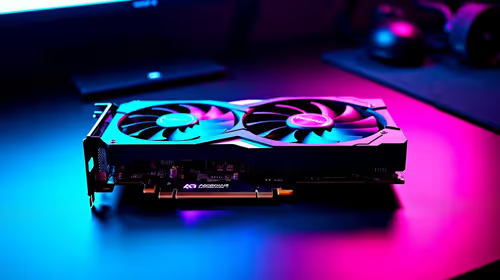
Can RTX 4080 Super Run AI Workloads for SA Developers Detailed answer with SA data, expert analysis & practical recommendations for local buyers.
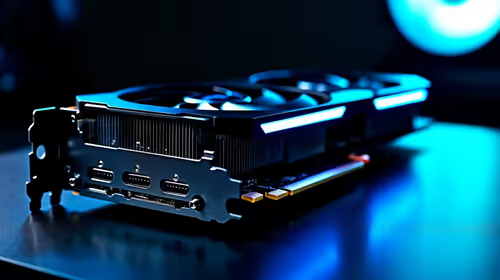
Can RTX 4090 Run AI Workloads for SA Developers Detailed answer with SA data, expert analysis & practical recommendations for local buyers.
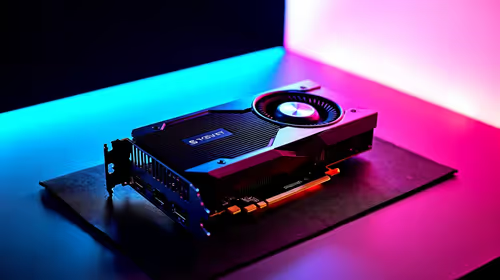
Top Settings for Intel Arc B580 at Ultrawide 1440p picks evaluated on performance, value & SA availability with current Rand pricing from Evetech.

RTX 4060 CS2 Low Settings at 1080p: FPS Results. Real-world benchmark data, FPS numbers & performance analysis. What SA gamers can actually expect.

Visual Artifacts: Possible GPU Issue Issue #1. Diagnosis steps, proven fixes & when to seek professional help. SA-specific support info included.
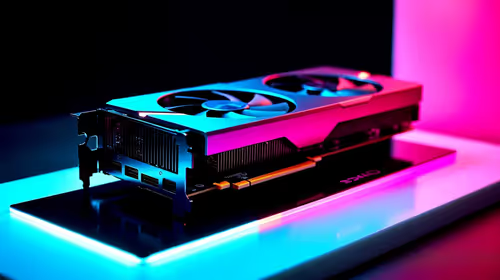
Can the RTX 4090 Handle 1440p 144Hz Gaming. Performance testing verdict with real data & practical recommendations for SA buyers.

Top ASUS GPU Under R15000 picks evaluated on performance, value & SA availability with current Rand pricing from Evetech.
GTA 6 Max Settings on RTX 5070. Tested & verified settings for best FPS and visual quality on SA hardware budgets.
Cyberpunk 2077 Max Settings on RTX 5080. Tested & verified settings for best FPS and visual quality on SA hardware budgets.
Starfield Max Settings on RTX 5070 Ti. Tested & verified settings for best FPS and visual quality on SA hardware budgets.
Top RTX 5090 Under R5000 picks evaluated on performance, value & SA availability with current Rand pricing from Evetech.