Quick Answer
Triple-shielded display cables reduce electromagnetic interference (EMI) through three sequential barriers: an inner foil wrap around individual signal pairs, a braided copper mesh around the full cable core, and a sealed outer jacket. Together these reject interference from nearby power cables, wireless devices, and high-wattage PC components, preventing the bit errors and link resets that appear as screen artefacts at high resolutions.
What EMI Is and Where It Comes From in a Gaming Setup 🔌
Electromagnetic interference is electrical noise radiated by any device that switches current rapidly. In a modern South African gaming PC, EMI sources are everywhere: the switching PSU, GPU power delivery regulators, RGB controller boards, mechanical keyboard controllers, and phone chargers all radiate at various frequencies simultaneously. These radiated fields couple into unshielded cables, inducing voltages on signal lines. At 1080p the bandwidth is low enough that differential signalling rejects this noise. At DisplayPort 1.2's 21.6Gbps, signal transitions are so densely packed that minor induced noise causes bit errors manifesting as pixel corruption or link resets.
How the Three Shield Layers Work Together 🔧
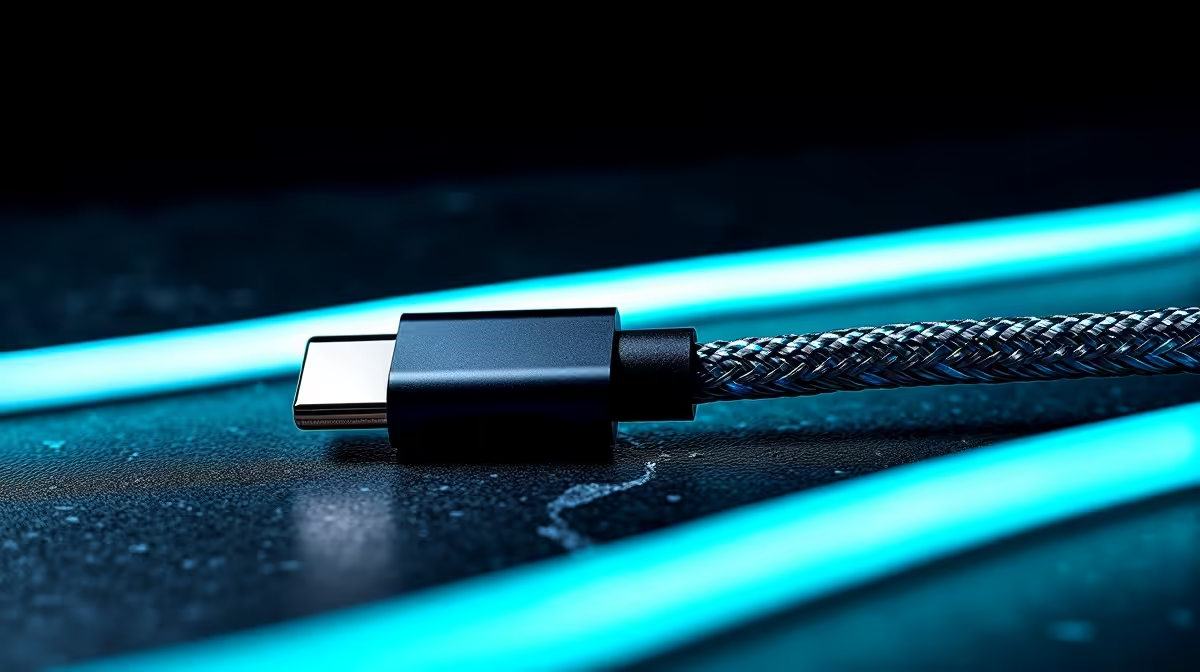
The inner aluminium or polyester foil wraps each twisted pair individually, providing high-frequency EMI rejection from nearby digital circuitry and preventing crosstalk between different signal pairs inside the cable. The braided copper mesh surrounding the full cable bundle handles mid-frequency interference (1MHz to 100MHz) from PSUs, motors, and power distribution. Braid coverage of 85% to 95% is typical on quality products. The outer PVC jacket seals against moisture and abrasion that would physically degrade the inner shielding over time, particularly in South African coastal environments.
Real-World Impact for SA Gaming and Professional Setups 🎮
For a South African gamer running an RTX 5080 on a 4K@60Hz display, the difference between single-shielded and triple-shielded cables becomes clear in noisy setups: PCs near NAS drives, large UPS units, networking switches, or in older buildings with legacy wiring common in Johannesburg's established suburbs. Triple-shielded cables mitigate 50Hz mains interference from adjacent power leads entirely. Professional video suites benefit even more: proximity to SDI cabling and broadcast equipment creates a demanding environment where shielding quality directly affects colour accuracy and output quality.
Route Cables Away from PSU Bundles ⚡
In gaming towers, display cables often run parallel to the PSU cable bundle on the back of the desk. Keep at least 5cm clearance from any PSU cable to maximise the shielding's effectiveness and reduce residual interference pickup.
FAQ
Does triple shielding apply to HDMI cables as well?
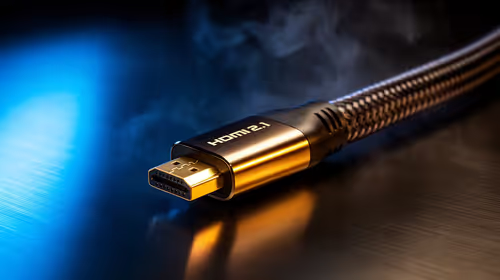
Yes. The same EMI physics applies to HDMI. High-speed HDMI 2.0 and 2.1 cables carrying 4K and 8K signals are equally susceptible to interference. Triple-shielded HDMI cables deliver the same reliability improvements in noisy environments.
Can I test for EMI interference causing display artefacts at home?
Move suspected EMI sources away from the cable one at a time while watching for screen artefacts. If artefacts disappear when a specific device is moved, that device is the likely interference source. A triple-shielded cable often eliminates the symptom even without relocating the source.
Is triple shielding worth it for 1080p displays?
At 1080p@60Hz, single-shielded cables work adequately in most clean environments. The triple-shielding premium is justified primarily at 1440p and above, where higher signal frequency increases susceptibility to ambient EMI.
Building a clean, stable display chain for gaming or professional use?
Evetech stocks triple-shielded DisplayPort and HDMI cables for South African setups that demand reliable high-resolution signal delivery.