Quick Answer
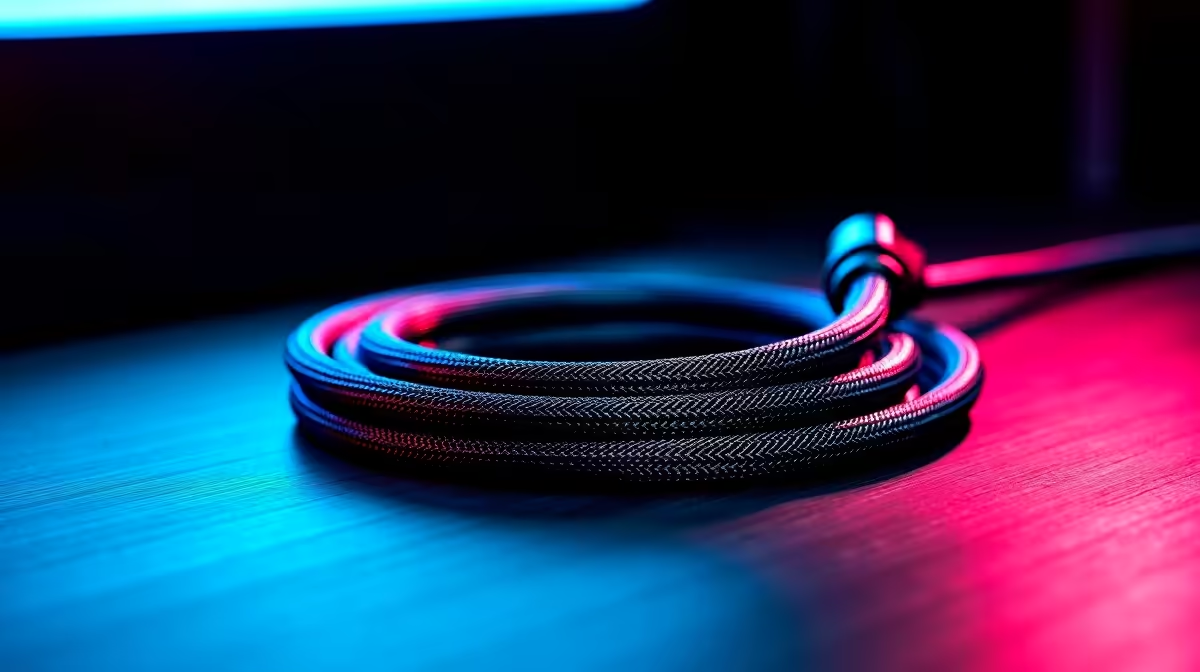
Triple-shielded video cables wrap signal conductors in three layers: aluminium foil against high-frequency interference, a copper braid against broadband EMI, and an outer conductive jacket that blocks external fields. The result is measurably lower noise and more stable 4K or high-refresh output compared to single-shielded cables.
How EMI Disrupts Display Signals 📡
Electromagnetic interference enters a cable through induction from nearby sources: power cables running parallel, USB chargers, and fluorescent office lighting. Inside an unshielded cable, this noise adds to the differential signal pairs carrying pixel data. At 1080p at 60Hz the cable has enough error headroom that minor interference rarely causes visible issues. At 4K at 144Hz or 1440p at 240Hz the signal timing is far tighter, and even small noise spikes cause pixel errors, black flashes, or dropped connections. SA offices that share conduit runs with high-amperage equipment see this more often than home setups.
The Three Shielding Layers Explained 🔧
The first layer, aluminium foil wrapped around the conductor pairs, blocks high-frequency radiated emissions above 100MHz where display signalling noise concentrates. The second layer, a copper braid woven around the foil, catches lower-frequency interference and provides a continuous ground path. The third layer is either a second foil wrap or a conductive jacket that stops external fields from penetrating inward. Cables marketed as triple-shielded should specify all three layers; some manufacturers use the term loosely to describe a single braided layer.
When Triple Shielding Is Worth the Extra Cost 💰
For a home desktop at 1080p or 1440p with no nearby interference, a well-made single-shielded cable at R100 to R250 is adequate. Triple-shielded cables run R350 to R900 locally, a premium justified when you run cables near power strips or UPS units, use 4K at high refresh rates, or work in a dense electronics environment. Professional video studios and SA data centres routinely specify triple-shielded cabling as standard.
Route Signal Cables Away From Power ⚡
Even the best triple-shielded cable benefits from physical separation from AC power cables. Where possible, route your DisplayPort cable at a 90-degree angle where it crosses power cables rather than running parallel to them. Parallel runs of even 30 centimetres with an unfiltered power cable can induce enough noise to matter at 4K resolutions.
FAQ
Does triple shielding affect cable flexibility?
Triple-shielded cables are slightly stiffer due to the additional conductor layers. Connector heads are the same size, but strain reliefs are longer and more robust, which is beneficial for cables frequently plugged and unplugged.
Can EMI cause permanent monitor damage?
No. EMI-induced errors cause display dropouts or flickering, but these are signal-level events. The monitor hardware itself is not damaged. Resolving the cable routing fixes the issue entirely.
Are triple-shielded cables necessary for gaming at high refresh rates?
At 1440p or 4K with 144Hz and above, a cable with at least dual shielding is recommended. Triple shielding is most valuable in electrically noisy environments; in a quiet home setup, dual-shielded is generally sufficient.
Want a cable that handles EMI without compromise?
Evetech stocks shielded DisplayPort and HDMI cables suitable for high-resolution, high-refresh-rate setups, browse the range on the Evetech website.