Competitive F1 laps come from repeatable controls and a display that shows each correction in time. A budget F1 esports rig should protect stable mounting and response before spending on cockpit scale or cosmetic extras.
Quick Answer
You can set competitive F1 laps with a good controller or an entry force-feedback wheel, a display with steady frame delivery, and a driving position that does not move. Spend around repeatable inputs. A premium cockpit cannot rescue pedals sliding under braking or a PC that stutters at the race start.
Start with the wheel, pedals, and mounting options in the sim racing range. If you need a freestanding frame, the adjustable hardware shown with flight simulator gear can help you compare footprints and shared-cockpit ideas. Confirm that the exact stand supports your controls before ordering.
Decide whether the pad is still enough
An F1 game can work well on a controller because its assists and input settings are built to make short analogue sticks and triggers usable. A good pad is the lower-cost route when you are still learning tracks, race craft, and whether league competition holds your interest.
Tune steering rate, linearity, trigger range, and vibration with one familiar car. Avoid copying settings without checking how they feel on your controller. Stick wear, platform, assists, and driving style change the result.
A wheel becomes valuable when you want a wider steering range, separate pedals, and force cues through long corners. It can make small corrections and brake release easier to repeat. Expect an adjustment period. Your first wheel laps may be slower because the movement and muscle memory are new.
Choose the wheel route when you have somewhere secure to mount it. A loose desk or rolling chair adds inconsistency. The pad remains a sound competitive input when the room cannot support a stable rig.
Build the minimum wheel setup
Use a force-feedback wheel and pedal bundle that supports your PC or console and the current F1 title. Platform compatibility is model-specific. A USB plug does not prove that a wheel licensed for one console ecosystem works on another.
Check what the package includes: wheel base, rim, pedals, clamp, power supply, and cables. A modular base may require a separate rim or pedal set. Compare the complete system needed for the first lap.
Mount the wheel near the centre of a solid desk or to a supported stand. The rim should sit around chest height with your elbows bent. Keep your shoulders against the chair through the steering range.
Secure the pedal base. Under maximum normal braking, it should remain in the same place and the chair should stay fixed. Use a stand, castor cups, or a suitable high-grip surface. Protect cables from being trapped against a wall or under the pedals.
Treat the display as a timing tool
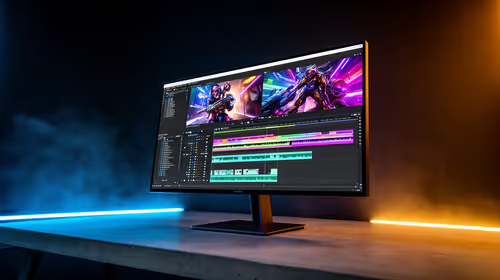
A high-refresh display can reduce the interval between frames when the gaming system produces them at a matching pace. It also makes motion easier to follow. The competitive value comes from a stable end-to-end setup, not the refresh number on its own.
Confirm the output port, cable standard, resolution, and refresh combination supported by the exact PC or console and monitor. Set the intended refresh rate in the operating system and game. Enable the display's low-latency mode when its manual recommends it for gaming.
Variable refresh can smooth frame-rate variation within the supported range. Check compatibility between the display and graphics platform, then verify it is active. Avoid enabling several frame caps and sync methods at random. Pick a documented route and test for tearing, stutter, and input feel.
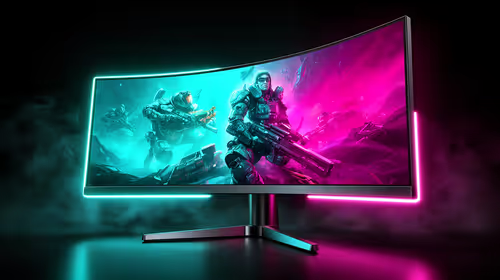
One monitor is enough. Place it close enough to read braking references and steering information without eye strain. Use the game's field-of-view tools as a starting point. An ultrawide or triple-screen system can add side vision later, but it also raises GPU, mounting, and room demands.
Set the PC or console for race conditions
Choose a frame target that holds with a full grid, weather, and a busy race start. Solo time trial gives you a useful driving baseline but may hide the heaviest load. Test an actual representative race before declaring the setup ready.
Reduce expensive visual settings in measured steps if frame times spike. Mirrors, reflections, shadows, crowd detail, and the number of visible cars can affect load. Keep track detail clear enough to read braking points.
On PC, close unnecessary overlays and background tasks after confirming they are safe to exit. Use the current graphics driver recommended for the game and create a restore point before a major driver change. On console, use the game's performance mode when it better supports your chosen frame target.
Network delay matters in online racing, but a faster monitor cannot fix an unstable route. Use Ethernet when practical, stop large downloads during a league session, and measure packet loss and latency to relevant services. Do not change the router before proving the local link is the problem.
Tune the wheel for information
Calibrate steering and pedals in the platform software and game. Confirm that the virtual wheel matches your intended range and each pedal reaches zero and full input without a large dead zone.
Set force feedback low enough to preserve detail in loaded corners. When every strong corner produces the same heavy pull, reduce gain and retest. Add damping or road effects only after the main steering load is readable.
Brake saturation and linearity can make an entry pedal easier to use, but excessive changes can hide poor mounting. Fix physical movement first. Then use the game's input display to build a pressure range you can repeat without pain.
Map pit limiter, overtake, DRS, radio, camera, and menu controls where your thumbs can reach them. Avoid filling every button on day one. Two reliable race functions beat a crowded map you cannot remember under pressure.
Practise for consistency, not one hero lap
Pick one circuit and run short stints on the same fuel and tyres. Build braking references, turn-in points, and exits. Compare a five-lap sequence rather than the single fastest time.
When laps differ, identify the corner where time moved. A replay and input trace can show whether braking began late, steering became abrupt, or throttle arrived before the car was ready. Change one technique or setting, then repeat the stint.
League preparation includes starts, pit entry, pit exit, and driving beside another car. Practise these with the same assists and rules used in the event. A stable modest rig that you understand is more useful than new equipment installed on race night.
Upgrade after the weak point becomes clear
Add a wheel stand when the desk, pedals, or chair move. Consider stronger pedals when the platform is rigid and braking pressure remains the limit. Upgrade the wheel when you need cleaner feedback, more control options, or a supported ecosystem the current unit cannot provide.
A larger or faster monitor makes sense when the gaming system can drive it and the current display limits motion clarity or viewing position. Measure the frame target at the new resolution before buying.
Leave cosmetic extras until the controls and system are dependable. Lighting, a formula-style rim, and a dedicated seat can add enjoyment, but they should follow the parts that make every lap repeatable.
FAQ
Can a controller be competitive in F1 esports?
Yes. The game supports controller input, and a well-tuned pad can produce strong laps. A wheel offers a different range of feedback and control. Your consistency, assists, practice, and event rules matter more than the shape of the input device.
Do I need a high-refresh monitor?
It can improve motion and reduce frame intervals when the system feeds it at a useful rate. A steady frame target, correct refresh setting, low-latency mode, and suitable connection must work together.
What should I upgrade first?
Fix the moving part of the setup. That may be the chair, pedals, desk, frame delivery, or network. Upgrade the wheel or display only after a repeatable test shows the current equipment is the limit.
Build your F1 esports setup around stable inputs and frame delivery, then upgrade the one limit your lap data can prove.