Two friends start 3D printing the same month. One is pulling clean Benchy boats off the bed by the weekend; the other is still wiping sticky resin off a workbench and waiting for parts to cure under a lamp. The difference was not skill, it was the technology they picked. For an absolute beginner in South Africa, FDM (the spool-of-plastic kind) is the lower-hassle on-ramp, and resin is the higher-detail reward you grow into.
Quick Answer
Start with FDM. A Creality Ender-3 V3 SE or a Bambu Lab A1 Mini at around R5,499 prints straight onto a removable plate with no gloves, no chemicals, and no ventilation worry. A resin printer like the Halot R6 is cheaper at roughly R3,999, but every print needs an isopropyl alcohol wash and a UV cure, plus gloves and airflow. Both are locally stocked under R5,500.
What Actually Separates FDM From Resin
FDM (Fused Deposition Modelling) works by heating a plastic filament until it is soft and pushing it through a nozzle that traces out the model layer by layer, building the part from the bottom up. Resin printing uses a tank of liquid photopolymer that an LCD screen cures with UV light, building the model upside down out of the vat one thin slice at a time.
That single mechanical difference drives everything that matters to a newcomer: mess, smell, post-processing time, and what the finished part looks like. FDM gives you a solid object the moment the bed cools. Resin gives you a fragile, dripping part that is only half done until you wash and cure it.
The Honest Mess Factor
This is the part most buying guides skip, and it is the one that decides whether a beginner keeps the hobby.
FDM: Plug In And Print
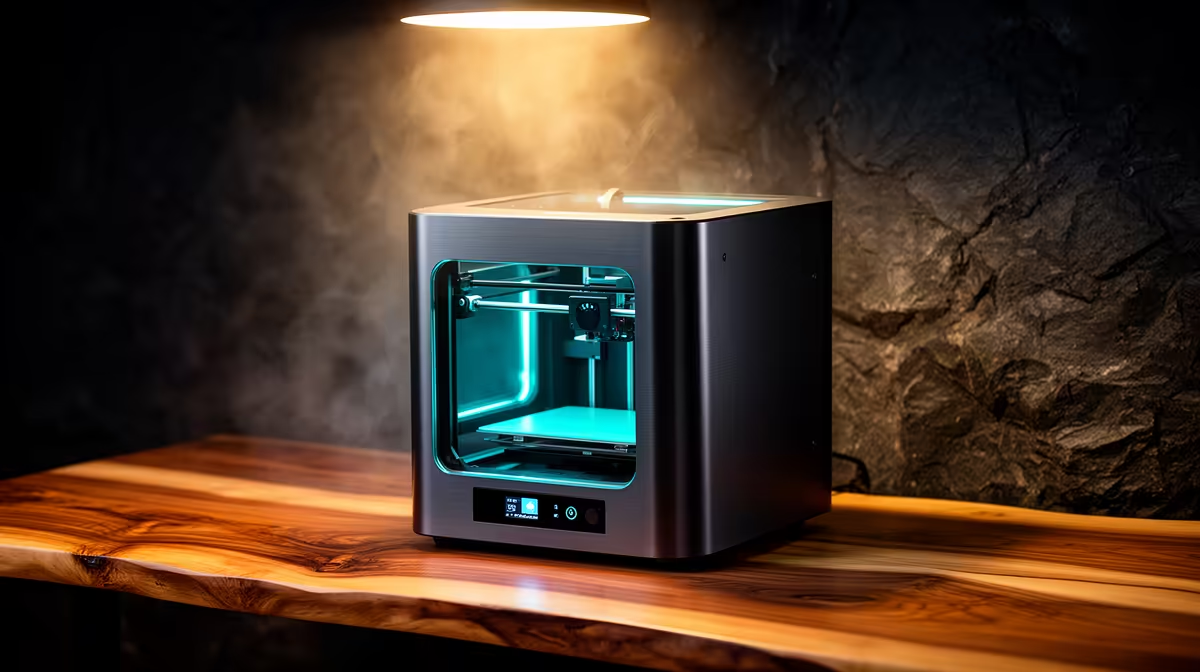
With an Ender-3 V3 SE you load the spool, run the auto-levelling routine, and send a file. When it finishes you flex the spring-steel plate and the part pops off. No protective gear. The only smell is a faint warm-plastic note that PLA gives off, and it clears quickly in a normal room. You can run one on a desk in a bedroom or a flat without a dedicated workspace.
Resin: A Real Post-Processing Routine
Resin is genuinely beautiful, but uncured resin is an irritant. You wear nitrile gloves, you keep the printer somewhere with airflow, and every single print goes through two extra steps: a bath in isopropyl alcohol to rinse off the sticky surface, then time under a UV source to harden it fully. You also have to filter and store leftover resin properly. None of this is hard once you have a rhythm, but it is real time and real handling that FDM simply does not ask of you.
Detail, Strength And What You Will Actually Print
For miniatures, tabletop figures, jewellery masters, and anything with fine surface texture, resin wins decisively. The layer lines are so small they are nearly invisible, and crisp faces or filigree come out the way the designer intended.
FDM is the better all-rounder. It is stronger for functional parts: brackets, organisers, phone stands, replacement clips, cosplay armour, and anything that needs to survive being handled. PLA on an A1 Mini is forgiving and cheap, and a 1kg spool stretches across many prints. If your plan is "I want to make useful things and learn how this works," FDM is the format that rewards that goal fastest.
Understanding Print Speed as a Beginner
Speed matters differently to a beginner than to an experienced maker. On FDM, newer machines like the A1 Mini run up to 500mm/s, which means a small object can finish in 20 to 30 minutes. The Ender-3 V3 SE tops out at around 250mm/s, still fast enough for practical work. Resin cures one full layer at a time regardless of how many objects sit on the plate, which is efficient for batches of small detailed models but adds a wash-and-cure routine of 20 to 30 minutes after every single print. For a beginner, the FDM workflow from slicer to finished part in hand is simply shorter even if the raw print times are comparable.
What It Costs To Get Going In SA
The printer is only the starting line. Budget for the consumables and tools so the first month is not a series of surprise top-ups.
For FDM, add filament (a couple of PLA spools), a scraper, and maybe a small glue stick for bed adhesion. For resin, factor in the resin itself, isopropyl alcohol by the litre, gloves, paper towel, a wash-and-cure step (a UV lamp or a dedicated station), and a way to ventilate. The Halot R6 looks cheaper on the shelf, but the running kit narrows the real-world gap. You can compare the current local lineup and pricing across the full 3D printer range at Evetech before you commit to a technology.
It is also worth budgeting a little for the small extras that make either machine pleasant to live with, from spare nozzles to a decent scraper, which you will find alongside other handy bits in the most popular accessories on the site.
Who Should Pick Which
Choose FDM if you are completely new, want minimal fuss, plan to print useful and functional objects, or share the space with family who do not want chemicals around. The Ender-3 V3 SE and A1 Mini are the safe first machines.
Choose resin if your main interest is high-detail miniatures or fine display pieces, you have a ventilated corner you can dedicate to it, and you are comfortable with a short cleanup routine after every print. The Halot R6 is a strong, affordable entry into that world once you accept the handling that comes with it.
Frequently Asked Questions
Is FDM or resin cheaper to actually run, not just to buy?
FDM is cheaper over time for most beginners. A 1kg PLA spool covers a lot of printing, and there are no chemical consumables. Resin printers cost less up front but add resin, isopropyl alcohol, gloves, and a curing step on an ongoing basis.
Can I print resin in a bedroom?
It is not ideal. Uncured resin is an irritant and you want airflow and a surface you do not mind protecting. A garage, balcony nook, or a room you can ventilate is far better. FDM is the format that suits a bedroom or shared living space.
Which one gives better detail for miniatures?
Resin, clearly. Its layers are fine enough to capture tiny faces, textures, and thin details that FDM nozzles cannot resolve as cleanly. If miniatures are your whole reason for buying, that is the trade worth the extra handling.
How long before I get a usable print?
On an FDM machine like the A1 Mini you can often have a clean first print within an hour or two of unboxing, thanks to auto-levelling. Resin adds wash and cure time after every print, so plan for extra minutes at the end of each job.
Do I need a PC to use these?
Not necessarily. Many current printers, including the A1 Mini, accept files from a microSD card or over a network, so you can slice a model on a laptop once and send jobs without keeping a computer permanently attached.