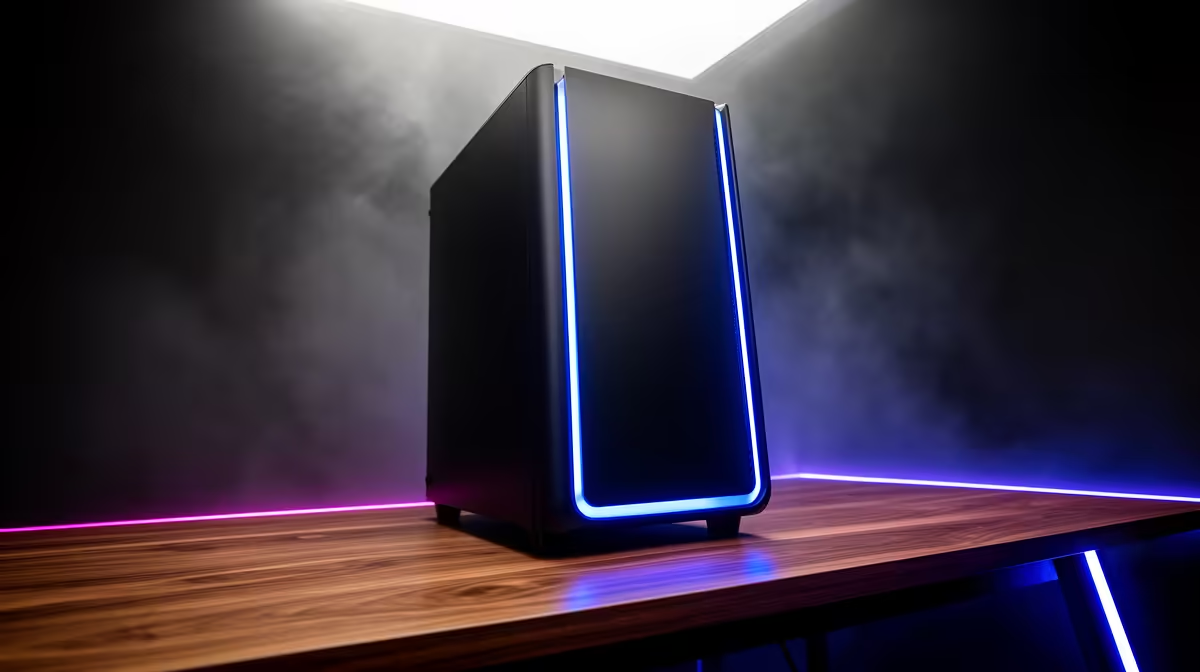
The first-gaming-PC ladder moves through three different experiences. Around R15,000 targets capable 1080p with careful parts. Around R25,000 opens strong 1080p high refresh and confident 1440p. Around R40,000 aims at high-refresh 1440p with room for a stronger platform. At every rung, memory capacity must be protected without taking the graphics card's job.
Quick Answer
At R15,000, keep the platform lean, use 16GB in a matched kit and prioritise the GPU for 1080p. At R25,000, move toward 32GB where the current basket allows and target a stronger 1440p card. At R40,000, use 32GB, useful SSD capacity and a GPU with enough headroom for your monitor. Price complete named systems, not parts in isolation.
R15,000: a focused 1080p build
This rung has no room for an oversized motherboard, elaborate cooling or decorative case. Choose a modern value processor, compatible board, 16GB dual-channel memory, an SSD and a quality PSU. Put the remaining performance share into the graphics card.
The target should be explicit. Competitive games can run at high frame rates on modest graphics, while demanding single-player titles may need medium settings or upscaling. Check exact benchmarks at 1080p.
Storage is the flexible line. A 500GB drive can start the system, but 1TB is more comfortable when current pricing fits. The motherboard should leave a route for a second SSD.
Use the gaming PC deals to compare current complete configurations around the rung. Open every specification because a low-priced office system with a display output is not a gaming-PC baseline.
R25,000: the 1440p transition
At this level, a stronger graphics card can make 1440p the natural target. A mainstream six-core or eight-core processor should keep the card fed, depending on game mix. Thirty-two gigabytes becomes easier to fit, though 16GB can remain valid when a GPU step changes the experience more.
Use current one-percent lows at 2560 x 1440. High texture settings require suitable VRAM. Ray tracing can change the card requirement by more than a normal quality preset.
Choose a 1TB SSD as a practical base and add capacity when the library needs it. Do not turn the transition rung into a storage server while the monitor and GPU are mismatched.
Cooling becomes more important because the GPU can release more heat. A mesh-front case, clear intake and sensible fan curve keep the system quiet.
R40,000: strong 1440p with headroom
This rung can pair a high-end 1440p graphics card with a strong gaming CPU, 32GB memory and 2TB storage where the current basket supports it. Light 4K becomes possible in many games, but maximum settings are still a game-specific claim.
Give the CPU enough performance for high-refresh multiplayer and simulations without consuming the GPU allocation. Large-cache processors deserve comparison, while a strong mainstream chip may free money for graphics.
Power supply capacity, native GPU connectors and case clearance need exact checks. Premium cards can be long and thick. Include safe cable bend and intake room.
The PC best-seller page gives a second local view across complete systems. Compare named configurations on the same date rather than treating a tier total as permanent availability.
RAM at each rung
Sixteen gigabytes is the R15,000 starting point when measured game use fits. Install a matched two-module kit. At R25,000 and R40,000, 32GB provides useful room for launchers, browser, voice, recording and new games.
Memory speed and timings influence performance, but stability leads. Enable the intended profile after assembly and run a full memory test. A high advertised speed may require CPU and motherboard tuning.
Do not buy four separate modules because the slots are empty. Two modules are easier on the memory controller and leave a cleaner layout. If 64GB is required for work, buy it as an intended matched kit and accept its budget effect.
GPU allocation should follow the screen
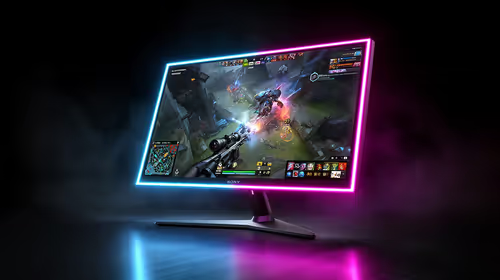
At 1080p 144Hz, an entry or lower-mid card may clear the target in esports. At 1440p 165Hz, the graphics card needs stronger average and low performance. At 4K, pixel load rises sharply and the R40,000 system may need quality upscaling.
Do not buy a high-end card for a 1080p 60Hz monitor without a display plan. Conversely, do not buy a 4K high-refresh screen and assume the R15,000 tower will feed it in demanding games.
Adaptive sync can smooth rates inside the monitor's range. Match ports and supported standards on both ends.
CPU allocation should follow the frame target
High-refresh competitive games and simulations can become CPU-limited. Cinematic high-setting play tends to put more work on the GPU. Choose benchmarks that resemble your library.
A CPU tier should also include board and cooler. An affordable chip on an excessive motherboard is not affordable. A powerful chip with inadequate cooling may not hold its boost.
Keep an upgrade route where it has a real chance of use. Paying a large premium for theoretical socket longevity can cost the graphics tier you need now.
Compare complete system value
At each rung, record CPU, GPU, memory capacity and layout, SSD, PSU model, case airflow and operating system. A strong CPU/GPU headline can hide one memory module or an unknown power supply.
Use dated named prices only. If quoting one, state as of July 2026. The R15,000, R25,000 and R40,000 figures are planning bands and should be rebuilt from current listings before checkout.
Account for the monitor and peripherals separately. If they share the total, move the tower down a rung and compare the full experience.
Upgrade order after purchase
Add storage when the library fills. Add memory when measured use reaches capacity. Replace the graphics card when it is fully loaded below the frame target. Upgrade CPU when GPU use remains low and game frame time points to the processor.
This evidence order prevents the R15,000 machine from receiving 64GB while its entry GPU remains the limit.
Frequently Asked Questions
Which rung is best for a first PC?
Choose the lowest rung that meets your current monitor and five-game target with safe, balanced components.
Does every R25,000 PC need 32GB RAM?
No. It is a comfortable target, but 16GB can be valid when measured demand fits and the GPU gains more from the budget.
Can the R40,000 rung play at 4K?
Many configurations can handle light 4K with tuned settings. Verify each demanding game and base frame target.
Compare R15,000, R25,000 and R40,000 complete systems against one monitor and game list, choosing the first rung that clears your real target.